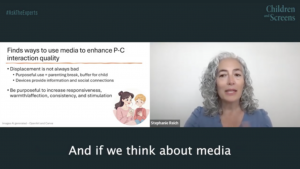
Stephanie Reich, PhD (Professor, School of Education, University of California, Irvine), explains how intentional, purposeful use of digital media can support both parent and child well-being—helping caregivers take needed breaks while maintaining strong, responsive relationships—at the #AskTheExperts webinar “Technical Interference: Screens and the Parent-Child Relationship” on Wednesday, April 9, 2025.
Read the Video Transcript
[Dr. Stephanie Reich]: Displacement is not always bad, right? Sometimes you just need a break as a caregiver, and if you have a break and are less stressed and less overwhelmed, you are more high-quality in caregiving afterwards. So purposeful breaks, where you give a device to a child, you let them go do something else, can be beneficial. It can also buffer children if you are having, you know, conflict in the environment and their attention is elsewhere, it enables them to go elsewhere and you can still reach them. And devices provide information and social connections to parents, and so those are really important for their mental health and well-being. The trick is to be purposeful so you can increase your responsiveness, your warmth, affection, your consistency, and your stimulation. And if we think about media as just, like, one more context that parenting happens in, then it can be a context that can also promote those high-quality, parent-child interactions.
View the Full Webinar

Technical Interference: Screens and the Parent-Child Relationship
How is today's digital world influencing the parent-child relationship? How do parents' own tech habits impact their children?
Catherine Steiner-Adair, EdD
Clinical Psychologist, Consultant, Author, Speaker
Brandon T. McDaniel, PhD
Senior Research Scientist, Parkview Mirro Center for Research and Innovation
Michaeline Jensen, PhD
Associate Professor of Psychology, University of North Carolina at Greensboro
Lara Wolfers, PhD
Faculty of Psychology, University of Basel
Stephanie Reich, PhD
Professor, School of Education, University of California, Irvine

Ditch the Guilt: Media, Stress, and Parent-Child Relationships | Lara Wolfers, PhD

What is Technoference?
How does mobile technology affect parent-child relationships? Are kids and parents both affected by these digital distractions?
Parent Media Use, Technoference, and Its Effects on Children | Brandon McDaniel, PhD
Win-Win Parenting: Child Safety, Autonomy, and Family Harmony In the Digital Age
How can parents and caregivers effectively guide their children’s media use in a way that reduces conflict, fosters independence, and helps guard against the development of problematic or addictive media use?

What are the most effective digital parenting strategies?
Can parents be too hands-off or too hands-on? How do you parent a child versus a teen online? Is it even possible to supervise a kid in a digital age?