
Children today face a nonstop stream of sophisticated online marketing techniques that look nothing like the TV jingles and commercials of the past. Ads promoting ultra-processed and fast foods are affecting children’s cravings, routines, and physical health.
Children and Screens held the #AskTheExperts webinar “Online Marketing and Child Eating Habits: What to Know and What To Do” on Wednesday, November 19 2025. The webinar featured a panel discussion on the significant effects of modern food advertising on children, including:
-
- Why online food advertising can interfere with healthy food cues and rewards systems
- How high or problematic media use factors in
- How algorithmic targeting intensifies unhealthy food advertising to minoritized groups
- What parents can do to increase their own – as well as their children’s – awareness and combat advertising-driven unhealthy food behaviors and choices




Resources Mentioned During the Webinar
- Digital food marketing: what parents and caregivers need to know (Tip Sheet)
- Evidence-Based Recommendations to Mitigate Harms from Digital Food Marketing to Children Ages 2-17 (Report)
- Phone Free Schools Movement (Program)
- Fairplay (Organization)
- Child Social Media Influencers and Unhealthy Food Product Placement (Scholarly Article)
- TEDx Talk: The truth about dares on social media (Video)
- Genetic risk for obesity predicts nucleus accumbens size and responsivity to real-world food cues (Scholarly Article)
- Associations between everyday exposure to food marketing and hunger and food craving in adults: An ecological momentary assessment study (Scholarly Article)
- Television food advertisement exposure and FTO rs9939609 genotype in relation to excess consumption in children (Scholarly Article)
- Association of Food and Nonalcoholic Beverage Marketing With Children and Adolescents’ Eating Behaviors and Health: A Systematic Review and Meta-analysis (Scholarly Article)
- Elucidating pathways to pediatric obesity: a study evaluating obesity polygenic risk scores related to appetitive traits in children (Scholarly Article)
- Handbook of Children and Screens (Book)
00:00:11 – Introductions by Executive Director of Children and Screens Kris Perry.
00:01:47 – Moderator Dr. Kelly Brownell on marketing influences in the current media landscape.
00:12:07 – Dr. Jennifer Harris on how food marketing works and its impacts on youth.
00:22:07 – Moderator follow-up: Did the impact per dollar of food marketing increase in the digital age?
00:26:15 – Dr. Marie Bragg on social media influencers and targeted food marketing.
00:38:30 – Moderator follow-up: Are ads targeted at parents as well as children? What tactics should parents look out for?
00:39:49 – Moderator follow-up: Marketing seems to try to persuade consumers that some products are healthier than they actually are. Is this accurate?
00:41:31 – Dr. Diane Gilbert-Diamond on children’s reactivity to food cues in advertisements.
00:54:55 – Moderator follow-up: Are food companies using neuroscience research to develop marketing?
00:56:23 – The panel addresses questions from the audience.
00:56:40 – Q&A: Can you help parents understand some of the terms used today (e.g., “processed”, “ultra-processed”, “healthy”, “unhealthy”)?
00:59:39 – Q&A: How can parents protect their child from harmful dieting advice online?
01:01:29 – Q&A: What can parents do about food ads that come up while their children are playing online games or other types of digital media?
01:02:45 – Q&A: How do addictive feeds or social media algorithms exacerbate the problem of children’s exposure to digital marketing?
01:04:46 – Q&A: Aside from product promotion, are there other types of content children see on social media that could be harmful to their diet/nutrition?
01:09:01 – Q&A: Do children who overuse social media or video games have poor nutritional outcomes? If so, why is that?
01:13:17 -Q&A: Are certain types of food ads trendy for children on social media? What does the next generation look like? How sophisticated can the marketing get?
01:15:51 – Q&A: What advice do you have for parents to protect their children from food marketing?
01:19:18 – Q&A: What is your outlook on the future of policy in this space? Are you optimistic?
01:24:41 – Wrap-up with Children and Screens’ Executive Director Kris Perry.
[Kris Perry]: Hello and welcome. I’m Kris Perry, Executive Director of Children and Screens. Thank you for joining our Ask The Experts webinar, “Online Marketing and Children’s Eating Habits: What to Know and What To Do”. Children face a constant stream of sophisticated digital marketing techniques that look nothing like the TV ads of the past. Promotion of ultra-processed and fast foods, often embedded in influencer content and amplified by algorithmic targeting, can shape cravings, routines, and health. Today’s panel will address these issues and more. They will share practical steps parents can take to build their own and their children’s awareness to reduce advertising driven food choices. Now let’s get started. I’d like to introduce you to today’s moderator, Kelly Brownell. Dr. Brownell is the Robert L. Flowers Professor Emeritus of Public Policy, Professor Emeritus of Psychology and Neuroscience, and Director Emeritus of the World Food Policy Center at Duke University. A member of the National Academy of Medicine, Dr. Brownell has published 15 books in more than 350 scientific articles and chapters. He has advised U.S. and international leaders on issues of nutrition, obesity, and public policy, and was named one of Time magazine’s 100 Most Influential People in 2006. His honors include the American Psychological Association’s Lifetime Achievement Award and distinguished awards from Yale, Purdue, Rutgers, and the New York Academy of Sciences. Finally, he serves on our own National Scientific Advisory Board. Welcome, Kelly.
[Dr. Kelly Brownell]: Thanks very much, Kris, and congratulations to you and your colleagues for the amazing work that the Children and Screens organization does. It’s a pleasure for me to be involved with the organization and I just constantly admire the work it does. And that the work is important on many, many fronts. One of which is the marketing of food to children. So this webinar is especially timely and important. I’d like to make just a few introductory comments, and then I’ll introduce our three guests Dr. Jennifer Harris, Dr. Marie Bragg, and Dr. Diane Gilbert-Diamond, who really constitute an all-star team of people working on this topic. I’m really happy they could all take part. And I just know we’re going to have a great webinar. But one of the questions that I often ask is, “Why do the companies do so much marketing?” There are a number of interesting questions that I think will come up in the discussion today, and that’s one of them. The companies do tons and tons of marketing – we’ll have some statistics on that, but a lot of it’s directed at children. And what is directed at children is marketing primarily for unhealthy foods that you’d like to see the population eating less of. So the question is, why are children such an important target for the companies, and why do they spend so much money marketing to children? First of all, just to put it in context, a number of years back, the Robert Wood Johnson Foundation started an initiative to help the nation address childhood obesity. And at the time, they were spending $500 million a year on the problem. And they were by far the biggest funder of work in this field, in the world. So I set out one day to try to figure out the day of the year by which the food industry had already spent $500 million just advertising, just junk food, just to children. And when I would give talks, I would ask the audience what they thought and people would say, well, maybe the industry would spend that much by October 1st or July 15th or May the 4th. Well, it turned out that they were spending that much by January 5th each year. So the biggest funder in the world was being outspent by the food industry from January 6th through the rest of the year. So you can see it’s just not a fair fight. And one also has to ask if the industry is spending that much money to recruit children, why are they working so hard to do it? Why are they spending so much money? But it also has to ask how powerful it is. Well, you sort of say, well, “Duh, of course it’s powerful and having an impact, or the companies wouldn’t spend that much money on it.” Well, of course that’s true. But it’s interesting to see some real life examples of that. And one that I’ve noticed is if you asked people out there, “Are you a Coke or a Pepsi person?” Almost everybody will have an immediate response – they prefer one over to the other. Even among people who aren’t drinking a lot of those sorts of things, everybody will have a favorite. And if you ask people, “Can you tell the difference between the two?” Almost everybody says, “yes”. Otherwise why in the world would they have a preference? Well, it turns out not many people can tell the difference when you do studies on that. So if these are pretty indistinguishable products, how in the world can people have such strong brand loyalty? Well, it’s all about the marketing. It’s what might have been in your school, what might have been the logo on the scoreboard as you were going to football games in high school, what music star or athlete endorse the product or whatever. So it’s very powerful and can have lasting impacts. Another interesting question is “What’s the right language to use to describe the relationship between companies and the children they advertise to?” Now, you could characterize children here as future customers, as potential buyers. You could use sort of the commercial language to describe this relationship. But some people have used a whole different language to describe this, and they’ve talked about children being the prey of the food industry and children being groomed into a lifestyle that is profoundly unhealthy. So all the people listening here, you can decide in your own mind what makes most sense in terms of describing this relationship, once you hear from our experts. The industry fights really hard to protect their ability to market to children. Any time there’s the least hint of government being involved here, industry comes down like a ton of bricks. And there are some interesting case examples of that that go way back into the 60s and 70s. But they fight really hard to protect it, so it’s important to them. Industry will often respond when the government starts getting concerned about doing something by saying, “We will regulate ourselves”, that “You don’t need to regulate us. We’ll set up some sort of an organization or a body to monitor what we’re doing. And you can count on us to do that right.” And that’s occurred in this area as well. And it’ll be interesting for our experts to weigh in on how effective that’s been. One wonders why this marketing – because it has such obvious negative consequences, and parents are very concerned about it – why it’s been able to go on forever. Well, there are legal reasons for that. Namely, the First Amendment of the Constitution protects such speech as commercial speech. And it’s hard to do anything about that given American laws, less so in other countries, but certainly true in America. But there’s also this sort of interesting blindspot that people have. I was on the faculty at Yale University for many years and taught a big food policy class there each year, and I would ask students in the beginning of the year in a survey, did they think marketing had an influence on people’s purchasing behavior? And I would ask them to rate it from zero to say ten, and people would give it a very high score. The students would say, oh yeah, it’s that nine out of ten that has a big influence. But then later in the survey, I’d ask how much they were influenced by food marketing, and they would say like 3 or 2, they would give responses to that. So there’s this real blindspot that people have – blindspot people have where they think, “Well, everybody else is affected by this, but I’m not. I’m strong. Other people are not as strong as I am. And so why should we do anything to regulate it? Because it’s just people being weak.” Well, that turns out not to be the case. But this blindspot’s a pretty interesting phenomenon. And then the last thing I wanted to mention is that the question is, “Who’s going to do something about this? If the industry is acting in ways that are having harmful impacts, who’s the police force here? I mean, who’s going to stand up to it and say, this is wrong and we’re going to do something about it?” Well, there you look to government and you start looking to each of the branches of government. Well, the first branch is the legislative branch. So this would be the Senate, the House of Representatives and there are state versions of these things, of course. And that would be the people we elect to office. They’ve been notoriously ineffective at doing anything about this, obviously, because of the power of the food industry. The next branch of government would be the administrative branch of government. And there you get regulatory agencies under the control of the president, like the Food and Drug Administration, the U.S. Department of Agriculture, the Federal Trade Commission, etc. And the question is, “Has that been effective?” Well, the answer is no. I mean, the marketing is way worse than it used to be. There’s way more of it than there used to be. So the problem seems to be getting worse rather than better. So those two branches of government really haven’t done very much. And this is a history that repeats itself a lot. That leaves the third branch of government, which is the judiciary. And that brings up the possibility of litigation. And there’s a really interesting question that we can ask ourselves, “Is litigation likely to be helpful here?” And if so, “Who would sue who for what?” And we maybe have the opportunity to address that today. But if we go back and we look at precedents like, tobacco, automobile safety, opioids, what we found is that when there’s a commercial interest that conflicts with public health, the commercial interest always wins out. And there are decades go by between proof of harm and government taking any reasonable action. And during that period of time, hundreds of thousands or millions of people die unnecessarily. So can we count on these precedents to teach us lessons? And the answer is almost certainly yes. And that would lead us to say that the administrative legislative branch of governments just aren’t going to get much done because the industry is way too powerful, has way too much lobbying money, and that the judicial part of government might be, in fact, an important player. So maybe that’s something we can discuss with our experts. So again, we have the all star team on the field today. I’m really happy to be able to introduce each of our experts. I’ll introduce them as they’re about to speak. And I’ll begin with Dr. Jennifer Harris. So, Dr. Jennifer Harris is senior research advisor at the University of Connecticut, Rudd Center for Food Policy and Health, and a leading international expert on the extent and health impact of food related marketing. Her current research examines the emerging issues in food marketing to youth and their parents, including targeted marketing to Black and Hispanic youth, and digital food marketing to children and adolescents. Dr. Harris received her MBA in marketing from the Wharton School. She was a business executive and consultant in consumer marketing for 18 years, before completing her PhD in Social Psychology at Yale University, had established the The Rudd Center Research Group. And I can attest to the quality of her PhD work because I was on her dissertation committee some years ago. So, Jennifer, I’ll turn it over to you. And thanks so much for joining us on this webinar.
[Dr. Jennifer Harris]: Thank you, Kelly, and thank you to Children and Screens for this opportunity to speak to this group about food marketing to children and digital media. So last year, I had the pleasure to share an expert panel on digital marketing to children. And when I refer to children, I include adolescents. The panel is sponsored by Healthy Eating Research (H.E.R). So I’d like to start by thanking the panel members and H.E.R. for their contributions to the information that I’m presenting today. The most important point that I’d like you to take away from my presentation is this: as parents and caregivers, no matter how much we try to teach our children healthy eating habits, we’re always outweighed by the elephant in the room, which is food marketing to kids. So why do I say that? Well, first of all, U.S. food companies spend a lot of money to advertise their products – as Kelly mentioned – over $13.5 billion per year. And to put this number in context, the CDC’s (Centers for Disease Control and Protection) entire budget for prevention of all chronic diseases and health promotion the same year was just over 1 billion. That’s less than 10% of what companies spent on advertising alone. And on top of that, they spend hundreds of millions of dollars in market research to figure out how to capture the hearts, minds and, to use their lingo, “stomachs of our kids”. This is proprietary research that no one else has access to. And these billions almost exclusively promote ultra-processed foods and drinks that are high in sugar, fat and salt. These four categories make up more than three quarters of all food advertising expenditures. And despite companies’ continued promises to market healthier foods, in 2021, only one fruit or vegetable brand advertised anything at all and it spent a measly $5,000. This compares to 20 million and up to 500 million that is spent by these other brands. And today, children and adolescents especially, are also exposed to massive amounts of digital food marketing anytime and everywhere on their smartphones. These are just a few examples of social media posts that a group of teens we were working with received in one day. And as you can see, this marketing looks nothing like the marketing that we grew up with. So in addition to buying traditional advertising online, food companies create their own content, including social media accounts and mobile apps that children actively engage with on their phones. Branded food messages are also often embedded within entertainment content like gaming sites and videos – disguising its marketing intent. And kids’ smartphones now directly link them to their physical environment. So a fast food restaurant can send someone a coupon when they’re actually walking by their store. The companies also reach children in their schools through school owned devices and on school communications platforms. And brands have become part of online social networks, where kids distribute companies’ marketing messages virally to their friends and where trusted influencers, gamers, and celebrities frequently endorse unhealthy food brands. So in our research, we’ve found that kids know there’s no avoiding this marketing. But most adults have no idea what their kids are seeing online. And all that food marketing works. Companies know that continued exposure to enjoyable marketing automatically creates positive associations with the marketed brand in a form of classical conditioning. And this is an unconscious process which explains why most people think they’re not affected. But these positive associations in turn, link people to infer explicit positive attributes about the brand. And in the case of kids, this exposure creates lifelong, loyal customers for their brands. And digital food marketing is even worse. Not only does it make kids desire and consume unhealthy foods. It also takes advantage of their developmental vulnerabilities and threatens their rights to privacy and freedom from manipulation. It does this by precisely targeting marketing, using kids personal information and online behaviors to present them with the most effective ads for each individual. It disguises marketing content as entertainment embedded within game and video content, which deactivates any potential skeptical responses by making it more difficult to recognize as marketing. And it becomes an important part of their social lives, enlisting kids to share marketing content virally through their peer networks. So which leads to the question, “How do we protect children from this harmful influence?” Well, nearly all existing and proposed solutions assume that we can teach children to resist unhealthy food marketing. For example, the FTC (Federal Trade Commission) requires influencers to disclose when they have received compensation from a brand to promote a product. Similarly, the Children’s Advertising Review Unit calls for ad disclosures on branded content aimed at children under 13 – an example of industry self-regulation. And we also often hear calls for media literacy, education or marketing of healthy foods instead of all that unhealthy food marketing. But unfortunately, research has shown that information based approaches such as these, do not protect or inoculate children from harmful marketing influence. For example, ad disclosures may increase children’s ability to recognize that a message is marketing, but they don’t actually reduce children’s desire for the marketed foods. Sometimes they even make that marketing more effective. Similarly, media literacy education can teach children to recognize marketing when they see it, and it increases their skepticism about marketing in general. But it doesn’t make that food marketing less effective. An experimental research on the effects of healthy food marketing shows that it does not reduce kids desire for unhealthy foods, often, it doesn’t even increase their preferences or consumption of the healthy foods that are marketed. So what can we do? Well, caregivers can do a few things to try to limit their children’s exposure. Such as setting rules about smartphone use at home or utilizing digital privacy protections that are available on some phones and apps. But if your child uses a smartphone, it would be impossible to monitor what they’re seeing 24/7. And chances are that they are exposed to lots of food marketing. In a study we did recently, even children as young as 2 to 5 years old saw food brand messages while they were watching child-oriented YouTube videos. So I would argue that the most important thing caregivers can do is to support government policies to limit children’s exposure to digital food marketing. And there are a number of current policy initiatives that address broader digital media issues, not just marketing, but these would also help limit harmful digital marketing practices. At the state and federal levels, data privacy and internet safety policy proposals are on the table, and they have broad bipartisan support. States and school districts can also implement policies to limit children’s exposure to digital marketing in schools and on school owned devices, such as by incorporating digital marketing restrictions into school wellness policies, or requiring schools to implement ad blocking and student data privacy protections. Caregivers can also get involved in advocacy groups like the Phone-Free Schools Movement or Fair Play for Kids that are actively working on these issues. But in the long term, all members of the H.E.R. expert panel agree that what we really need is a free, child-friendly, commercial free space that has high quality, attractive digital content, a sort of online PBS Kids. The internet is here to stay, and children deserve a safe space where they are not the product, and their health and well-being are not being sold to the highest bidder. So thank you. And there’s more information on the Healthy Eating Research website. And also we posted some to the Children and Screens online website.
[Dr. Kelly Brownell]: Jennifer, thanks. That was a really terrific presentation. In just a short period of time, you got a lot of information across – including some very helpful ideas about what might be done. I have a question for you. So when I was growing up, the only sort of food advertising I saw were commercials on Saturday morning, children’s television, and, I imagine, those cost the industry a lot of money. And they were a pretty blunt form of advertising because the same ad was going out to everybody. And now with the targeting they can do with all the algorithms, and the fact they can do things like influencers, I’m assuming the number of dollars that they spend have much greater impact now than they used to. So, you know, how much, how far will $1 million go in convincing some child that they should eat Cheetos or a sugared beverage or some sugary cereal? I imagine it’s a lot easier to get impact from that million dollars than it used to be. But that’s just my impression. And I kind of wondered if that’s true. And what made me think about this, I had a conversation recently with somebody who was an influencer. And I learned a little bit more about the process. And what this person told me is that companies send her products, she then goes and reviews them, talks about them in a positive way, sends the videos to the companies that then have to approve them, and then if they get posted on YouTube or somewhere like that, then the companies pay – and not a lot, but they pay some. So it seems to me, they can have a fleet of influencers like that with almost no cost. So is that true, that the impact per dollar is probably gone way up because of all the digital forms?
[Dr. Jennifer Harris]: Yeah, unfortunately it’s impossible to measure that. But the couple – I have a couple interesting things to note. One is that ad companies are still advertising on television, and they’re still spending a lot of money on television, so that hasn’t gone away. But the ways that companies can advertise or market to kids online has just increased exponentially. And a lot of them don’t even cost companies anything or very little. Like when a company creates a mobile app and everybody uses it, and they send out coupons and, and offers – that costs the company very little, or they maintain their own social media account. So traditional advertising still is big business and it’s still driving the internet. Which is why companies, you know, use it – that advertising. But – and also the viral advertising, a lot of that is – and I’m – Maria will probably get into this with the influencers – sometimes influencers are just including brands in their videos because they want to attract the attention of companies who will then pay them. So, it’s – sometimes the companies don’t have to do anything at all and their brands are being promoted online.
[Dr. Kelly Brownell]: Oh, it’s so interesting. Well, thanks very much and thanks for a terrific presentation. I’d like, next, to turn to Dr. Marie Bragg, our second speaker. Dr. Bragg earned her PhD in Clinical Psychology from Yale University. I can attest to the quality of her dissertation research, as I was on her committee as well. She’s now an Assistant Professor in the Department of Population Health at the NYU School of Medicine. Her research examines how adolescent health issues are affected by social media use and food marketing, and including how exposure to unhealthy food and beverage advertisements affects food choices among Black and Latinx youth. Dr. Bragg has served as an expert witness in a litigation case against tech companies. She serves as the Senior Behavioral Expert at the US Federal Trade Commission, and has been an expert reviewer for the World Health Organization and the US Food and Drug Administration. Marie, welcome, and I’m delighted you could join us, and we look forward to hearing your comments.
[Dr. Marie Bragg]: Thank you, Kelly, and thank you, Children and Screens for having me and hosting this webinar. It’s an honor to be alongside my colleagues here in discussing this food marketing topic. So as Jennifer and Kelly mentioned, I am going to discuss social media influencers and targeted marketing in, and what I’ll share. I have no conflicts of interest to disclose, but as Kelly mentioned, I am currently a Senior Behavioral Expert at the Federal Trade Commission. I will not be discussing any of that work. This presentation will focus on my own research and the research from our lab. In a first show of appreciation to them for all of the work that they’ve contributed, to our influencer studies and related work. So Kelly mentioned when he was starting his introductions that there – it’s – for different reasons it’s hard, it’s been difficult, and we’ve been largely unsuccessful in addressing the impact of food marketing to kids in the United States. And I want to zoom out for a second and say that other countries are trying to get a handle on junk food marketing to kids. But one of the gaps in it is that they don’t often address digital ads for a few reasons. And part of that is because they can sort of cross country lines, there are other factors that go into it. But the two gaps I want to talk about today, in addition to the social media piece, are the targeted marketing towards Black and Latinx youth. And then thinking about this digital scope of food marketing, particularly influencer marketing. And the reason I want to talk about that is because when we think about why I’m going to zoom in on adolescents for a second and think about why they might be uniquely susceptible to social media content and influencer content. We know that likes are powerful social norms signals. We did a really simple study where we had one group of adolescents look at an ad of somebody drinking a soda, and we put 100 likes on the ad – we just use Photoshop. We had a different group of adolescents look at the same ad, but we put 10,000 likes on it. And what we found, unsurprisingly, is that adolescents thought that high-like ads were way cooler, trendier. They were more willing to share it with friends. And so even just that social signal of “what’s cool” really dramatically changed how adolescents felt about that particular ad. We also know that, as Kelly mentioned, you know, ads today look different than when we were growing up and only had access to TV. So this interactive nature where you can comment on a brand’s post or reshare and send to friends, or it’s capitalizing on a trend, that interactive nature is really unique. And it also – sometimes when a brand or an influencer comments back to someone – it can fulfill this adolescent developmental stage for sort of connection, identity formation. So they’re in a stage where they care a lot about what they’re associating with, what they determine as cool and the interactive nature of social media, maps on to that. One of my favorite studies was a brain imaging study where they brought adolescents into the lab and they said, “Oh, give us some of your social media posts. And, we’re going to look at them in the scanner.” And they also said, “Oh, by the way, we let a few of the other participants check out your social media posts. So you might see some different likes, something like that.” And what they found was that the reward hub of teenagers’ brains got really activated when they saw their own posts with a ton of likes on them. So there was this uniquely good feeling and positive reinforcement in the brain after reviewing their own posts with many likes. And as we’ve all seen on social media, ads can appear trendy and similar to friends’ posts. And, they can blur the line between marketing and entertainment, as our colleagues have written about over the years. And so these factors really uniquely map on to adolescents’ sensitivity to peer behavior and TV ads don’t quite mimic these features. So we’re really dealing with a totally new version of advertising. And if we think about those factors in the context of influencer marketing, we sort of are able to get a glimpse into a really powerful engine to promote products. As Kelly and Jennifer were saying, there is an opportunity for companies to reach lots of young people who are really dedicated and loyal followers to whatever influencers they like. So some of you may recognize this person, this is Charli D’Amelio. Her income is estimated to be around, mid 20 million, last year, which is, you know, roughly similar to what McDonald’s CEO makes. So this is an enormous amount of money. Obviously, CEOs can also make money from stocks and things like that. But the point is, influencers make a tremendous amount of money. And, part of that comes from advertisements that appear before their content or during their content. Part of it comes from sponsorship deals. But it’s really a new world compared to decades ago when we didn’t see this kind of interactive nature. And one of the things I want to draw attention to, in particular here, is that influencers form a bond with the people who follow them in ways that are really unique. We, as researchers, call this a parasocial relationship. It’s a sort of one-sided friendship where if I’m following an influencer, I might feel like I know them, I might feel like we’re friends, I might feel like I have some sort of special connection with them because they share details about their life – maybe I get a glimpse into how they start their day and the “Get Ready With Me” videos – and so that all feeds into this sense of loyalty and willingness to sort of trust the influence and opinion of the influencer. So I want to sort of do a deep dive into the landscape of influencer marketing, because one of the common things that I hear – and I know, my colleagues on this call do – is, well, what about healthy marketing and could that be an effective tool? And so we did this study to understand, okay, let’s see what’s going on in influencer marketing, particularly for the young influencers. So we wanted to just get a sense of how healthy and unhealthy were the products shown in young influencers’ videos. And, to Kelly and Jennifer’s point about brand appearances – sometimes they’re paid for, sometimes they might not be – we wanted to understand how frequently branded items versus unbranded showed up, and we thought that we would see more branded products than unbranded. The reason we were interested in this is because a few years ago, the highest paid YouTube star was a nine year old who was making $30 million a year. And, so the reach of this is, is really tremendous. So we identified a sample of videos by looking at the top five most popular YouTube channels among young kids. We excluded channels that were in languages other than English. And we visited each channel. And first we identified the 50 videos with the most views for part of our sample. And, then we identified 50 videos with food or beverage in the thumbnail. This was important because they can choose the thumbnail that they put on the video to entice us. So if something is showing food and, or a brand, it shows what they want us to be attracted to. There were only 168 of those because not everybody had a ton of food and beverage in the thumbnails. So that gave us a final sample of 418 YouTube videos by these five influencer channels. What we wanted to do was pretty simple. We wanted to say, “Is there food or beverage present in the video? Was the – were people in the video playing with it? Were they consuming it? Were they cooking with it? And how many minutes did it appear?” We used the Nutrient Profile Model, which the Rudd Center has really sort of, ingrained in their food marketing work, and is something that our lab has followed suit on, because it’s a really useful, validated tool. We did content analysis where people scored the material. But the main take home is, we saw very few healthy branded items like you see here, very few healthy unbranded items. So a healthy unbranded item would be like an orange or a piece of broccoli. And notice how similar this is to what Jennifer was saying about the very limited nature of healthy food marketing. What we did see a ton of was branded unhealthy foods. So you can see in this screenshot, the title of this YouTube video is “Baby Reacts to Pop Rocks Candy”. The mom was pouring the candy into the baby’s mouth and they filmed how he responded. And, and then there were, a sizable number of unhealthy, unbranded items. But you can really see the breakdown is nowhere near close on the healthy side. This had tremendous reach. So these handful of videos had 18 million likes and a tremendous number of views – 1 billion. So, it’s the – access to this information is growing and, out – sort of outguns any public health nutrition campaign we have. It’s not just influencer marketing to young people through what you just saw. One of the other aspects that we see on social media and, broadly speaking, with, digital media is targeted marketing towards groups of color. And part of my interest in this came from this interview with the – one of the executives from Coca-Cola and AD Age, which is a magazine that talks about advertising issues. And so what you can see in this interview between the two of them, AD Age is asking about campaigns that the – Coca-Cola has done. And the executive from Coca-Cola talks about targeting Black youth and how they perceive Black youth to be trendsetters. They ask, “What sorts of results are you seeing?” And they’re talking – Coca-Cola talks about building loyalty and building share. And so this is really part of what got us interested in this topic of targeted marketing to youth. And as you can see here, there – TikTok, you can see down at the bottom here, the enormous reach of these sorts of videos. And you can see celebrity endorsements, music celebrities, athletes – sometimes they’ll partner with smaller influencers. But as I close out here, the main takeaway, in addition to what Jennifer said, was thinking about share – think about sharing with kids, if you’re a caregiver, about how people are paid to do these things. And think about ways to sort of, talk to – talk through with them, with curiosity, what they’re seeing. But critically, talking about things, and kids’ awareness, and education on these things is not enough. So, part of what Jennifer discussed with the policy interventions is particularly important because of – because we’re still influenced by advertising, even when we know what it’s trying to do. So with that, I’ll stop, and thank you so much.
[Dr. Kelly Brownell]: Marie. Thanks. That was terrific. And, boy, what an interesting bit of insight into that world of influencers and just the scope of the number of people who are seeing these things. And the fact that, you know, some nine year-old, you know, would make so many millions of dollars a year is really pretty stunning. Let me ask you a follow-up question. So, are ads targeted at parents as well as children. And because you talked a lot about what children were exposed to – but do parents get targeted? And what sort of tactics should parents be on the lookout for?
[Dr. Marie Bragg]: Parents, if they’re on social media, have probably come across “Mom Influencers”. And this covers everything from sort of what to pack in kids’ lunches to how to stock your fridge, a whole gamut of topics. One of the things that stood out to me as a parent was when I was looking for lunchbox ideas online and I saw this information that was featuring these packaged gummies. And I thought, “Oh, this is in, like, every picture, what is this?” And then down at the bottom it said this, you know, they were sponsored by this pack of gummies. And so one of the – and I was like, “Oh my gosh, this isn’t just like something this person necessarily chose, it’s – they were paid to put this in here.” So it in – the advertising is infused in recommendations that moms or parents are giving to other parents. So being aware and keeping an eye out for those disclosures like “#ad” or “brand partner” or things like that, is really important. And in some cases the parent might be using those products. In other cases they might not. So that’s a really important issue to pay attention to.
[Dr. Kelly Brownell]: You know, it seems to me one purpose of some of this marketing is to give parents permission to yield to the children’s demands for some of these foods. So, you know, the kids are seeing ads, they’re going to ask their parents to buy this sugared cereal or that beverage or something. And it seems like some of these ads try to persuade parents that those things are okay, that they’re healthier than they really are, they’re somehow good for children. Is that – does that seem true to you?
[Dr. Marie Bragg]: Yes. And Kelly, that ties back to that idea that likes and views are a social norm signal. So if there’s something popular being featured and a parent sees, well, you know, this has been viewed a million times and there are lots of people commenting how much they like it, it seems okay if other people are doing it. So it’s supercharging that.
[Dr. Kelly Brownell]: That’s so interesting. Thanks, Marie. That was, as I said, very illuminating. So I’m happy that we can move on to our third speaker, Dr. Diane Gilbert-Diamond. She’s Professor of Epidemiology, Medicine and Pediatrics at the School of Medicine at Dartmouth University in Hanover, New Hampshire. She received her doctorate degree in Nutritional Epidemiology from the Harvard Chan School of Public Health. Dr. Gilbert-Diamond joined Dartmouth’s faculty in 2012, where she runs an NIH funded research lab that studies children’s responsivity to food cues, and its effect on obesogenic eating behaviors. Her lab uses a multimodal approach to study childhood obesity, including epidemiologic, behavioral, functional, neuroimaging, and eye tracking methodologies. Diane, thanks so much for being with us, and I look forward to your presentation.
[Dr. Diane Gilbert-Diamond]: Thank you so much. I really appreciate this opportunity to talk. And, thank you so much to the Children and Screens program for all the wonderful work and advocacy they do. So thank you. So today I’d like to share on the idea of food key reactivity to advertisements in children. So as Doctor Bragg and Doctor Harris presented, food marketing is extremely abundant. And I’d like to give you another thing to think about for how this marketing can influence our eating behaviors. So to start, I just wanted to point out that we have complex homeostatic mechanisms that regulate our energy balance. So, hormones like insulin, leptin, ghrelin, give us very strong signals related to hunger and satiety. And even though we can overeat or not eat enough, in general, we’re pretty good at regulating our energy intake – to regulate – to balance out the energy that we expend every day. But, of course, in the US and around the world, we have many, many people who have overweight and obesity. So this homeostatic mechanism is not perfect. Our biology is not set up to deal with our current environment where we have so much highly palatable food available to us, as well as a lot of cues to eat that are bombarding us every single day. So, in addition to those homeostatic mechanisms that I spoke about, we also have very strong reward mechanisms that drive eating. So, if you eat something like a chocolate chip cookie, your brain will release dopamine and you’ll feel a lot of pleasure or reward from eating that food. And highly processed, ultra processed foods have been carefully engineered to really activate our reward systems in our brain. So, when we eat something like a carrot or an apple, we will get some pleasure-response. But that’s nothing like eating a bag of Doritos or candy or these ultra processed foods that have really been studied and engineered to target this system. So through classic conditioning, we compare our reward response to something like food, to an external cue. So, this is an illustration of Pavlov’s famous experiment where he fed a dog while ringing a bell and he repeatedly cued the bell input with the feeding for this dog. And then, eventually, even when the food is not present and Pavlov rang that bell, the dog would have this response. He would produce saliva and start – eliciting – food seeking behaviors. So the same exact thing happens to us with food marketing. So, a lot of these processed foods are – fast foods are highly branded, and we consume these foods in the presence of these branded markers. And we elicit our reward response eating this highly palatable food. And eventually, when you see these advertisements for the foods, we will have a reward response in our brains that will lead to cravings and seeking for those foods. So, as Doctor Harris mentioned, children see many, many food advertisements a year, and they’re primarily for unhealthy, nutrient dense, sorry, nutrient poor, calorie dense foods. And this is not at all to, this is an underestimate. This is just for TV food advertisements. But if you want to consider all the marketing, of course we have to think about the other electronic forms of marketing and the influencer marketing that the panelists have already mentioned. So what I’d like to show you is research by our group and others that show that food ads activate brain reward regions. So we brought pre adolescents (9 to 11 years old) into our lab. And we used an MRI. And what we do is we show them a television show and we show them, control ads and food ads while they’re in the scanner. And we look at their brain response in these reward regions to, to the food advertisements. And what we found is the nucleus accumbens, orbitofrontal cortex… some reward regions of their brain are activated in response to food ads over and above the activation that they would have to toy ads, electronic ads, things like that. So really, these advertisements are eliciting this brain response, of reward. And I just want to pull it outside of the lab. So, other research has looked at food ad exposure in the real life, outside of the lab. So, they gave participants smartphones that they use throughout the week, and they repeatedly asked them, they asked them to report whenever they encountered food marketing through the day up to six times a day. And then they asked them to describe their cravings and hunger after they saw that food marketing and what they found… And this is in adults, but it’s very likely that this would extend to children as well. What they found is that adults report that their cravings for food increase after seeing food ads. Their cravings for food increase after seeing digital ads, and their cravings for food increase after seeing outdoor ads such as billboards or signs on the street. So it’s not just that the food ads increase this reward response and cravings, but the food ads increase how much food children consume. So in these same children, we brought them into our lab and we had them watch a television show embedded with food ads, or an alternative television show embedded with toy ads. And on average, children ate about 50 more calories of snack food after watching the show or during watching a show with food ads embedded. And this is, importantly, this is after they have already eaten a meal to satiety. So they ate a lunch, said they were full, and then they were presented with these food ads, which spurred them to eat more. And there’s also a robust body of research that suggests that food ads not only cause children to eat more food, but they influence the type of foods that children eat. So, as the panelists have already said, they’re not – there isn’t marketing for healthy foods. The marketing for healthy foods, like public service type marketing for healthy foods, isn’t as effective. And children will choose these, ultra processed foods when presented with food ads and given a choice with a buffet of different options. So one thing that our lab was particularly interested in asking is whether some children are genetically predisposed to react to food ads. So we know that genetic factors can increase our risk of excess weight gain. And we also know that genetic factors can relate to excess weight gain through appetitive traits like how much children ask for food, are interested in food and how quickly they say they’re full, or if they slow down over the course of a meal. So we know that they’re genetic factors related to how children interact with food. So what we did is in this same experiment where we brought children in and into a scanner, we genotyped them. So we tested their genetics for a marker that’s related to obesity, called the FTO gene. So we looked at a marker in FTO. And what we found was that for children who have the lowest genetic risk for obesity, their reward response to the food ads was not different than their reward response to the toy ads. But for the children who had genetic risk for obesity, they had much more of a reward response to food versus toy ads. So there was a difference in how much the reward response was activated by their genetics. In addition, when we look at how much the kids ate after their lunch, when provided with snacks in relation to when they were exposed to food ads versus toy ads. We found that these are the kids, the TT on the left, are the kids that have the lowest genetic risk for obesity and the food advertising didn’t influence their eating very much at all. But when you took kids that were at the higher genetic risk for obesity, they were very influenced and ate a lot more when presented with food ads versus toy ads. In fact, those at highest genetic risk for obesity ate 125 more calories over the course of just 20 minutes when presented with food ads versus toy ads. So when we think about food ad exposure and how it influences eating, it’s important to realize that there are some kids who are very, very at risk for having negative effects from food ad exposure. So, strategies to reduce unhealthy food cue exposure: of course, as Doctor Harris mentioned, we want to limit exposure to food advertisements. And we can try to do that through limiting screen time, choosing screen free content, blocking ads when possible. And it’s important to consider all forms of food marketing. The influencer marketing that Doctor Bragg mentioned is increasingly important. And when possible, I know then we can have more awareness of the ads that they are exposed to. I also just want to bring this, out of, not just … this … idea, cue reactivity, is not only important in relation to advertisements, but as we set up our home food environment, we can also consider increasing the visibility of nutrient rich, low processed foods and limit the visibility of nutrient poor, ultra processed foods. So just the old idea of putting the candy bowl away, perhaps putting the fresh fruit out. And then I’d like everybody to really consider that the impact of food cues on eating can be greater for some individuals compared to others. So what works for one individual, may not work as much for another. And of course, as we’ve all said, we need to advocate for child friendly policies around food marketing. So having policies that don’t leave this up to individual parents – individual families – to limit this food advertising, but create a positive, healthy culture. Thank you. Thank you so much for your time and I appreciate this opportunity, again.
[Dr. Kelly Brownell]: Diane, thanks so much. Boy, it’s really interesting to hear about the – the work being done with brain imaging and other very sophisticated techniques to see what the response to children is by – by having all this exposure to the food ads. One assumes the food industry is doing this neuroscience kind of research to develop their ads in the first place. Is that – is that true? And the, you know, people are using pretty strong terms to describe what’s happening to the brains of children, like children’s brains are being hijacked by the – by the chemical properties of the foods, but also by the marketing. Do you think the industry is doing this kind of research and, and is – are words like hijacked too strong in this context?
[Dr. Diane Gilbert-Diamond]: That’s a great question. I actually I’m not – uh – I don’t know firsthand whether the industry is doing brain imaging studies for food marketing. What I would say, though, is that a lot of the focus groups that we know that they do – can reveal whether some of the ads elicit, you know, this reward response. Because what follows after the reward response is food seeking. So, you know, when you’re watching a television show and the ad comes on and then you a couple minutes later have the urge to go to the kitchen for, you know, a snack, that’s not a coincidence, right? It’s – it’s triggered whether we’re aware of it or not. And I think the food industry is very aware of their success in eliciting reward-response both from the composition of the foods that they’re putting out there, but also through their marketing.
[Dr. Kelly Brownell]: Thanks. Very, very helpful. So I’d like to welcome Marie and Jennifer to rejoin us and to open up the floor to questions from the audience. And, I’ve been getting some of these in the chat room, and, and we’ll start off with a few. But first, I wanted to thank all our speakers. Those were terrific presentations. So let me start off with a question. And really, anybody can answer this, but there are a lot of terms thrown around to describe the types of foods that are being marketed, “processed” was used – “ultra-processed”, “healthy”, “unhealthy”. How do parents think through these terms? I mean, what’s meant by “ultra processed foods,” for example. And how do you think of healthy versus unhealthy foods? And that’s open to anybody to answer.
[Dr. Diane Gilbert-Diamond]: Yeah. I think it can – it can be confusing for sure. I think that one easy way to think about ultra processed foods, they typically have ingredients that you wouldn’t, independently, in your kitchen. So an emulsifier or a gel or something that would not typically exist on its own in your kitchen. So that’s an easy, kind of rule to think about. Ultra processed foods often have very long shelf lives that make them very convenient. So that’s another thing that, you know, if it’s in the pantry, it’s, a lot of the foods that we have that are highly packaged in the pantries – it could be more ultra processed. And really, the ultra processing to increase the palatability of the foods – they often have a lot of added sugars. So that’s something that you can look for in the labels. Added sugars, added salt and added fat, and often the fiber is taken out and all of those things together make it easier for the sugar to enter your bloodstream and kind of elicit, elicit more, even more cravings and reward response.
[Dr. Kelly Brownell]: Okay. Thanks. You know, it’s – it’s timely that that question comes up because just, yesterday and today, there’s a lot of publicity about a committee established by the well respected medical journal – Lancet – on ultra processed foods. And a report has come out, and the basic concept, as I understand it, about ultra processed foods is that foods can deliver beneficial or harmful nutrients, and foods can be bad because they’re high in, say, sugar, fat and salt. But the concept of ultra processing is that the techniques used to produce those foods to industrially engineer those foods can have an independent set of effects on health and well-being beyond the fact that they’re delivering those nutrients. And there’s some controversy about whether that’s true. But I think at the very least, it’s safe to say that all that industrial processing is designed to make people overeat the foods that are high in sugar, fat and salt, and that, in turn, is having negative consequences. So I’m happy we were able to address that. Let me ask another question. This didn’t really come up in anybody’s discussion, but I know you probably all thought about it. And it’s how can parents protect their children from harmful dieting advice and things about disordered eating, because that comes up in this kind of context as well.
[Dr. Marie Bragg]: One thing I like to chime in about dieting advice is helping kids, depending on their age, understand the tools that modify how people look online and, and how what’s presented online isn’t reality in many cases. And so being able to talk to them about that sets in some foundation. But as we’ve been saying throughout this… so what I’m talking about is sort of filters that make people’s body shape look different. And, and, how we don’t know exactly what they’re doing when the video is turned off. But as we’ve been saying all throughout this webinar is that simply educating young people on those things is not enough to not be influenced by them. So curious conversations with kids and teenagers is important to understand what they’re seeing, what they think about it, and being able to link them up with appropriate resources if needed. But we know that some of the diet culture of influencers, I’ve seen it raise questions, you know, among young people saying like, should I be eating one meal a day? And, and so if we have – if you have that open dialog with your child or teen, it allows you to be a resource, for them amid the sea of, you know, misinformation and dangerous advice that’s given.
[Dr. Kelly Brownell]: Okay. That makes good sense. Let’s see, there are a number of questions from the listeners that have to do with particular parenting practices. So one question said, what can I do about ads that come up while my kids or playing a game on an iPad? And that’s just one example of the kind of exposure that a child might have. But any suggestions for what parents might do to: A, be aware of it or to be able to monitor and then second, what to do about it?
[Dr. Jennifer Harris]: I, I would say that one thing parents should be aware of is that this is an old adage in digital marketing: if the product is free, then you’re the product. Or if the application is free. So all these games that are available for free to kids online have a lot of embedded marketing content in them. You know, Minecraft and I can’t think of the other popular, really popular ones, but there’s marketing in there. So I think just knowing that and trying to limit your children’s use of those free games is good advice.
[Dr. Kelly Brownell]: Okay. Sounds good. Somebody asked a question that I thought was pretty interesting having to do with algorithms. So the question is, how do addictive feeds or social media algorithms exacerbate the problem of children’s exposure to digital marketing? So how do these algorithms get used exactly. And how, how carefully can they target an individual child?
[Dr. Jennifer Harris]: I could talk a little bit about that, but that’s sort of the black box out there that nobody really understands how these algorithms work. And, advertisers say that they don’t understand all the details either. But, for example, take something like energy drinks: If you – your child goes on gaming sites, you know, live stream gaming sites or is … or looks at video games sites, then they – then they will be flagged as a potential energy drink user. That’s a market that energy drinks are actively targeting. So, it creates sort of a negative loop because if you are exposed, if you go to these types of sites and you’re going to be exposed to more of this unhealthy marketing, and then you’ll be identified as someone who views unhealthy marketing and then it can snowball. So, but … but calling for more oversight and more, more, visibility of what these algorithms are doing and how they’re targeting not only kids, but adults too, that’s … that would be a huge, privacy call to action.
[Dr. Kelly Brownell]: Okay. Makes sense. Here’s a question that reminded me of something in particular. And here’s the question. Aside from product promotion, are there other types of content children see on social media that could be harmful to their diet slash nutrition? And what is it… I was reading that question, I thought of how the norms of eating have changed over the years, and how the food industry has driven this to a large extent. So, for example, when I was growing up, nobody ate food in their car, and now everybody eats food in their car. And that’s a norm that’s been systematically changed. You can think also of the campaign that the industry has waged to convince people it’s okay to have a meal between dinner and breakfast. And the, you know, Taco Bell, I think, called this the fourth meal. So, it gives … gives permission for people to eat, not young children, but teenagers especially, to eat late at night. And that fast food is what you should be eating during that time. Do you – do you see other examples of norm change that come across in this context, as well as marketing for specific products?
[Dr. Diane Gilbert-Diamond]: Yeah, I, I’ll, follow up on what you said, Kelly, that the norms have changed drastically. And one of the biggest differences is the multitasking when people are eating. So you had mentioned eating in the car. But many, many people are eating in front of a device. So they’re being marketed to from the device, but also just having the split attention where people are eating when they’re not aware of their eating, causes people to eat more. So when you know, in, you know, laboratory studies, they’ve done many studies of distracted eating and people just … the homeostatic mechanisms that I mentioned just work less well when we’re eating and not paying attention to the fact that we’re eating. So, it’s, you know, at our college, like many colleges, if you go into the dining hall, home, if anybody is alone, they’re always on their phone eating. And in the libraries people are eating while working. So that is something that we can consider as parents that, when our kids are eating, you know, have them eat and pay attention to that in isolation. Yeah.
[Dr. Marie Brigg]: And I’ll just chime in that the rapid nature of viral trends means that norms can shift in what becomes popular in very rapid fashion. And so, things that might seem gross … somebody on my team, Zora Hall, was just sharing that the popular trend is to take a fast food restaurant and, you know, deep fry it or cover it in orange, you know, stuff and eat it and people film it. And so things we would never do before are now new norms because of that popularity
[Dr. Jennifer Harris]: And I’ll just add my two cents. So, Kelly, Kelly, when you and I were kids, I don’t think it was the norm that parents need to serve their kids fun, colorful – you know – immediately satisfying foods. And I … and the marketing to kids especially has, I think really created that expectation and hurt kids’ eating habits.
[Dr. Diane Gilbert-Diamond]: Yeah. And just one other quick thing that that made me think of, is just the variety also can override some of our regulatory mechanisms. So just the sheer abundance of the types of cereals, the types of chips, the types of ice cream can keep us interested and eating more. So if the freezer only has vanilla ice cream and that’s the only ice cream day after day, people tend not to eat – over eat it as much as if every day there’s a different flavor. So that’s also a different norm. And, the marketing takes advantage of that. That’s why there’s always new flavors and versions and, you know, packaging in different ways to keep us interested.
[Dr. Kelly Brownell]: A question that got submitted, I thought was pretty interesting, and it seems to have an obvious answer, but I think it’s worth addressing in any way. And it’s: the children who overuse social media or video games have poor nutritional outcomes, and if so, why is that? And I was reminded, Diane, when you were speaking, you talked about one of your studies and how many calories a child might, might overeat and in response to some stimulus from, from out there in the ether. And, Jennifer, I remember you did research on this many years ago looking at exposure to food ads and what it did to eating in an acute sense, what it did to immediate eating. So tell us about that, the magnitude of that impact. So okay, children watch a commercial for some food and they want more of that food, but how much more? And do they eat a lot more of it, or just a little bit? And is the amount, the increment that they might eat in response to that kind of advertising a public health concern? So help put that in context, if you will. And really, I’d like to hear from anybody.
[Dr. Jennifer Harris]: Well, I would just say that, uhm, the studies I think and I think Diane’s study as well showed that it wasn’t the advertised food that that kids ate more of. It was any … whatever food was available to them at the time. So it just stimulated consumption and, you know, that is really the million dollar question. But the problem is how do you find a control group for that study? Because if kids are not watching as much screen time or using social media, there’s probably something, something else about them that isn’t the average child. And you know, doing research at Yale, during my … during our days there, Yale students do not watch as much television as students at the public university that I, that I went to. So, you know, it’s really hard to make generalizations or to make causal connections between those two.
[Dr. Kelly Brownell]: But given what you just said, that the food advertising stimulates the desire to eat so people will eat whatever is around; wouldn’t the smart parent then just have good food around? And, presumably, advertisements for Cheeto could stimulate the desire to eat. But if you have broccoli and baby carrots around, the children will over eat that. Tell me about that.
[Dr. Diane Gilbert-Diamond]: So I don’t think they’ll overeat the carrots and broccoli … but go ahead.
[Dr. Kelly Brownell]: So I’m suspecting that.
[Dr. Jennifer Harris]: Well, actually, so… so we did a study with college students where we did provide healthy foods as well as unhealthy foods. And what we found was that people ate more after seeing food ads. They ate more of what they liked. So there was a group of students who, you know, loved carrots. So they ate more carrots. So … but it wasn’t specific to the marketing that they saw.
[Dr. Kelly Brownell]: Okay. That makes sense.
[Dr. Jennifer Harris]: And the, and the healthy foods ads did not increase consumption in the same way.
[Dr. Kelly Brownell]: Okay.
[Dr. Diane Gilbert-Diamond]: Yeah. I think what you’re…
[Dr. Kelly Brownell]: So the fundamental … No, you go Diane.
[Dr. Diane Gilbert-Diamond]: … I just know that … I mean, I think you’re right that the food that we have accessible at home is important, but I think that the marketing creates a situation where parents and children can be in constant conflict about, you know, getting this cereal or getting that or stopping at the stores. And so it can just make …the marketing can make it more difficult for parents, because the children will nag at the parents for certain items. So, yeah, I just think it’s like, it’s not just the parents responsibility. As a society, we should figure out how to solve this.
[Dr. Kelly Brownell]: Yeah. One question that somebody submitted is interesting and makes me want to answer – ask a question about the future. If each of you can, you know, look into your crystal ball. And the question is this: are certain types of food ads trendy among children’s – on social media? And I think you, you helped address that already. But the question is: what’s the next generation of this going to look like? I mean we – you talked a lot about influencers and about algorithms and highly targeted messages. How sophisticated … sophisticated can it get and what do you expect… you know, and this is changing, I mean, you could ask what it’s going to look like tomorrow and it would be different than it is today. But if you think ahead a year or two, five what, what – where do you think this is going to go?
[Dr. Marie Bragg]: Something I have been hearing a lot of people discuss, is having meal plans – this is parents specifically – having meal plans sort of generated by ChatGPT. And, and I’ve been curious about marketing through AI, and… But the other thing is the ability to know someone’s preferences deeply based on the constellation of people they follow and interact with. It creates a kind of hyper targeting opportunity that could just continue to get more sophisticated with advanced analytics.
[Dr. Kelly Brownell]: Okay.
[Dr. Jennifer Harris]: And I guess other more – I don’t even – I can’t even guess what companies are going to come up with to be honest. But I think one thing that gives me a little bit of hope is that, you know, in the whole scheme of things, the food marketing that kids are seeing online is not the worst. I mean, they’re seeing gambling ads, they’re seeing alcohol ads, they’re seeing tobacco as diet products, steroids, guns. And I just have to believe that it’s going to get to a point where enough people are going to say, this has to – this has to stop. This has to be regulated.
[Dr. Kelly Brownell]: Okay. So from that point of view, some general effort to protect children might include a lot of things, including food. And therefore there … So like for example, there are lawsuits by the state attorney’s general against some of the social media companies. And maybe the food picture would improve to the extent those lawsuits are successful. Here’s sort of a million dollar question, if you will. So what’s the panel’s take on specific food, parenting practices or styles that can help counteract the effects of food marketing? So what are, what are some of the other things that parents can do to not only counteract the effects, but just create a food – good food environment in general?
[Dr. Diane Gilbert-Diamond]: Yeah, I think that, we have mentioned the idea of eating… like having eating be its own activity, not done on the run or in front of the TV, but eating. And to add to that, there is research that supports that eating with your child … So, you know, family meals are really beneficial. And partly because children, especially young children, the parents are models for their children. So, you know, when parents are eating a variety of foods and healthy foods that actually does impact what the child will eat. And maybe they won’t eat a new food right away, but if they see it again and again, they’re more likely to eat it after repeated exposure. So, those are just a couple of things that could be helpful.
[Dr. Kelly Brownell]: Okay. And Marie and Jennifer, what are – do you have additional advice you’d like to offer parents?
[Dr. Jennifer Harris]: I guess I can talk about my experience because I started studying this issue when my youngest was in elementary school, and I’m one of those parents that bought sugared cereals and, you know, Lunchables and those kinds of things. And, my … I just assumed they were okay because they, you know, they were for kids. And I also learned how difficult it is to stop having those things around once … once that’s what your kids are used to eating. So I guess my advice for new parents is to just keep those foods out of your house, if at all possible.
[Dr. Kelly Brownell]: Okay.
[Dr. Marie Bragg]: And my comment… So I’m a parent of four and part of what I think about is the battles that come up when things are around and the sort of ease when they’re not. And so, I sort of have two mindsets. One is, our house is going to have, you know, nutritious foods. It’s also going to have some things that we like to enjoy as a family. And that’s okay. And then I can’t really control what’s at other kids’ birthday parties and, and things like that. So there may be times where that sort of flexible mindset of, you know, being mindful of things I can’t control is important. But the really critical piece, Kelly, I think that’s important too, is if you’re a parent and this is hard and you feel overwhelmed and you feel like this is an uphill battle: you’re not alone and you are dealing with a multibillion dollar engine that is programmed to get your kids to, to request these things and to make it challenging. So be kind to yourself, too. And, and just be aware of how big the engine is that you’re working against.
[Dr. Kelly Brownell]: Okay. Thanks. That’s very helpful advice. I’d like to ask each of you a final question. And sort of a big picture question. Do you have any hope that anything legislative or regulatory might have an impact? What do you think about litigation as a possibility and sort of overall, are you optimistic about the future? So it’s kind of a lot built into that single question. But if you could just kind of conclude by saying, how are you feeling about the way things are going and, if you could wave a wand and certain things could happen, what would they be? Diane let’s start with you.
[Diane Gilbert-Diamond]: I would say one thing that gives me optimism are seminars like this where we kind of are bringing up the science and helping people to understand, just the landscape of what’s happening and the influence that things have and really backed by, by scientific research. To add to that, I think that Marie’s point about not feeling stigmatized around food choices is really important. And I just want to add to that: I think we have a growing awareness, also, about obesity stigma and that really is counter … It’s … there’s a lot of stigma against individuals for, for their weight or food choices that people make. And I think that having this broader understanding about the food industry and all of the efforts that they’re making to market this food, and also broader understanding that it’s not just this self …. individual self-regulation issue, that these foods are kind of designed to push us to eat. To me that gives me hope that we have this broader understanding. And people are feeling, less at individual fault. And we understand that’s more of a societal problem. And I think as a society, we can be very … we’ve done hard things before, and I think that we can solve this.
[Dr. Kelly Brownell]: Okay. Marie, what about you?
[Dr. Marie Bragg]: I’m inspired by the recent Children and Screens Congress, the conference that I went to, where I saw all the cutting edge research that was happening in the way people were coming together and, and how policymakers, parents and researchers are really excited and energized by these issues. And I reflect back on tobacco companies and how, you know, it seemed like an uphill battle. But public opinion shifts and policies can shift. And so things that feel impossible can become possible. And I think what we’re seeing in the news with school districts doing things with digital media and, and everything like that, gives me a lot of hope. And so, people staying involved in ways like this is what captures the attention of the people who can make decisions to change things.
[Dr. Kelly Brownell]: Sounds good. Thanks. And Jennifer.
[Dr. Jennifer Harris]: Yeah, I think, there is action as, as Marie said, going on outside of the U.S., where other countries are starting to tackle food marketing to kids, and digital marketing more broadly. So that gives me, that gives me hope. And the researchers working on that to evaluate how they affect what kids are eating is, I think, really important. Yeah, I think, I don’t know who has the political will to do this, but, you know, if we can somehow show… put companies to task for what they’re costing society as a whole, and health care and shorter lives and, you know, more, comorbidities that, you know, that would be extremely, extremely positive.
[Dr. Kelly Brownell]: Good. Well, thank you all. This has been a remarkable webinar. We still have just a few quick things to do, but I wanted to thank each of you. When I introduced you as the all star team, that turned out to be … that was absolutely correct. I really loved all the, the responses to questions and the presentations themselves for the, the … bringing together the … looking at the intersection of what’s known from science and what can practically be done out there by parents in the real world. So it was extremely helpful. So thank you, Jennifer and Marie and Diane, for taking part. I’m really grateful for that. And in just a moment, I’m going to turn it over to Kris Perry to – to conclude. And she might be mentioning this herself, but I wanted to draw people’s attention to a particularly helpful resource, which is a book called The Handbook of Children and Screens. And, this is a book that got published that has many excellent chapters in it, and thankfully, it’s an open access book. So you can download the book and not have to pay for it. So it’s available online. Again, it’s called the Handbook of Children and Screens. There’s a lot of helpful information on that. So I’d like to turn the floor back over to Kris Perry, executive director of the Children and Screens organization. And I wish we’d had more time because there were some fantastic questions that we didn’t actually get to. So I wanted to thank everybody who participated in this for having so many wonderful things to say. Kris, the floor is yours.
[Kris Perry]: Thank you to our panelists and especially Doctor Kelly Brownell, for sharing research and practical guidance on how digital food marketing shapes children’s cravings, routines and health. We heard clear takeaways. Influencer content and online ads can distort kids’ food cues. Problematic media use can compound those effects, and families, schools and policymakers all have roles to play to advance science based safeguards. If you found today’s webinar insightful, help us keep the conversation going by making a donation today. Just scan the QR code on the screen, or visit childrenandscreens.org to give. Thank you.
Online Marketing and Child Eating Habits: What to Know and What To Do
Children today face a nonstop stream of sophisticated online marketing techniques that look nothing like the TV jingles and commercials of the past. How can parents safeguard children from the impacts of this endless, ever-present influx of food marketing content?
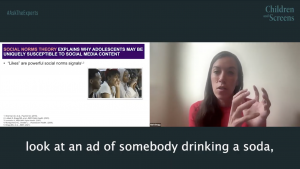
Why "Likes" Change What Teens Think
From the #AskTheExperts webinar “Online Marketing and Children's Eating Habits: What to Know and What To Do”

Suspicious minds: Adolescents' inferences of manipulative intent in retouched influencer ads
Young Children's (Aged 3 to 8 Years) Food and Beverage Brand Exposure on YouTube and YouTube Kids: An Observational Study and Content Analysis
Screens and Physical Health: Summary and Recommendations
Summary and Recommendations found in the "Handbook of Children and Screens: Digital Media, Development, and Well-Being from Birth Through Adolescence," Part One: Research Concerning Cognitive, Physical, Mental, and Psychosocial Impacts on Children, Screens and Physical Health Section (pages 61-116)

Driven to Distraction: Media Use, Attention, and Cognition
How do hours spent daily on digital media affect children’s attention spans, multitasking skills, and cognitive functions? How are digital platforms affecting how youth interact with the real world?