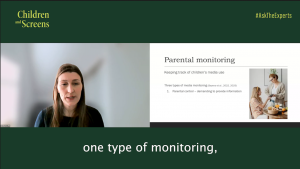
Ine Beyens, PhD (Assistant Professor, Amsterdam School of Communication Research, University of Amsterdam), explains how parental controls are one part of a broader approach to monitoring children’s media use and outlines the benefits and potential drawbacks of active parental monitoring, at the #AskTheExperts webinar “The Smart Parent’s Guide to Parental Controls” on March 31, 2026.
Read the Video Transcript
[Dr. Ine Beyens]: Parental control is just one type of monitoring, one way for parents to keep track of their children’s media use. So it’s part of a broader landscape that also involves parental surveillance, where parents check their adolescent’s smartphone and social media, for example. For example, inspecting their kid’s text messages, checking their social media contacts, tracking their kid’s smartphone use, and so on. And this may, of course, be a very convenient way for parents to obtain information about what their kids are doing online. It’s beneficial for catching risky situations early, but there are also potential downsides to this. It can be an intrusive form of monitoring that violates adolescents’ privacy, undermines teens’ trust, and it may encourage secrecy so that your child does not want to share anymore. And it may also cause conflicts among parents and their children in the end.
View the Full Webinar

The Smart Parent’s Guide to Parental Controls
How can families effectively use parental controls to monitor their children’s digital experiences without damaging trust or interfering with opportunities for children to build independence and digital skills?
Paul Weigle, MD
Associate Medical Director
Natchaug Hospital
Sheena Peckham
Content Lead
Internet Matters
Andrea Davis
Founder
Better Screen Time
Ine Beyens, PhD
Assistant Professor
Amsterdam School of Communication Research, University of Amsterdam

Get Screen Smart: Essential Tech Knowledge Needed for Digital Parenting
The tech children use is evolving at a dizzying pace, making it difficult for families to keep up. What do parents need to know to best support child health and safety?

What are the most effective digital parenting strategies?
Can parents be too hands-off or too hands-on? How do you parent a child versus a teen online? Is it even possible to supervise a kid in a digital age?

Win-Win Parenting: Child Safety, Autonomy, and Family Harmony In the Digital Age
How can parents and caregivers effectively guide their children’s media use in a way that reduces conflict, fosters independence, and helps guard against the development of problematic or addictive media use?

Online Safety for Youth
A tip sheet for parents and caregivers

Hidden Costs: Protecting Kids from Online Financial Exploitation
From influencer advertising, manipulative persuasive design, video game loot boxes, and even illegal financial extortion – children face a digital minefield designed to capture their money and their trust.