Support for school-enforced cell phone bans and restrictions is growing among educators, families and students.
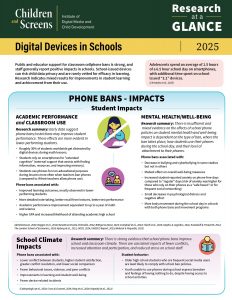 Research shows tangible benefits of such policies for students’ academic achievement, school and classroom climate, as well as educators’ daily experiences. Meanwhile, school-issued devices carry their own impacts to classroom learning, as well as unique risks. Children and Screens’ Research-at-a-Glance on “Digital Devices in Schools” distills the latest findings into clear takeaways for parents and educators.
Did You Know?
-
- Phone bans and restrictions may help improve student academic performance.
- Device policies’ effects on mental health and well-being vary depending on several external factors.
- School phone restrictions can lead to fewer conflicts, increased attention and participation, and reduced stress for school staff.
- Educators in schools with phone bans notice benefits to students as well as themselves.
- School-issued devices can provide mixed results for academic performance and may present privacy risks for students.
How You Can Use This:
-
- Inform parents and educators in discussions about enacting phone bans in your local schools.
- Educate adolescents who may be curious about (or wary of) school phone restrictions.
- Provide insights to school administrators to guide the use of school-issued devices.
What’s Inside the PDF:
-
- A concise, visual summary of current research
- Key takeaways at a glance
- Insights for students and educators
Abrahamsson, S. (2024). Smartphone bans, student outcomes, and mental health. NHH Department of Economics Discussion Paper 1. https://papers.ssrn.com/sol3/papers.cfm?abstract_id=4735240
Andriono, M.A., Curtis, C.J., Block, N., & Prasati, S. (2024). Exploring the effectiveness of mobile learning on early literacy skills of kindergarteners in Indonesia. Journal of Children and Media, 1-21. https://doi.org/10.1080/17482798.2025.2506488
Baggio, S., Wade, T., Radunz, M., Galanis, C.R., Billieux, J., Starcevic, V.,…& King, D.L. (2018). Psychological consequences of school mobile phone bans: Emulated trial of a natural experiment in South Australia. Computers in Human Behavior, 172. https://doi.org/10.1016/j.chb.2025.108767
Barbetta, G.P., Canino, P., & Cima, S. (2023). Let’s tweet again? Social networks and literature achievement in high school students. Education, Finance, and Policy, 18, 676-707. https://doi.org/10.1162/edfp_a_00363
Beneito, P., & Vicente-Chirivella, Ó. (2022). Banning mobile phones in schools: Evidence from regional-level policies in Spain. Applied Economic Analysis, 30(90), 153-175. https://doi.org/10.1108/AEA-05-2021-0112
Böttger, T., & Zierer, K. (2024). To ban or not to ban? A rapid review on the impact of smartphone bans in schools on social wellbeing and academic performance. Education Sciences, 14. https://doi.org/10.3390/educsci14080906
Campbell, M., Edwards, E.J., Pennell, D., Poed, S., Lister, V., Gillett-Swan, J., Kelly, A., Zec, D., & Nguyen, T.A. (2024). Evidence for and against banning mobile phones in schools: A scoping review. Journal of Psychologists and Counsellors in Schools, 34(3), 242-265. https://doi.org/10.1177/20556365241270394
Cakirpaloglu, S., Cech, T., Maléřová, M., & Adámková, H. (2020). The effect of mobile phone ban in schools on the evaluation of classroom climate. 12th International Conference on Education and New Learning Technologies. https://library.iated.org/view/DOBESOVACAKIRPALOGLU2020EFF?re=downloadnotallowed
Center for Democracy & Technology. (2021). Student activity monitoring software. Center for Democracy & Technology. https://cdt.org/wp-content/uploads/2021/09/Student-Activity-Monitoring-Software-Research-Insights-and-Recommendations.pdf
Cherif, K.M., Bendania, A., & Djaballah, S. (2024). The teachers’ ban or permission of smartphone use in Algerian secondary school classrooms. Educational Dimension, 11, 176-192
Cross, A. (2024). UConn study examines benefits of school phone bans. Center for Digital Education. https://www.govtech.com/education/uconn-study-examines-benefits-of-school-phone-bans
Gajdics, J., & Jagodics, B. (2022). Mobile phones in schools: With or without you? Comparison of students’ anxiety level and class engagement after regular and mobile-free school days. Technology, Knowledge and Learning, 27(4), 1095-1113. https://doi.org/10.1007/s10758-021-09539-w
Hall, C., Lundin, M., Sibbmark, K. (2019). A laptop for every child? The impact of ICT on educational outcomes. Institute for Evaluation of Labour Market and Education Policy. https://www.ifau.se/globalassets/pdf/se/2019/wp-2019-26-a-laptop-for-every-child-the-impact-of-ict-on-educational-outcomes.pdf
Harper, B., & Milman, N.B. (2016). One-to-one technology in K-12 classrooms: A review of the literature from 2004 through 2014. Journal of Research on Technology in Education, 48, 129-142. https://doi.org/10.1080/15391523.2016.1146564
Kelso, E., Soneji, A., Navid, S.Z., Soshitaishvili, Y., Rahaman, S., & Hasan, R. (2025). Investigating the security & privacy risks from unsanctioned technology use by educators. Education Technology Acquisition Practices. https://arxiv.org/pdf/2502.16739
King, D.L., Radunz, M., Galanis, C.R., Quinney, B., & Wade, T. (2024). “Phones off while school’s on”: Evaluating problematic phone use and the social, wellbeing, and academic effects of banning phones in schools. Journal of Behavioral Addictions, 13(4), 913–922. https://doi.org/10.1556/2006.2024.00058
Kopecký, K., Fernández-Martin, F.D., Szotkowski, R., Gómez-García, G., & Mikulcová, K. (2021). Behavior of children and adolescents and the use of mobile phones in primary schools in the Czech Republic. International Journal of Environmental Research and Public Health, 18. doi: 10.3390/ijerph18168352
Kuznekoff, J.H., & Titsworth, S. (2013). The impact of mobile phone usage on student learning. Communication Education, 62, 233-252. https://www.tandfonline.com/doi/abs/10.1080/03634523.2013.767917
Mecom, K., & Lehtinen-Vela, A. (2024). Teacher survey: Cell phone bans lead to safer environment and more learning time. Study.com. https://teachinglicense.study.com/featured-insights/mobile-bans-increase-engagement-and-learning-time.html?utm_source=chatgpt.com
National Education Association. (2024). Take cellphones out of the classroom, Educators say. NEA Today. https://www.nea.org/nea-today/all-news-articles/take-cellphones-out-classroom-educators-say
Netland, T., von Dzengelevski, O., Tesch, K., & Kwasnitschka, D. (2025). Comparing human-made and AI-generated teaching videos: An experimental study on learning effects. Computers & Education, 224. https://doi.org/10.1016/j.compedu.2024.105164
New South Wales Department of Education. (2024). Mobile ban improves learning, concentration and socialisation. New South Wales Department of Education. https://education.nsw.gov.au/news/latest-news/mobile-phone-ban-improves-learning–concentration-and-socialisat
Nyberg, G., Ekblom, O., Kjellenberg, K., Wang, R., Larsson, H., Jakobsson, B.T., & Helgadóttir, B. (2021). Association between the school environment and physical activity pattern during school time in Swedish adolescents. International Journal of Environmental Research and Public Health, 18. https://doi.org/10.3390/ijerph181910239
O’Daffer, A., Liu, W., & Bloss, C.S. (2025). School-based online surveillance of youth: Systematic search and content analysis of surveillance company websites. Journal of Medical Internet Research, 27. https://www.jmir.org/2025/1/e71998/
Organisation for Economic Co-operation and Development. (2024). Managing screen time: How to protect and equip students against distraction. OECD. https://www.oecd.org/content/dam/oecd/en/publications/reports/2024/05/managing-screen-time_023f2390/7c225af4-en.pdf?utm_source=chatgpt.com
Rahali, M., Kidron, B., & Livingstone, S. (2024). Smartphone policies in schools: What does the evidence say? Digital Futures for Children. https://eprints.lse.ac.uk/125554/1/Smartphone_policies_in_schools_Rahali_et_al_2024_002_.pdf
Randolph, D., & Liu, L. (2022). Comparing middle school student learning outcomes from in-person, online, and hybrid instructions: A consideration of learning engagement during a pandemic. International Journal of Technology and Learning, 18, 46-65. https://files.eric.ed.gov/fulltext/EJ1397759.pdf
South Australian Department of Education. (2025). Behavior improves as a result of mobile phone ban. South Australian Department of Education. https://www.education.sa.gov.au/department/media-centre/our-news/behaviour-improves-as-a-result-of-mobile-phone-ban
UNESCO. (2023). Technology in education: A tool on whose terms? Global Education Monitoring Report. UNESCO. https://unesdoc.unesco.org/ark:/48223/pf0000385723/PDF/385723eng.pdf.multi
Webster, T.E., & Paquette, J. (2023). “My other hand”: The central role of smartphones and SNSs in Korean students’ lives and studies. Computers in Human Behavior, 138. https://doi.org/10.1016/j.chb.2022.107447
Yeung, K.L., Carpenter, S.K., & Corral, D. (2021). A comprehensive review of educational technology on objective learning outcomes in academic contexts. Educational Psychology Review, 33, 1583-1630. https://doi.org/10.1007/s10648-020-09592-4
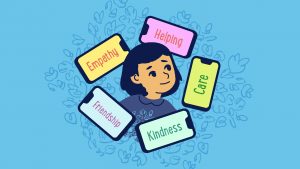
Learned Behavior: How Youth Digital Life Shapes Moral Development
What do parents need to know about how experiences with digital media shape youth moral and social development, as well as how they apply their morals online and offline?
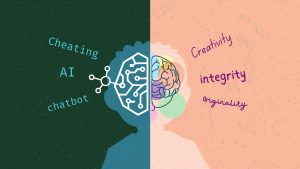
Raising Independent Thinkers in the Age of AI
Is AI use impacting the development of resilience, critical thinking, creativity, academic integrity, and intellectual curiosity in today’s youth? What happens to forming one’s own identity as a thinker when easy answers are just a few keyboard taps away?
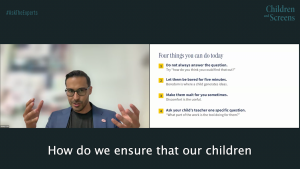
Four Simple Ways to Support Kids' Thinking Skills in the Age of AI
From the #AskTheExperts webinar “Raising Independent Thinkers in the Age of AI”
The False Promise of Tech and AI in Schools | Jared Cooney Horvath, PhD, MEd

AI in Education: What the Research Says