
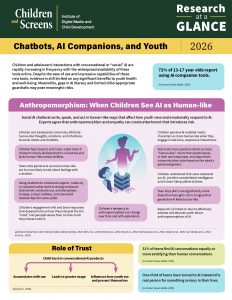
 AI chatbots and companions are increasingly part of young people’s lives, but are they benefiting youth health and well-being? Evidence from this emerging area of research suggests there are meaningful risks from children’s attachment to human-like AI.
Children and Screens’ Research-at-a-Glance “Chatbots, AI Companions, and Youth” distills the latest research into a two-page visual guide highlighting how children and adolescents interact with social AI, and how these interactions affect their health and well-being.
Did You Know?
-
- Children’s trust in conversational AI grows with use, which leads to increased use and can influence how youth see and present themselves
- Children’s anthropomorphism of AI agents can create attachments that introduce risks to their well-being
- Nearly a third of teens find AI conversations as satisfying or more satisfying than human conversations, and have turned to AI instead of a real person to talk about something serious in their lives
- Most mental health chatbots are labeled as unsafe for mental health support by experts
- Robot and humanoid robot-assisted interventions for children with autism spectrum disorder suggest potential benefits for improving social interaction, communication, attention, and emotional skills, but may also reinforce avoidance of difficult social experiences
How You Can Use This:
-
- Identify when children are at risk of over-attributing human-like qualities to social AI chatbots and foster dialogue about their limitations
- Discuss with youth how conversational AI products are influencing how they feel about and present themselves
- Talk with youth about the shortcomings and risks associated with mental health-focused AI chatbots
What’s Inside the PDF:
-
- A concise, visual summary of current research
- Key research findings at a glance
- Insights for families and educators
Alghamdi, M., Alotaibi, F., Alghamdi, H., Alfakeh, S., & Alqarni, S. (2023). Assessing the Potential of Robotics Technology for Enhancing Education for Children with Autism Spectrum Disorder. Behavioral Sciences. https://www.mdpi.com/2076-328X/13/7/598
Andries, V., & Robertson, J. (2023). Alexa doesn’t have that many feelings: Children’s understanding of AI through interactions with smart speakers in their homes. Computers and Education: Artificial Intelligence. https://doi.org/10.1016/j.caeai.2023.100176
Balan, R., Dobrean, A., & Poetar, C.R. (2024). Use of automated conversational agents in improving young population mental health: A scoping review. NPJ Digital Medicine. https://www.nature.com/articles/s41746-024-01072-1
Blake, A., Carter, M., & Velloso, E. (2026). Restoration, exploration and transformation: How youth engage Character.AI for fun, feels, and finding themselves. CHI ’26: Proceedings of the 2026 CHI Conference on Human Factors in Computing Systems. https://doi.org/10.1145/3772318.37905
Caffaratti, L.B., Longobardi, C., Badenes-Ribera, L., & Marengo, D. (2025). AI adoption among adolescents in education: Extending the UTAUT2 with psychological and contextual factors. Frontiers in Artificial Intelligence. https://www.frontiersin.org/journals/artificial-intelligence/articles/10.3389/frai.2025.1614993/full
Clark, A. (2025). The ability of AI therapy bots to set limits with distressed adolescents: Simulation-based comparison study. JMIR Mental Health. https://pmc.ncbi.nlm.nih.gov/articles/PMC12360667/
Common Sense Media. (2025b). Talk, trust, and trade-offs: How and why teens use AI companions. Common Sense Media. https://www.commonsensemedia.org/sites/default/files/research/report/talk-trust-and-trade-offs_2025_web.pdf
Driscoll, J., Chen, Y., Shi, V., Vucharatavintara, I., Yao, Y., & Jin, H. (2026). Understanding parents’ desires in moderating children’s interactions with GenAI chatbots through LLM-generated probes. CHI 26: Proceedings of the 2026 CHI Conference on Human Factors in Computing Systems. https://doi.org/10.1145/3772318.3791622
Family Online Safety Institute. (2026). Generative AI in uncertain times: How teens are navigating a new digital frontier. Family Online Safety Institute. https://fosi.org/wp-content/uploads/2025/11/Generative-AI-in-Uncertain-Times-FOSI-2025-Research-Report.pdf
He, K., Cervera, K., Levine, J., Xu, Y., Collins, P., & Warschauer, M. (2025). Promoting parent-child shared reading with a bilingual conversational agent. International Journal of Human-Computer Studies. https://www.sciencedirect.com/science/article/pii/S1071581925000461
Hope Lab. (2024). Teen and young adult perspectives on generative AI: Patterns of use, excitements, and concerns. Hope Lab. https://assets.hopelab.org/wp-content/uploads/2024/05/Teen-and-Young-Adult-Perspectives-on-Generative-AI.pdf
Hou, J., Gibson, J., Phi, T., Ritchie, B., Gallagher, L., Strudwick, G.,…& Hawke, L.D. (2025). Designing digital conversational agents for youth with multiple mental health conditions: Insights on key features from a youth-engaged qualitative descriptive study. Digital Health. https://journals.sagepub.com/doi/abs/10.1177/20552076251330550
Kim, P., Chin, J.H., Xie, Y., Brady, N., Yeh, T., & Yang, S. (2025). Young children’s anthropomorphism of an AI chatbot: Brain activation and the role of parent co-presence. ArXiv. https://doi.org/10.48550/arXiv.2512.02179
Kühne, R., Peter, J., de Jong, C., & Barco, A. (2024). How Does Children’s Anthropomorphism of a Social Robot Develop Over Time? A Six-Wave Panel Study. International Journal of Social Robotics. https://link.springer.com/article/10.1007/s12369-024-01155-9
Leech, K.A., Lin, G., Pedonti, S., Schoenfeld, I., & Bilgin, C. (2025). Evaluating the usability of a conversational agent to enhance parent-child shared reading interactions. International Journal of Child-Computer Interaction. https://www.sciencedirect.com/science/article/pii/S2212868924000898
Maheux, A., Boeldt, D., Akre-Bhide, S., Flannery, J., Paige, A., Villella, G.,…& Kollins, S. (2026). How youth use AI chatbots: Conversation patterns from naturalistic keystroke data. https://osf.io/preprints/psyarxiv/z4mts_v1
Maj, K., Grzybowicz, P., & Kopeć. J. (2024). “No, I Won’t Do That.” Assertive Behavior of Robots and its Perception by Children. International Journal of Social Robotics. https://link.springer.com/article/10.1007/s12369-024-01139-9
McBain, R.K., Bozick, R., Diliberti, M., Zhang, L., & Zhang, F. (2025). Use of Generative AI for Mental Health Advice Among US Adolescents and Young Adults. JAMA Network Open. https://jamanetwork.com/journals/jamanetworkopen/fullarticle/2841067
Menon, D., & Shilpa, K. (2023). “Hey, Alexa” “Hey, Siri”, “OK Google” ….” exploring teenagers’ interaction with artificial intelligence (AI)-enabled voice assistants during the COVID-19 pandemic. International Journal of Child-Computer Interaction. https://www.sciencedirect.com/science/article/pii/S2212868923000594
Namvarpour, M., Brofsky, B., Medina, J., Akter, M., & Razi, A. (2026). Understanding teen overreliance on AI companion chatbots through self-reported reddit narratives. 2026 CHI Conference on Human Factors in Computing Systems. https://dl.acm.org/doi/10.1145/3772318.3790597
Pew Research Center. (2026). How teens use and view AI. Pew Research Center. https://www.pewresearch.org/wp-content/uploads/sites/20/2026/02/PI_2026.02.24_Teens-and-AI_REPORT.pdf
Quan, S., Tu-Shea, X., Ding, Y., Du, Y., Zheng, Q., Gerdich, L. (2026). Conversational AI in children’s home literacy learning: effectiveness, advantages, challenges, and family perception. Computers and Education: Artificial Intelligence. https://www.sciencedirect.com/science/article/pii/S2666920X2600010X
Sobowale, K., Humphrey, D.K., & Zhao, S.Y. (2025). Evaluating Generative AI Psychotherapy Chatbots Used by Youth: Cross-Sectional Study. JMIR Mental Health. https://mental.jmir.org/2025/1/e79838
Stanja, J., Meier, J., & Krugel, J. (2025). Children’s and adolescents’ anthropomorphic conceptions of social robots and chatbots – A systematic literature review. Koli Calling ’25: Proceedings of the 25th Koli Calling International Conference on Computing Education Research. https://doi.org/10.1145/3769994.3770002
Sula, C., Dewan, U., & McDonald, N. (2026). Rehearsing the self with AI: Teens cross-domain use of chatbots. CHI ’26: Proceedings of the 2026 CHI Conference on Human Factors in Computing Systems. https://doi.org/10.1145/3772318.3793144
Vagnetti, R., Di Nuovo, A., Mazza, M., & Valenti, M. (2026). Social Robots: A promising tool to support people with autism. A systematic review of recent research and critical analysis from the clinical perspective. Review Journal of Autism and Developmental Disorders. https://doi.org/10.1007/s40489-024-00434-5
van Straten, C.L., Peter, J., & Kühne, R. (2023). Transparent robots: How children perceive and relate to a social robot that acknowledges its lack of human psychological capacities and machine status. International Journal of Human-Computer Studies. https://doi.org/10.1016/j.ijhcs.2023.103063
Wohn, C., Çarik, B., Ding, X., Won Lee, S., Kim, Y.H., & Rho, E. (2026). “Are we writing an advice column for Spock here?” Understanding stereotypes in AI advice for autistic users. Conference: CHI Conference on Human Factors in Computing Systems. https://arxiv.org/html/2601.12690
Xiao, F., Zou, E., Lin, J., Li, Z., & Yang, D. (2025). Parent-led vs. AI-guided dialogic reading: Evidence from a randomized controlled trial in children’s e-book context. British Journal of Educational Technology. https://bera-journals.onlinelibrary.wiley.com/doi/10.1111/bjet.13615
Xu, Y., Thomas, T., Li, Z., Chan, M., Lin, G., & Moore, K. (2024). Examining children’s perceptions of AI-enabled interactive media characters. International Journal of Child-Computer Interaction. https://www.sciencedirect.com/science/article/pii/S2212868924000692
Chatbots, AI Companions, and Youth
A two-page research snapshot on how youth are affected by social AI
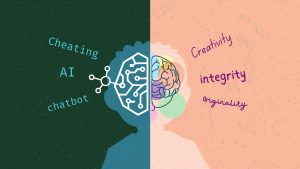
Raising Independent Thinkers in the Age of AI
Is AI use impacting the development of resilience, critical thinking, creativity, academic integrity, and intellectual curiosity in today’s youth? What happens to forming one’s own identity as a thinker when easy answers are just a few keyboard taps away?
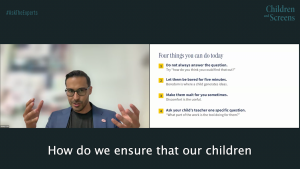
Four Simple Ways to Support Kids' Thinking Skills in the Age of AI
From the #AskTheExperts webinar “Raising Independent Thinkers in the Age of AI”

How are Children Impacted by Deepfakes?
How are deepfakes created? How might kids be affected by deep fakes? What can parents and caregivers do?

AI in Education: What the Research Says

Get Screen Smart: Essential Tech Knowledge Needed for Digital Parenting
The tech children use is evolving at a dizzying pace, making it difficult for families to keep up. What do parents need to know to best support child health and safety?