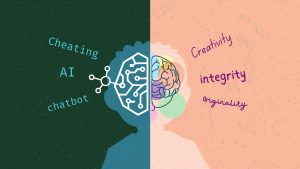
Is AI use impacting the development of resilience, critical thinking, creativity, academic integrity, and intellectual curiosity in today’s youth? What happens to forming one’s own identity as a thinker when easy answers are just a few keyboard taps away?
Children and Screens held the #AskTheExperts webinar “Raising Independent Thinkers in the Age of AI,” on Wednesday, August 19, 2026, the first webinar in its “Character Matters: Values and Resilience in the Digital Age” series. A panel of researchers and thought leaders engaged in a timely discussion to help parents, caregivers, and educators grapple with the challenges and opportunities AI presents in shaping children’s ability and motivation to learn new things, think critically and creatively, and persist through challenges.
The “Character Matters” series is made possible through the support of Grant 63314 from the John Templeton Foundation. The opinions expressed do not necessarily reflect the views of the John Templeton Foundation.





Resources Mentioned During the Webinar
- Data and Computing in K–12 Education: Foundational Competencies (Report)
- Empowering Learners for the Age of AI: An AI Literacy Framework for Primary and Secondary Education (Report)
- Cheating in the age of generative AI: A high school survey study of cheating behaviors before and after the release of ChatGPT (Scholarly Article)
- Cheating in the second year of generative AI chatbots: a follow-up study on high school student cheating behaviors (Scholarly Article)
- I study AI cheating. Here’s what the data actually says. (News Article)
- The Connected Classroom (Website)
- The Cognitive Privacy Project (Website)
- A New Direction for Students in an AI World: Prosper, Prepare, Protect (Report)
- The Dance of Entropy: A Transdisciplinary Exploration (Blog Post)
- Thinking, Fast and Slow (Book)
- Who Wrote This? How AI and the Lure of Efficiency Threaten Human Writing (Book)
- Reader Bot What Happens When AI Reads and Why It Matters (Book)
- How We Read Now: Strategic Choices for Print, Screen, and Audio (Book)
00:00:00 – Introductions by Executive Director of Children and Screens Kris Perry
00:02:35 – Moderator Tenelle Porter on intellectual character and the goal of education
00:06:23 – Victor R. Lee on cheating in the age of AI
00:17:54 – Moderator follow-up: Are AI detectors a good option for reducing cheating?
00:19:38 – Timothy Cook on the difference between atrophy and foreclosure and the importance of friction
00:30:10 – Moderator follow-up: How should parents of elementary school children discuss AI with their child’s teacher?
00:32:51 – Punya Mishra on curiosity, creativity, and independent thinking in the age of AI
00:46:33 – Naomi S. Baron on AI and the lure of efficiency, automation bias, and cultivating your own voice through reading and writing
01:01:46 – Q&A: What are some specific ways parents can model ethical AI usage?
01:05:06 – Q&A: How can we help students maintain critical thinking skills when AI tools consistently validate their ideas?
01:16:18 – Q&A: How do we push back against tech companies to defend human cognition?
01:21:35 – Summary and final thoughts from Tenelle Porter
01:22:11 – Wrap-up with Children and Screens’ Executive Director Kris Perry.
[Kris Perry]: Hello everyone, and welcome to Children and Screens #AskTheExperts webinar series. I’m Kris Perry, executive director of Children and Screens Institute of Digital Media and Child Development. I’m especially pleased to welcome you today because this is both the first webinar of our Fall 2026 season and a milestone for Children and Screens. This is our 100th #AskTheExperts webinar. Over the course of 100 conversations, we’ve brought together experts from across disciplines to help families, educators, clinicians, and others better understand how our rapidly evolving digital world is affecting children’s health and development. Today’s session, Raising Independent Thinkers in the Age of AI launches our new series, Character Matters: Values and Resilience in the Digital Age. This series of webinars will address a spectrum of topics related to youth character development and digital media use, and was made possible through the support of the John Templeton Foundation. If AI can answer a homework question, write an essay, or solve a problem in seconds, what does that mean for how children learn to think for themselves? Today, we’ll explore how AI may be influencing children’s critical thinking, creativity, academic integrity, intellectual curiosity, and motivation to learn. We’ll also discuss why productive struggle or the effort involved in working through something difficult, actually matters for development, and what parents and educators can do to preserve the opportunities for children to question, create, persist, and develop confidence in their own thinking. We have an outstanding panel of researchers and thought leaders here with us to help us examine these questions. Now, I’m pleased to turn things over to today’s moderator, Dr. Tenelle Porter. Doctor Porter is assistant professor of psychology at Rowan University. Her research spans developmental, social, and educational psychology and explores intellectual character strengths like intellectual humility, open mindedness, and curiosity. Tenelle earned a PhD from Stanford University, a master’s degree from the University of Oxford, and a bachelor’s degree from the University of Kansas. Welcome Tenelle.
[Dr. Tenelle Porter]: Hi. Thanks so much. I am delighted to be here with you all to help moderate this really important and timely panel. And I want to begin with a brief reflection about why we’re here. I want to ask you all to consider what is the purpose of education? What is our aim? What are we trying to do when we, as teachers and parents, educate our children? No shortage of thinkers have weighed in on this question. Martin Luther King Jr wrote that “Intelligence plus character – that is the goal of a true education”. English philosopher Mary Wollstonecraft wrote that “The most perfect education is to enable the individual to attain such habits of virtue, as will render it independent”. And Jason Baehr, the modern philosopher and professor, wrote that “Education should foster a lifelong love of learning and should help students become thinkers who can form their own opinions, learn from others, and speak up for what they believe in.” Where these thinkers converge is on this notion that the goal of education and the purpose is about more than merely imparting knowledge and skills – though of course, that’s part of it. It’s also about more than preparing students for the workforce. That a deeper aim of education is to shape the kind of people that students become, to shape their intellectual character. Jason Baehr defines intellectual character as: “The ways we are disposed to think, act, and feel in the context of epistemic pursuits like learning, wondering, and reasoning.” We hope that education helps to cultivate in our children intellectual virtues or character strengths. These are attributes of good thinkers and learners like curiosity, intellectual autonomy, open mindedness. But these are virtues because they help us get closer to the truth. So without further ado, I want to leave you all with a question, which is how do you think AI is shaping our children’s intellectual character? So just think about that as we hear from our speakers today. And again, we are eager for your questions, so please feel free to put those in the chat. We’ll have each speaker talk and then we’ll have – I’ll ask everyone one question, then we’ll have a general Q&A at the end. So lots of time for your question to be considered. And I know we’ve also worked in many of those pre-submitted questions into what we’ll be covering. Without further ado, I want to introduce our first speaker. Victor R. Lee is the Kozlov Family Professor of Education at Stanford University, and leads the Stanford Accelerator for learning’s initiative on AI and education. One line of his research, funded by the John Templeton Foundation, has been examining academic integrity related to AI in high schools. He’s coauthored several national academies of science, engineering, and medicine reports, including the recent report on Foundational Competencies for Data and Computing in K-12. Additionally, he was also part of the team that produced the OECD AI Literacy Framework, released in 2026. We’re real fortunate to have Dr. Lee with us today. Please join me in welcoming him.
[Dr. Victor R. Lee]: Thank you so much for the introduction Tenelle. Thank you to Children and Screens for the opportunity to speak and engage with you all. Today, I’d like to speak about the topic of cheating in the AI age, and Tenelle was kind enough to give a little bit of context. But just to also reiterate, this is one of many lines of research, and I mention these different lines of research because all of these have me engaging in conversations directly with students or with teachers in the classroom. So you’ve heard about and I’ll speak primarily about this work funded by the John Templeton Foundation that I do in collaboration with Challenge Success to research academic integrity directly. But I also work on thinking about AI literacy resources for students with support from Google research and federally funded research funded by the National Science Foundation, as well as some of our internal efforts at Stanford. Now it’s 2026. The school year has just begun, and I want us to do a quick rewind to 2022. If you remember back four years ago, even four years ago today, what were we worried about in education at that time? Well, you could go check the news. You could go check your journals or look back and try to remember what everything was at the time. But a lot of the conversations were emphasizing post-Covid return to school. We had gone through the year of remote learning, and there was a lot of talk about learning loss. So we are still producing the data on how test scores and performance were looking after that remote learning period, which was really challenging for everybody. Part of that really emphasized student social development and mental health post-Covid. There’s a lot of talk and acknowledgment by teachers that students are having a hard time in their in-person and classroom interactions. And understandably, given this very challenging time, and, I think this continues today, teacher retention, the teaching profession is having a harder time with recruitment and retention, given all the increase in demands. And starting in 2021 and extending 2022 and onward has been ongoing curriculum controversy, including things such as book bands and other policies that are part of larger national and local discussions. But in 2022, and specifically November 30th, 2022 was the hatching of ChatGPT. So that was four years ago almost now, once we hit the post Thanksgiving time, and that was the moment when AI sort of became the real attention grabber. And what I want to point out here is that at this particular moment, the conversation in education shifted very dramatically to cheating, and the perception had largely been that this was Pandora’s box. AI was going to unleash the cheating onto the world. You know, there is a whole new set of considerations that this technology, with its ability to write and present human-like text, was going to offer, and it was only a matter of time. Well, I want to adjust that image a bit by drawing at some of the research that we’ve done with the support of the Templeton Foundation and with my collaborators at Challenge Success, and stress that even though in 2022, prior to ChatGPT, we weren’t talking about it as much, cheating is very old and very common. Study after study in the undergraduate middle school, high school realm, going back to the 1980s, has documented cheating rates that are quite high, at a rate of about 60 to 80% of students in high school and college, reporting cheating behaviors engaged in the previous month. And even looking within our data prior to ChatGPT being part of anyone’s vocabulary, we saw across schools about 60 to 80% cheating rates, and after ChatGPT had already been out for a year and a half, 60 to 80% cheating rates. So what I want to stress here is that cheating is not a new phenomenon. This is something that is almost as old as education itself. Now with that said, this does invite the question about what’s different or what might be happening differently in the context of ChatGPT and other AI technologies that are increasingly available? So I know some of this text is rather small, but what I want to point out to here is, from a series of charts I’m going to show, is – you can look at these bars and think of the red line here in the middle as dividing – on the left is the percent of students who don’t cheat, don’t engage in cheating behaviors within the previous month. And on the right side is different intensities of engaging in those cheating behaviors, but engaging in them nonetheless. And so at the very top, you’re going to basically see what I’m going to call cheat with friends. This is working on assignments with peers that are supposed to be done alone, copying from peers and getting help that is not generally expected or permitted. And then on the bottom is using artificial intelligence or digital devices, which I’m going to just describe as cheating alone, is going to the technology because you have it available and using that as a source. So this is what it looked like in 2024. Is that cheating with friends? Quite high. Cheating alone? Present but modest. 2025, we see those same graphs and we see cheating with friends is starting to come down a little bit, and cheating alone is starting to come up a little bit. And you extend that now to this most recent school year. We just finished collecting the data and doing some initial passes. So this is just this past school year and that trend is continuing. It’s that cheating with friends is decreasing and cheating alone is increasing. So to clarify, cheating is still happening, but the mode and the resources that are being used are shifting such that we want to be aware that going to one another, tapping that relational capital in service of whatever sort of help one needs, is changing in light of that technology. And as a professor, we can attest to this. We are seeing fewer and fewer students coming to office hours. We’re hearing a lot less about students working with one another. Now, looking also at some of the data that we’ve collected over the past few years, I want to point out two different trends. One is students who used AI to revise or improve their work. So imagine taking a paper you’ve written and having AI make improvements or suggestions to it, and on the bottom, completing the entire assignment, just having AI do the assignment and turning that in. And what you can see is from 2023-2024 we had about 40%. And that’s increased this past year to 55% for revising or improving their work, and from 12% for completing their entire assignment to 22%. So for many teachers who are feeling like they’re seeing AI all over the place, I want to validate there are certainly signs that even if a student is using AI to assist, but not do all their thinking for them, that you can feel like this is a big new problem in that AI signature writing style is coming across. Although we would argue this is a displacement of other sorts of cheating activities, but now it’s having that AI signature and that’s eating a larger share of that particular pie. And that 55% in the revision and improving work, what we want to point out is, from our studies with students and focus groups with students, is the challenge here is that students are not sure what is or is not allowed with using AI to help, but not do their work for them. And so that’s something that they feel they get contradictory messages or it’s not talked about because this is a taboo topic. And so they’re working with what they think is the most rational solution that they can get with, which is not necessarily the same thing that the teachers or schools are seeing. So to reiterate, cheating has been around for a long time and at very high levels — say 75% — because we’re looking 60 to 80%. So in the olden days it was happening, in recent times, and now. But what we’re seeing here is that the sorts of things that were more human, social cheating, using things like Course Hero or copying from Wikipedia, that share is shrinking relative to the amount that AI is taking, although that same amount of pie is being chipped away at. So when we think about this question about character, intellectual character and responsibility, there’s a few points that the research is telling us that we want to state here is, with AI use, it’s not really an either or. It’s not, you either use AI responsibly or you don’t use AI responsibly. If students have different reasons for using AI and they use it sometimes and they avoid it sometimes, and there’s different times they think they’re using it very responsibly and other times when they’re doing it and someone would say that is not a responsible use. So it’s a much more complex manner of use rather than yes or no for using AI. We know that there are very important virtues with respect to honesty, perseverance. And what we’re seeing within our analyses is that these are very closely related to engagement. So the kinds of AI use, the more restrictive, cautious work that is done so that the student is doing more of the work – that appears to be tied to school engagement. When students are feeling really connected to the schoolwork, they feel like they’re intellectually challenged and that this is interesting and that they’re enjoying the kinds of ideas that they’re engaging with, that actually is in line with those virtues that we see. Where we are seeing also positive character virtue or character strength is with love of learning, is that there’s an extra added boost. We know students have a sense that they really enjoy learning, they love learning as an activity in general – that will lead to more restrained or more judicious use of AI. So thinking about what to do moving forward, my colleagues on this panel will have lots to say and to unpack more about some of the processes and mechanisms and risks. But based on what I’ve talked about today, what I would encourage all of you is, if you are within the education system, or you have another opportunity or space as a parent or other person in the world working with students is talk with students honestly about AI. They feel like it’s a very taboo topic and they have lots of thoughts and opinions. So give them space to say why and when they think AI is appropriate. I have on the right a recent story that had gone national about a delegation of students and across all 50 states who created their own AI policy framework, which I think, as an adult who’s wanting thoughtful engagement with the world and judicious use of AI, is a quite nice document. And I think that reflects that students have really thoughtful points with this and do have considerations, but they need to engage in that dialog. As an educator, rearticulate why different assignments and assessments matter. Redesign the assignments and assessments that need changing. Be clear about your AI expectations or different parts. Is it okay to use AI as part of search – considering it’s built into Google now – for grammar correction, for getting feedback, for explaining topics that they’re not understanding? And as a whole, I think we all want to focus on reigniting the love of learning, which I know is a challenging task, but I think something that we all hold dear, we really want to support in pursuit of strong intellectual character. Thanks.
[Dr. Tenelle Porter]: Wonderful. Thanks so much, Victor. We have time for a really quick question. And my question for you is, do you think AI detectors are a good option for reducing AI cheating?
[Dr. Victor R. Lee]: That’s a great question. And what I would say is that AI detectors are part of a game of whack a mole, where you’re always going to have this arms race where whatever new AI detector, a new technology comes that can counter it. And my biggest concern, and what we are hearing from students is that it’s eroding the trust between teacher and student. They feel like they’re always under suspicion. And I think that is not the direction that we want to move the education system. So even when you hear about the newest detector, it’s only a matter of time before that detector is undermined. And I think we want to really focus on nurturing that teacher learner relationship, to ignite that love of learning back for our students.
[Dr. Tenelle Porter]: That makes sense. Thank you so much. Those relationships are really important, I agree. So I want to introduce our next speaker. Timothy Cook is an elementary school teacher in Amman, Jordan, with more than 13 years of classroom experience across five countries. He writes The Algorithmic Mind, a Psychology Today column on cognition, development and technology, and directs the Cognitive Privacy Project and Connected Classroom, both research and policy initiatives on cognitive autonomy and AI. His book, Built to Think, is forthcoming from MIT press. Please join me in welcoming Tim.
[Timothy Cook]: Hi. Yes, I’m a teacher, and I actually just finished Back-to-School night. So for any teachers or parents that are in this panel right now, I finished 20 minutes ago. I had two sessions where I was talking to parents about their kids and the learning and the environmental space that we’re building in the class, building community, building relationships. Ultimately so that we can have better learning. And what Victor just said was really interesting because I want to share a story on this that happened last year, when he’s talked about Google and whether or not it’s even appropriate to think about these things now. And I know that we’ve all used Google Search for the last decade. And what you’re seeing here is a picture of my wife and I, and we’re actually on Komodo Island. We’re sitting behind a Komodo dragon. And this was like a very specific moment in our life. And I’m showing this because the way I might think about Komodo dragons might be different than somebody else. And what happened last year is a third grade student, they came up to me with their notebook — we were doing a research project — and she came up to me and she had all these notes about Komodo dragon diets. And I said, “Wow, this is fantastic, like, you have the diets of the adolescents and adults and it’s all this fantastic information. Where did you find this?” And what she told me was “AI told me.” And I paused for a moment, because eight-year-olds don’t have access to AI in their classroom. They don’t have access to chatbots. So I said, “What do you mean AI told you? Like, can you show me?” So she brought me her iPad, and right there at the top is, what we’re probably all familiar with now, is this AI overview. Now, what struck me about that was the entire point of this project was for students to synthesize information across multiple sources. And where in the past we might go to a library or use Pebble Go or Epic, or even Google search, the point is that I read multiple sources, and then in my brain, there’s a cognitive event that takes place where I have to piece these pieces of information together to see what overlaps and what doesn’t, and ultimately make a judgment about what I think Komodo dragons eat. And the Google AI overview changed all of that. And it wasn’t because a child intended for this to happen. It was done through a product update. And this is what I’m finding kind of interesting about how AI is developing in schools is, while Victor was talking a little bit about how students are making these decisions, right? There’s also an invisible architecture that’s happening in the way AI and algorithms are embedded into all the programs that we’re used to, even Google Docs or Canva or anything like that, right? So this is very common now. So what I really want to focus my presentation on today is the difference between atrophy and foreclosure. So I want you to think of this as a muscle. And why when we think about AI, it’s not just whether, like, an adult can use it, whether you can use it, whether my eight-year-old can use it, whether my 14-year-old can use it. It’s not really bracketed by age. It’s bracketed by what skills have we already developed, right? So for an adult, if I am habitually offloading to AI, over time what happens is this muscle weakens. So if I continue to say, “Hey, ChatGPT or Claude or whatever, can you just respond to this person by email?” Over time, when I continue to do this, my ability to write an email will kind of decrease. In my mind, I’ll offload the skill, but because I’ve already developed those skills of writing in the past, I should theoretically be able to rebuild that skill, with some effort. Now, for a child, a child that’s never learned how to write an email before, this is a different cognitive event because there’s nothing to atrophy, there’s nothing to weaken – it’s foreclosure. It’s a skill that’s never developed because it was always mediated through AI technology. So this is really where I want us to sit with, you know, today when we think about when and if we should ever use AI in the classroom, I don’t want us to think of it in terms of what age is appropriate, but rather what cognitive event is this replacing right now? Is it replacing the relationship between the teacher, right? We know that kids learn well through relationships. Is it replacing the synthesis that we just talked about in that example? Is AI asking questions that a peer would be asking, right? That’s replacing a relational dynamic which is collaborative, which is how we learn together. So we have to be careful about when these things are introduced and why. So I want to show you on the next slide an activity that I was doing in my class earlier this year. Because part of learning, and this is also a solution to this, is to build actual human relationships. And oftentimes when we’re in school, we’re so obsessed with data – tracking data, tracking this, “how is my kid meeting the standard? Have they grown over the last month?” – that we forget that a classroom community is a community of thinkers that learn together, and friction, when it happens, is both an academic event, but it’s also a relational event. And earlier this year, right, at the beginning, I was giving a math lesson and I had a student asking me a question. And this is a very common event. If you’re a parent or a teacher, you’ve probably experienced this a bunch of times. You have 20 kids in your class, one of them asks a question, you go over, and another kid has a question. So what do you do? Now, a lot of AI companies right now, they’re offering this solution as well. We might as well give every child an independent tutor. That way everyone can be acknowledged, have their questions, answer, anytime they want. But part of building a relationship, part of building cognition, is through friction. And part of that means that sometimes you have to wait. So if I say to a student, “I’m talking to Sally here, I need you to wait three minutes”. What that does is it creates an event of struggle or friction where the kid has to sit and either try to figure out what they were asking themselves or wait patiently for a response. And this is the real world, right? The real world isn’t that you should get a response every single second you ask for one. If your parent always responded to you right when you asked, right, you would grow up thinking that there’s no – you never have to wait for anything, and this is the way you would effectively be shaped. So let’s talk about four really simple solutions that anyone, parent, teacher, can deploy, like as culturally as part of their classroom, as part of their home. It doesn’t even matter – like if we’re not even thinking about AI, we’re just thinking about how do we create, like, a pro capability? How do we ensure that our children are still developing well? So these are the four things. I’ll just let you, like, look at them for a few minutes. I don’t want to lecture on all these when you can read them. But as you might notice with these four things, these are probably four things that you as an adult grew up with when you were a kid. And these are the things that still need protection, right? So asking that follow up question, not telling the answer right away, letting a child be bored just for a little bit, right? Making them wait for you sometimes. And specifically, if you were a parent that was concerned about how AI is deployed in the school, just asking the teacher or the school, like, what cognitive event is either AI assisting or replacing here? Not in an aggressive way, but just out of curiosity. Like, what’s the purpose of this tool or technology for this cognitive event? And if it’s replacing an event a child should be learning how to do before they use the model, then I would consider that the wrong usage. So I’m going to end today with kind of a thought about where I land on AI, is we can look at this through a lens of restriction, or we can look at it through the lens of construction. We can be fearful or we can think about pro capability. We can think about what we want our kids to learn. And that AI isn’t really a technological problem. It’s really a biological one. It’s when you insert a frictionless technology into an education, atmosphere or environment that is built on friction to be successful, right? That we’re changing the way our kids learn to think. And this is where I want us to sit as parents and teachers, is how do we continue to build the space for struggle, for friction, for relationships, so that regardless of how this technology progresses, that we still can make sure that our kids can adapt, think, have tenacity, have perseverance, that they’re built to think. Thank you.
[Dr. Tenelle Porter]: Wonderful. Thank you so much. That really gets me thinking as well. And I think, one thing on my mind, I know you were just at Back to School Night, but it’s like, when you think about parents of elementary school children, do you have any tips for them about how to discuss AI with their child’s teacher?
[Timothy Cook]: Yeah, so really it’s about the developmental work. And one of the most important things I want teachers and parents to understand is oftentimes we like to put blame on others, and we like to believe that people intend to do something. But AI as a product, we need to start thinking that the architecture of the product allows these things regardless of the intent of the person. So this is all a collaborative space. When I’m asking a teacher or a parent what, when and where or why AI is being used, this is really from a position of curiosity. It’s asking teachers questions about what cognitive event this is replacing, right? And seeing if the school or the teacher has figured out why they’re using it in the first place. Because if they’re using it to replace a relationship, if they’re using it to replace the thinking, then this would be the wrong use for AI. If they’re using it to extend, they’re using it to augment, right? They’re using it to translate, to create equity, to make access to curriculum easier, then this is different right? Then it’s a technology that has equitable value to each other.
[Dr. Tenelle Porter]: Awesome. Thank you so much. Great food for thought, for sure. I have the privilege of introducing our next speaker. Punya Mishra is a professor at the Mary Lou Fulton College of Teaching and Learning Innovation in Arizona State University, a nonresident senior fellow at the Brookings Institution’s Center for Universal Education and an AI innovation fellow at ASU’s Learning Engineering Institute. Internationally recognized for his work in educational technology, creativity, and the application of design to educational innovation, he is a TED-Ed educator, and an AERA fellow. Ranked in the top 2% of scientists worldwide and number 44 among scholars with the biggest influence on practice and policy, he’s a podcaster, an award winning instructor, engaging public speaker, and accomplished visual artist. Please join me in welcoming Punya.
[Dr. Punya Mishra]: Thank you so much. I wish you’d kept that introduction shorter because you know you should keep the bar low. But I do appreciate these kind words and thank you to Children and Screens for inviting me here today. I can’t imagine a better sort of sequence with Victor and Tim coming before me, sort of setting up. And what I’m going to talk about is sort of twofold, building out of two questions, actually, that were asked by the panel beforehand. And I’m going to focus on this idea of curiosity, because that’s something that we often talk about as being really powerful for educational purposes. But it turns out that curiosity is a little more complicated. And I want to talk a little bit about that. But here are the two questions that sort of prompted my thinking about what I would talk about today. So one question was that “I’m worried about my child’s reliance on AI and lack of curiosity or curious thoughts – how do I foster this curiosity and critical thinking?” And a parallel question that came is, “how can AI be leveraged to support creativity and independent thinking?” And so I’m going to frame, sort of, what I’m going to talk about in terms of these two sorts of questions. I think first half about the first one, and second sort of as a possible solution for the second one. So when we talk about curiosity, it turns out there are two different kinds of curiosity. So one is what we call a deprivation curiosity which is just an itch where you just want to get the answer and move on. And if you think about a lot of what we do in school is about getting the right answer, and you get the answer, you’re done, it’s over, right? I mean, it’s sort of the equivalent of your student who got that information from Google and was like, “okay, life is good.” But what is more interesting and more powerful is what people, what psychologists call discovery curiosity, which is a pull, which is driven by wonder, which is driven by sort of that always leads to more questions rather than, “I am done, let me move on,” right? And I still think it’s very important to make this distinction, especially in a world which, like Tim described it, which is frictionless, in a space where we – and, you know, atrophy and foreclosure were some of the words that were used there, right? So when we think about it in that context, you now have a technology that is sycophantic, which is always sort of agreeing with you. All of us have faced this when, you know, I’ve – there are lots of examples on my website about where, you know, I’ve given it something absolutely obvious that is wrong, and I just push back and it’ll say “oh yeah, yeah, yeah, you are right.” You know, because these things are designed to be that way. And so now we have this sort of a yes-bot problem, which is a chatbot is now a computer aided instruction with just better manners. But as you can see, as sort of was laid out beforehand, that we shouldn’t see this as a bug. This is a design choice that these companies have made, in large part because they want to hold you onto the platform. I mean, if this, you know, chatbot disagreed with you, after a while, you would be like, “uh, why do I need to talk to this guy?” You know, and this is tapping into – just like social media tapped into – deeply human need for, you know, validation. And like, “how many likes did I get?” This is the design equivalent of that in the AI space. And I don’t think this is – I mean, this is not to reargue friction. Tim, you did a great job of doing that. But I think this agreeableness is something that we really need to be sort of thinking about. And to add to it, – and again, this is building on what was said before – is looking at this sort of quadrant of where a learner exists. If you look at the continuum of knowledge of a given domain and knowledge of AI, what we have is a learner sitting at the bottom left corner and an expert, for instance, sitting at the top right corner. There are challenges that come with expertise as well. I don’t want to get – I don’t need to get into that right now, but a lot of your effort, if you’re an expert, now goes into evaluating the output. So you become sort of a middle manager of a bunch of little things who are spouting all kinds of stuff at you. But think about the learner. By definition, a learner is someone who does not have judgment or knowledge of the domain. And if they have sort of inherent trust in AI, partly because AI is designed to be fluent – we have a fluency heuristic, which is if somebody speaks fluently about something we assume they put in the effort to learn that thing. Well, AI can speak fluently about anything correct or incorrect. And so if you are a novice in that bottom corner, you are in double trouble because you neither have the critical thinking to know that AI could be making stuff up, or could just be off in nuance. You know, we often talk about factual errors. Factual errors can be corrected very – relatively easily. It’s the nuanced errors which are going to be really, really hard to catch, especially if you are what we define as a learner, which is you don’t know that domain. Now, the other piece I want to emphasize, and I really don’t have time to get into this completely, but one of the biggest uses of AI that we are seeing is happening not within school. In fact, I recently wrote an editorial which argued that in my domain, my field of educational technology, has missed the point in many ways by focusing on learning that’s happening within school. That this is a cultural technology, just as film is a cultural technology, television, social media, AI is a cultural technology and we are embedded in it. Our children are embedded in it. We can try to ban it in the classroom or think of intelligent ways of using it. But the moment they step out, go home, or when they’re off with their friends, or as Victor said many times, not with their friends, they are chatting alone, right? What happens then, I think is a very important thing as educators and parents we need to be thinking about. I was recently part of a Brookings report which looked at sort of the risks and benefits. It’s online, you can Google it and find it. If you want the link, let me know. One of the things that the basic conclusion that we came up with was that there are benefits to this technology, don’t get me wrong, right? In the classroom context, customization, personalization, translation, accessibility, so on. But the risks, what we argue in the report, are more foundational. The risks are about relationships. As Victor said, even if kids were getting together to cheat, at least they were getting together, you know, if I can take it that way, right? In terms of knowledge formation, how do we develop this epistemic ways of thinking about domains and about trust? How do we know what we trust anymore, whether this is right or wrong or, you know, so on so forth. So the risks are more foundational at some level. One of the things that I’ve been sort of working a lot about and builds on my previous work is thinking – two questions, you know, one is, you know, Victor, you talked about five years before when there was no chatbot. I don’t think educators were sitting around saying, “Oh, I wish there was a chatbot, which would solve all my problems,” right? Tim, were you wondering about that as a classroom teacher? I don’t think so. But here it is. The other thing that happened is that we saw it to be a chatbot, which is like a little box where I can type something and an answer will come back at me. And a lot of school sort of depends on that, so we sort of gravitated towards that. I think that there is a different way of thinking about it. And this brings me back to the deprivation and discovery curiosity. So if you are going at this deprivation mode, you ask a question, you get an answer, you are done. But if you approach this technology from this curiosity mode where you’re trying to build something with it, build understanding, build actual artifacts, so on, and I will talk a little bit more about that, then there is no end to that process. And I think that’s critically important. And on this I build upon of course, John Dewey who talked very eloquently about sort of the four primary impulses. Now, these impulses have been with us forever. I mean, he argued in his book that this is the impulses that drive children. I believe this drives all of us. And the four that he talked about is inquiry. We get joy by understanding something. We get that hit when we understand something. We like building things. Whether that building thing might be a website, might be an actual object, it might be a poem, it might be a scientific theory. We like building stuff. That gives us joy. It’s open ended, it gives us joy. We are social beings. We communicate, we like to talk with each other. And that’s the relational piece I think that becomes critical to education. And finally, we like to express, we like to bring ourselves into everything that we do. And I think that it is in these four that we can possibly look at ways – so I’m going to give very quickly, you know, for the purposes of time, examples, right? So here is one of inquiry. This is me asking ChatGPT to create an image of the ear-nose-throat system. And like all AI output, it looks very professional and fluent, except if you look at those words, it’s made up some parts of the anatomy. It looks very slick. And so I think a piece of inquiry that can happen in a classroom context, like what is the “Eoriched” or a “Staped Atirlage?” Is that even a thing? How do we even find out? A second example and these are again, if you go to my website, you can see lots of examples of simulations that I have built using AI. Not lining a line of code, but there is a beautiful simulation of how a unit circle connects with sine waves and cosine waves, and you can see how they relate to each other. These are difficult things to understand, but what I’m saying is it’s not for teachers to build them, but you can actually have children build these. That’s for once. We can take what was, you know, a dream of a children’s machine to build and construct things and actually make it real. This inputs for communication. This is a sort of a game I played with pre-service teachers once where, you know, we know children have scientific misconceptions, but a teacher never really confronts them till they’re actually in a class. So here I have this very simple prompt where I ask the AI to play a child who has a misunderstanding about Darwinian evolution, and then I have a conversation with that. And I can run it over and over again, and through that, gain knowledge about how to properly teach that subject. And you can see how these can become powerful tools for engaging with ideas in a powerful way. And finally, my favorite, which is I do a lot of work around transdisciplinary creativity. And so I asked once, you know, AI to write a song, which you can go to my website and listen to about the unfair beauty of the second law of thermodynamics. Because I think science we often talk about in very instrumental terms. I think there is a huge aesthetic dimension to learning science. And so it came up with the song, we edited the song together. Then we sort of went and composed the song. This is again a way of sort of bridging the sciences and the arts, which this technology, in its multimodal capabilities, can do very powerfully, as long as you just don’t see it as a chatbot. And so in terms of the answering the questions that was asked, like, how do I foster curiosity and critical thinking that started my talk and creativity is, again, I think, focus on these four primary impulses. Ask questions after you get the answer, play and build something, a simulation, a game, which you can change the variables and try again, make it talk back, you know, argue against me prompts of that nature, and make something that the child truly cares about. A song, a piece of art. But again, push them to develop that aesthetic sense. The sense of greatness and wrongness and judgment through this sort of engagement. You know, I mean, I’m a parent to two kids that are both grown up now. And one of the things that parenting taught me is that, you know, there’s this famous infamous Facebook algorithm statement Zuckerberg once made: “move fast and break things.” And I think that as educators, as parents, we understand that what we do is we move intentionally in and nurture things. And this is a picture of two of my kids, of both my kids, which I photoshopped badly. This is pre AI, and it’s their first day of school and the last day when they’re graduating high school. And I always look at the expression of the two little ones and they look so sad, like 12 years of this, you know, and I wish that school weren’t that. And I do think, again, I have huge concerns about AI along the lines that the others have spoken about. And I can go on about that, particularly around forming relationships with them and so on, which I’ve written extensively about. But I also see this as a potential to think about technology and think about education in new ways that I think would be more — most — productive. Thank you. I hope I was within my time limit because I didn’t have a clock running. And thank you again for this opportunity and look forward to the questions and the rest of the discussion.
[Dr. Tenelle Porter]: Wonderful. Thank you so much Punya. We are going to move on to the next speaker currently, but we have plenty of questions for you that we will tee up during the group discussion, so stay tuned for those. In the meantime, I’m pleased to introduce our final speaker of today’s panel. Naomi S. Baron is Professor Emerita of Linguistics at American University in Washington, DC. For over 30 years, she has studied the effects of technology on language, including the ways we speak, read, write, and think. She is a former Guggenheim Fellow, Fulbright Fellow, and visiting scholar at the Stanford Center for Advanced Study in the Behavioral Sciences. Among her 11 books are Who Wrote This? How AI and the Lure of Efficiency Threaten Human Writing, and Reader Bot, what Happens When AI Reads and Why It Matters? Translations have appeared in Korean, Chinese, Italian, and Japanese. Please join me in welcoming Naomi.
[Dr. Naomi S. Baron]: I began by really thanking everybody who has been a panelist for this rich conversation they have started for us. And what I’d like to begin with is for us to think about what it means to be human. And the fact that as human beings, we get to make decisions on how much mental energy we invest in something. The first thing I wanted to talk about is what’s known as the Lure of Efficiency. It’s a phrase I’ve used and I think it’s important for us to think about. When we look at AI, it’s really understandable for us as human beings to want to turn to it. And it’s not always that we’re lazy. We’re sometimes just being extremely pragmatic. There’s a large psychological literature, some of it tracing to work of a psychologist, a late psychologist from Princeton: Daniel Kahneman, who wrote a book that some of you may have heard of called Thinking Fast and Slow. And what he argues is that we have two basic modes by which we decide how much mental energy to expend. There are certain kinds of quick decisions, intuitive decisions that we make that don’t require a whole lot of effort. And then there’s- that was system one. And system two is more slow and considered and effortful thinking. And one of the things we people have to decide is when is it worth expending more effort? Other psychologists, such as Susan Fiske and Shelley Taylor, have a phrase “cognitive miser,” which is not a negative thing. It’s rather saying, there are contexts in which we don’t need to waste our cognitive resources on X, but instead expend them on why. The second concept I want to talk about is automation bias. So what is that all about? It’s trusting the technology, relying on it to do the kinds of things that previously a human being would have done, relying on human judgment. A lot of talk of automation bias traces back to the development of autopilot for planes. And there’s the good news and the bad news. If you have taken a flight in the last 10, 20 years, you probably have had your pilot using autopilot. That’s the good news. The bad news is pilots are under threat, as it were, or risk of losing the skills they have of dealing with difficult situations that autopilot may not know how to cope with. And there have been a number of fatal crashes that have resulted when the pilots couldn’t intervene because they couldn’t do it fast enough. That is, turn off autopilot, or they didn’t know what to do. So there’s a general issue of what kinds of skills are we maintaining? And there’s been some conversation about this today. And where do we risk de-skilling, that is, losing skills we once had. And yes, there’s the question: if you never develop the skills in the first place, then there’s nothing to deskill in. You never had it. But there’s some other issues as well. One has to do with motivation. Do you care to learn and maintain skills? And another is self-confidence in your own human ability to use your cognitive abilities to solve problems and use a skill that is a human ability. Next slide please. What I’d like to focus on with my time is a very specific area of cognition and character and AI, namely reading and writing. Specifically with regard to the individual’s development of his or her own voice. Let’s think first about reading. What is it that reading in principle can do? If you’re a member of a literate society? It gives you the opportunity to develop what you think about what you’ve read. The story, the article, what the content is vis a vis you and why it matters to you. Now turn to writing. If you look at what writers have said for centuries actually about what’s so useful about writing is it’s a way of figuring out what you think about a subject matter. One of the many people who have talked about this is the writer Flannery O’Connor, who said, “I don’t know what I think until I read what I say.” “Say,” meaning, “have written”. So how does AI bring together these reading and writing issues along with those two concepts I started with, that lure of efficiency and automation bias? The first is it’s really easy for a person, whether it’s an adult or whether it’s a child, to somehow assume AI is going to be doing a better job than you would do yourself. A better job at reading, summarizing, analyzing, comparing, or a better job at writing. Creating the text to begin with, doing the editing. And what are the possible consequences of being lured because of efficiency and automation bias? Trusting that the technology is going to be better at it, in this case reading or writing, than you, it’s losing our own personal voice, our own personal take. Plus, as an awful lot of studies are now showing when AI is doing the reading or writing for us, it’s losing a sense of ownership, of saying this thing that I’m attaching my name to is mine. It represents what I think or I’ve rethought. Next slide please. So a simple illustration by having a person who wrote about this problem. This is an email that was sent to me and I will read from it. The person had used a tool called Grammarly that many of you I’m sure are familiar with. It used to be a kind of editing tool, now it’s totally, entirely AI driven. And in addition to making changes to your grammar or spelling or punctuation, it can change your style. It can change whether you’d come across as authoritative or you come across as meek, or you come across as confident, or not. And this is what the person wrote: “Grammarly is correcting my email. Half of it, namely the email that I wrote, is highlighted blue.” Blue means, “oh, you’re supposed to do something, you original writer” says Grammarly. “Highlighted with suggestions asking me, do you want to sound more confident? I’d rather be myself than Grammarly confident.” So the reason that I’m citing that, and we’ll see another couple of examples in a moment, is there’s an awareness among a lot of people. It’s not just adults, it’s an awful lot of kids as well that they don’t necessarily want an AI tool to do what might be a better job than they could do themselves. They want to be themselves. They want to express their own voice. And incidentally, it’s not just that Grammarly is editing emails. It’s these days AI can write the emails to begin with. But AI is not the only culprit in this story. Next slide please. I’d like to talk about some challenges from the side of reading, and then I’ll get to writing. There are a huge number of statistics out there deriving from studies in the United States, but elsewhere as well. But there is a decline in the amount of reading that people are doing. That goes for adults and it goes for kids. And there is what I would call more broadly, a decline in a reading culture. So people aren’t choosing to read for pleasure as much as they did. And this has been a trend that began long before modern AI and November 30th, 2022 came along. There’s also a decline in schools in the length of texts that are being assigned, and a lot of people have been discussing this in the current literature as well. Another factor is that there are other modalities by which we can get access to words in a continuing stream. So we have audiobooks. We have video that are in many ways edging out text as a way of “reading.” There’s another dimension that I think is important to talk about, and I’ll just touch on it. I’ve written a lot about it and been on webinars for Children and Screens discussing this previously, and that is the impact of ebooks on what it means to read. So ebooks in many schools, often for cost issues driven even before the pandemic, driven by publishers realizing it’s far less expensive for them to produce ebooks than it is for them to produce print, and therefore pushing education from K through graduate school to go to ebooks. But if you actually look at the literature, and there’s a huge amount of it now, on at least informational text, the kinds of things you might be reading in a textbook, for example, or an article, a factual article, comprehension studies and perception studies asking users themselves what they think they have learned or not learned. They show that statistically, this isn’t for everybody. Statistically, there’s more learning that’s going on when reading print than in reading digitally. And the other thing that happens is we get – we develop a mindset of what it means to read when we read digitally, namely the kinds of things that we read with, when we- on a screen, that we read on a screen tend to be shorter and of less depth. If you’re reading ads for something for shoes on Amazon, then in a serious book. But if you’re reading the serious book on a screen, then you tend to read it the same way you might those ads. And then there’s what’s happening in testing, which is going digital in schools. The passages are short and we tend to teach to the test, which means only assign short articles. Okay. Next slide please. Challenges for writing. Victor has talked eloquently about the cheating issues, but there are other things that I think we need to think about. There’s a lot of study these days on what’s happening with handwriting. Namely, we’re not doing it anymore. But there’s a huge literature suggesting – and some of it is looking at what people think about their handwriting. I’ve done studies on that kind of thing, that they are more connected with their handwriting than they are with typing on a screen. One student from a study said: “Handwriting leaves tracks in my mind.” They never said keyboarding leaves tracks in my mind for thinking and connecting up with the content. And then there are these educational dilemmas of, yes it would be great if we could spend lots of time with students writing multiple drafts of things and teachers reviewing them. That is, the teachers, not the AI, but how much class time and how much teacher time do you have? There’s also a debate about how important it is, and various of the speakers have talked about friction, things not necessarily being easy. How much is it important to make students live with the struggle of a blank page, as opposed to saying, well, AI can brainstorm because then you haven’t had to work out for yourself what you think. Just a couple of suggestions for educators and some of these will be obvious, but here goes my list. The first is: Find ways for students to do voluntary reading that they might actually enjoy. One of the things that’s growing, particularly for older adolescents and young adults, is –- and older adults –- is silent reading clubs. When you get together, when you read whatever you want. And there’s some research being done in Norway and in Denmark showing how students are feeling, “I can read in a way I didn’t think I could for lengths of time I didn’t think I could because there are other people doing it around me.” These are not assignments. Another suggestion is: Meet students where they are, and if some of them say, I hate reading books, okay. Would they read a digital book as opposed to print? Would they listen to the audio? Would they engage with words in some way? And then going back to a point that Victor made and others have as well, it’s important to talk with students themselves. What do they think reading is good for? What did they not like about it rather than just say you have to do more reading. Same thing goes for writing. And here I would really recommend in-class writing. Not just so that it voids the possibility of AI having to do the writing, but we know that writing stimulates the brain and stimulates the sense of ownership in a way that writing on a keyboard does not. And then I would talk with students about what they think they’re gaining or losing when they’re letting AI do the brainstorming, or the writing or the editing for this. Quickly for parents. Talk with your kids. Talk about what they think AI’s benefits are. What you think its benefits are. Have a conversation. Rather than thou shalt, thou shalt not. And most important of all, model the kinds of reading and writing practices that you want your children to engage with, rather than just telling them this is good or this is bad. Because if they’re seeing you do the things you know, do as I say, not as I do, that you’re saying are not good for them, then why should they believe you? And let’s go to another slide. And this is my last. Students understand a lot more about the impact of AI on them than we tend to think. So another quotation from another student. “I prefer to do my own research and speak for myself, rather than let a mechanical box of pigeons talk for me.” Thank you very much.
[Dr. Tenelle Porter]: I certainly agree. That’s a nice callback to B. F. Skinner and his pigeon research. Wonderful. Well, thank you so much, Dr. Baron. I think we’re a little short on time, so we’re going to move to the group Q&A. So all of our folks can know they can join us. But I want to toss out a question that was really queued up nicely by your final slides, which is: What are some specific ways that y’all think parents can model ethical AI usage? And maybe, Naomi, we can start with you.
[Dr. Naomi S. Baron]: Sure. The first thing is to actually use, as a parent, use AI for your own purposes in front of your kids. Have them hanging out, you know, eating a sandwich or whatever it is while you’ve got your computer out doing something and then vocalize. Maybe you have your partner there or another child or whatever it is. So there’s a context for conversation about what you, the parent, are doing and not doing, what you’re frustrated with. So you’re sitting and going through your email and you’re reading something and saying, you know what, I don’t think this person who “sent the email” actually did it. So again, it’s the issue of not telling kids what they should be doing, but showing what your own feelings are and why you have them about uses of AI that you’re engaging with yourself or you’re feeling other people are engaging in with you.
[Dr. Tenelle Porter]: Yeah, I really like that. That psychologically very savvy protects the children’s autonomy. Do others have thoughts on how we can help our kids properly use AI when we as adults are just sort of inundated with it as well?
[Dr. Victor R. Lee]: Well, related to what Naomi said, and that’s a trick I do as well. I am very open about when I’m using AI, or when I have a suspicion because there is an AI generated content, but also when my kids, high school and college age, find out some new bit of information that likely came via social media, I ask, “Oh, did you verify it?” And I always hold them to account that I want an additional source and sort of think out loud like, oh yeah, that could just be something someone is spreading. But we had to go check something that actually shows that that’s true. So just kind of setting up that expectation that that’s the quality of information. One thing I would also suggest is for parents who want to open up the conversation space about potentially what they, as children are doing is, you know, parenting 101 trick is ask “what do you hear kids at school are doing?” Rather than “what are you doing?” That oftentimes becomes an easier space and to respond initially non-judgmentally and just more with curiosity, because that may be some of the things that they’re doing or they’re thinking about doing and contextualizing it as what they think other kids are doing can become a good conversation starter about why that might be productive or not productive, and how you would hope that they could come to you if that was something they thought about in sort of a more neutral context.
[Dr. Tenelle Porter]: There’s real wisdom there. What do you hear other students doing? What are your friends- What are other kids talking about? Really good. It’s a – I’m not seeing other folks right now. So I think it’s on a related issue here, which is just- we want our students to be, you know, thinking critically and I’m curious about your whole thoughts on how we can help students develop that critical thinking and maintain it when their trust in AI is not only based on, like the quality of information it’s providing, but also in the fact that AI kind of seduces them or makes them feel, you know, validated and really good about themselves. As some of Punya slides spoke to, it’s sort of sycophantic. So, you know, Punya, I don’t know if you have thoughts on that. How can we help students maintain their critical thinking when these sycophantic bots are just validating them all the time?
[Dr. Punya Mishra]: Sure. So thank you for that. I think, you know, there is a fundamental tension in the thinking critically and so many literacy frameworks. We’re like, oh, we need to be thinking critically. The problem with that is that critical thinking is so dependent on knowledge of a domain, because thinking in different disciplines differs. What is a good proof in mathematics, doesn’t transfer to history, right? So thinking critically. So that’s the fundamental tension. As a learner you don’t have the knowledge and the judgment. And so just to say go think critically is not very helpful. You know. But I love, you know, some of the sort of things that Victor sort of talked about, which is how do you know what you know? So, you know, in the IB curriculum, they have I think in the senior year, they have a course called Theory of Knowledge. And I’ve always felt that that is a class that needs to be from kindergarten onwards, like how do you know what you know? And it’s amazing if you sit and reflect on that, how much you realize how many things we just take for granted, you know? But I was doing this chat thing with, you know, where I have a ChatGPT or whatever Claude play a student with a misconception. I had it play a student who believes that the sun goes around the earth. And oh my God, it was so hard to convince. And I’m online looking up on Google like what are different ways — and ends up being Foucault’s Pendulum is maybe the only way that I can truly sit in here. And I’m like, wow. So at some level, I am taking the Copernican point of view based on just people having told me that enough times and the story, you know, and so on. Right? And so that revealed to me even my sort of, you know, the ways that we take things for granted about what we know and what we don’t know. And I think that that’s the conversation we often don’t have in school. We are often saying, this is the received wisdom, when really school should be about that second form of curiosity, the discovery curiosity, which is what does this question lead me to more questions. And then you’re always sitting at that edge of ambiguity and over time, learn to embrace that rather than have the deprivation curiosity, where ambiguity is something you want to run away from. You know, that’s why you take anything and you say, okay, if I can fill it with a conspiracy theory or something that I saw in a meme somewhere, I am good to go, right? And I think so. To me, that’s the kind of conversation we need to be having in school, it’s about how do we know what we know? Whether it’s history, whether it’s math, because whether it’s music or whether it’s art, right? I mean, all of these are ways of being and knowing in the world, and that’s why we have schools at the end of the day. But I think that very often it has become a process of received wisdom rather than an engagement, a dialog, you know, just like Naomi talked about this act of writing. I mean, I often don’t know what I really think till I start writing it down. And then I realize that I don’t really understand it as I thought I did. And then I have to go read up some more and, you know, so on and so forth. So again, I could go on and on. But I think this going back to this foundational question of how do we know what we know? And once you engage in that, that is a very powerful drug, I think, which then keeps you always being curious in that positive discovery curiosity sets.
[Dr. Tenelle Porter]: I agree.
[Timothy Cook]: Yeah —
[Dr. Tenelle Porter]: Sorry. Go ahead.
[Timothy Cook]: So Punya that got me thinking. The last thing you said about well, how do you know what you know? But through the path of discovery. And I was thinking about this, like when I was 15 and everyone think about, like when you were a teenager and you were going through the path of discovery. There wasn’t supposed to be a right answer. Like, when you’re growing up, it’s not expected that you should know. Part of growing up is discovering for yourself and discovering from yourself or for yourself. Because you’re right sometimes. You’re wrong sometimes. You make a good judgment. You make a bad judgment. And there’s consequences with all of those things, whether they’re good or bad. And this is how we develop a sense of self. And if all of the explorations that I had as a kid, right, were monitored, tracked algorithms were inferring what I liked or the behaviors that I had because it was all tracked through a dashboard, right? This actually affects the way my brain develops. It affects my curiosity. We don’t develop without- with the expectation that we have to know who we are in that moment, right? People are ephemeral. We change over time. We don’t exist as the same person each day. So I do really think that keeping that path of curiosity or discovery is absolutely necessary. And, you know, there may be some use, right? For myself, I use AI to learn new things all the time. Because I’m a curious learner. So there may be use from that technology to augment or extend a child’s curiosity. Once, as you said Punya, once they’ve established a little bit of that domain and expertise to ask the right questions.
[Dr. Punya Mishra]: Yeah. If I can just add one thing, I love what you said, Tim. And I think education for a lot has become about becoming something as opposed to emphasis on becoming. You know, becoming is an unfolding of self. You don’t know where it’s going to end up. And I think the more we think about education in terms of that, rather than like I’m becoming an engineer as opposed to I am in this process of – you know, it’s a very Deweyan idea of experience, right? I mean, it’s an openness to things and so on. I think those are the kinds of things which have often gone out of school, really, with the curriculum and all of the other stuff, which is a different kind of forms.
[Dr. Naomi S. Baron]: Let me add to that if I could. Since Punya had us thinking about what universities were like, at least in the United States in the 19th century, where it was the president of the university, who would give this final course to help people think about how do you become a person out in the world. Particularly in the 19th century and it was in Germany, but not just there.There was this concept of bildung, of building. And out of that grew what was called the bildungsroman, or today we call it the coming of age novel, where you trace the development of an individual, who has trials and tribulations and comes out at the end, maybe sadder but wiser, but has lived through experiences and has become a person that he or she wasn’t originally. And I think going back to the broader question of what’s happening in education. We have lost the vision that education should be a context where you can stumble, you can fall. You can get angry. You can declare things that maybe two years from now you will deny you ever said, because who could be so stupid to have said them, or whatever it happens to be. So I think we have to look at the culture that we’re living within to understand how this technology is affecting us. So there’s one more thing I want to add there, going back to something that I think Tanelle started with asking, you know: “How do we raise critical thinkers and what kind of a culture do we have?” Part of the problem is, before AI came along, at least within the United States, within the last 20 or 30 years more, we have a culture that says, you’re all winners to kids. Everything. You know, everybody gets a prize, everything you’ve done is great. And when AI comes along and validates your thinking, it’s not just this is something new that AI is doing, it’s building on what the broader culture already has said to you, that all your thinking is good thinking, all your acts are good acts. So we have to ask, is it AI that is the villain here, or do we have a broader culture context that we have to think about as well?
[Dr. Victor R. Lee]: I’ll add in also, I mean, clearly there’s larger questions and things that we want to ask about the direction that education and our image of education has gone. But as a panel, speaking really specifically on the age of AI, I want to name something that I’ve seen in many talks and professional development sessions I’ve given. I mean, we live and look at the word AI, artificial intelligence. The decision to call it intelligence imbues it with a set of capabilities that are fundamentally not there. But with all of the headlines, all the releases of new models, all of the talk about AI can pass the MCAT. AI can do math better than a PhD. It gives this illusion, and I will emphasize the illusion that it is superior and better and best at. And what we really need to focus on is helping students to reposition AI as a tool amongst many possible tools. This particular tool is good at producing patterns from information that it’s been given that looks like thought to us, but it’s not. We do the thinking on that. And I think one of the things culturally we want to do, and I’d emphasize when you talk with your schools or teachers, press for more AI literacy. This more unpacking of what AI is in sort of a colloquial sense, and how would we use it responsibly or not choose not to use it because as a tool that has its own limits, I think is incredibly important. Because right now the sense is it can do everything. It’s only understandable by an esoteric view. And I would challenge that 100%. Now, granted, there are some technicalities in there, but if you recognize it’s just a big fancy pattern matching machine, and as you get more and more comfortable with that, it really deflates what kind of a tool that is and invites you to bring in some of the heavy thinking that is necessary to get the most out of it.
[Dr. Tenelle Porter]: Yeah, I mean, in some ways, calling it intelligence is like a great marketing strategy, which brings up a question that our audience has posed which is: “How do we push back and defend human cognition and cognitive skills against tech companies that are pushing the idea that AI is somehow like you but better, or is going to replace our ability to write, etc. how do we push back?”
[Dr. Victor R. Lee]: It’s definitely challenging. And I think, you know, in some ways it feels like a David versus Goliath kind of situation. But first and foremost, recognizing and naming it as hype and sort of calling it what it is, letting it be sort of an inflation of ideas, I think, is an important way for us to all publicly frame what’s going on. And I think that that can help us all sort of as a mass, form a different relationship with this. So even if it’s said to do all of these great things, even if it’s pushed to do all those great things, if our expectation and strongly held belief is that it’s just truly not suitable, then I think we bring something to the table to challenge that. But I also think that, you know, as consumers, how we make choices with which services and products that we use, how we make decisions in terms of what we want to hold different companies accountable for is really important parts of our decision making. But I think a lot of it comes from feeling, again, empowered in this age where it seems like this is bigger and more potent than all of us. But I think really, as people with an extensive history, we can be quite powerful when we approach this in generative ways.
[Dr. Naomi S. Baron]: I think there’s a way to stand up for David at this point. If you look at the research that the Pew Research Center just came out with yesterday, it said, a survey of adults, 18 to 29, 55% of them say they’re more concerned than they are excited about AI. And I don’t have data and I don’t know if anybody does on, you know, lower school, middle school, high school students. But my guess is there’s a growing awareness that maybe AI is not all it’s cracked up to be in many, many ways. So what I’m – and then there’s so much in the news about, you know, are social media harmful to us? Should we be getting screens out of lower schools in particular, or at least not so many hours? So I would not be surprised if in the next year or two, the discourse about, you know, about AI and are we just going to say, you know, big tech, is going to tell us what we should be doing with all of our lives and all of our screens. I think that’s going to start to change, and maybe that’s just being hopeful on my part, but we see some signs of it already.
[Dr. Punya Mishra]: So one of the things I’ve been thinking about- so first of all, like agree with everything that’s been said so far. So one of the things I’ve been thinking about is a) we need to understand how this tech works so that it is a stochastic parrot, or that it’s probabilistic in its way, and that’s why it hallucinates that it has no connection with reality, all of that stuff. Absolutely. I think there’s a second piece which I think we’ve been alluding to, which is that it is designed in a certain way. So the sycophantic nature is not inherent to a large language model that has – it is a layer that’s been put on it based on certain decisions. And, and then there are all these other sort of biases and things that are baked into it because of the data that it has been trained on. You know, my former student, Melissa Ward, does a phenomenal sort of research showing how subtle these biases can be. Even just the use of a word. Even if you give no identifying information about the student, whether the student says they like rap music or classical music, just one word in an essay is enough to give it – across every model, different scores, different kind of feedback. Right? So that’s the second piece I think that we need these systems within which these technologies function in many ways define that technology and how we experience it. Right? I think the third piece, and that has to do with sort of how we develop, you know, and I’m so glad you brought up Daniel Kahneman and others, where I think how we get this reflective mode where we are not just doing system one thinking, but we are pulling back and bringing that system two. That’s where the critical thinking happens. That’s where we start questioning things like, why am I so excited when my LinkedIn post got 75 likes? You know, what does that tell me about me? Do I seek validation? I mean, that’s self-awareness. And I think that’s a third component of when we think about AI literacy. Think about the tech, think about the system within the tech exists. And thirdly, think about what it is doing to you and why you respond a certain way. Why do we anthropomorphize? I don’t think we can not anthropomorphize. I see a lot of people saying, oh, we shouldn’t. No. That’s human nature. We will. Then the question becomes, given that we will, what can we do about it? That’s knowledge of self, which is sort of the third piece. I think I’ve been sort of thinking sort of trying to write a little bit about.
[Dr. Tenelle Porter]: Know thyself.
[Dr. Punya Mishra]: Yeah, exactly.
[Dr. Tenelle Porter]: Really important. Well, I think we’re nearly out of time. So I just wanted to end with a couple thoughts. We’ve covered a lot today. I think we could have filled the entire day. So thank you all speakers for sharing. Thank you, audience for your thoughtful questions. We’ve touched on the importance of productive struggle, relationships, societal values and cultural practices, and big questions about what it means to be human. So these conversations need to continue. And thank you all for joining today. I want to hand it back to Kris for some concluding thoughts.
[Kris Perry]: Thank you to all of our panelists, and thank you for joining us today. One of the ideas we just heard is that the process of learning is about much more than arriving at the right answer. It’s about wondering, struggling, making mistakes, and trying again. These are essential parts of how children learn and grow. As AI makes it increasingly easy to bypass parts of this process, helping young people develop the skills and confidence to think for themselves will only become more and more essential. On behalf of Children and Screens, thank you for joining us and for your commitment to children’s well-being in a digital world. We hope you’ll join us for the next webinar in our Character Matters Series, Learned Behavior: How Youth Digital Life Shapes Moral Development. Have a great afternoon!
Chatbots, AI Companions, and Youth
A two-page research snapshot on how youth are affected by social AI
Artificial Intimacy: What Happens When We Turn to AI for Connection? | Sherry Turkle, PhD
Raising Independent Thinkers in the Age of AI
Is AI use impacting the development of resilience, critical thinking, creativity, academic integrity, and intellectual curiosity in today’s youth? What happens to forming one’s own identity as a thinker when easy answers are just a few keyboard taps away?
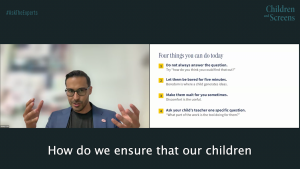
Four Simple Ways to Support Kids' Thinking Skills in the Age of AI
From the #AskTheExperts webinar “Raising Independent Thinkers in the Age of AI”
The False Promise of Tech and AI in Schools | Jared Cooney Horvath, PhD, MEd
How are Children Impacted by Deepfakes?
How are deepfakes created? How might kids be affected by deep fakes? What can parents and caregivers do?