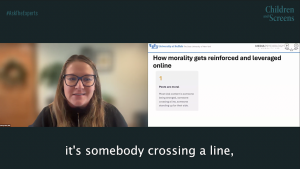
Lindsay Hahn, PhD (Associate Professor, University at Buffalo), explains how viral digital content can reinforce “us versus them” thinking and shape how young people understand right and wrong at the #AskTheExperts webinar “Learned Behavior: How Youth Digital Life Shapes Moral Development,” on September 16, 2026.
Read the Video Transcript
[Dr. Lindsay Hahn]: When we’re thinking about how the online environment works for morality, typically the ways that we’re looking at this is that most viral content is moral in some way – might be immoral – but it’s somebody being wronged, it’s somebody crossing a line, and therefore it almost feels like paying attention to it is a righteous things for me to do. And then, of course, we know reactions reinforce this, and they are teaching kids kind of which of these moral framings win, right? And who is right and who is wrong. And then, of course, the algorithms are sort of helping to amplify those same things that we have already reacted to. And so I would just say here moral outrage and kind of that my-side-versus-their-side framing are really engaging. So, of course, they do get boosted. But the work in moral psychology generally suggests that over time, if we repeatedly have these steady diets of us-versus-them, that can nudge kids – and not just kids, actually, adults too, perhaps unsurprisingly – toward this kind of rigid, tribal thinking where my group is right and your group, therefore, must be wrong. And so the point here is really just that the moral wiring which makes stories really powerful is the same wiring that kind of makes this online outrage really sticky in our minds. So it’s something to be aware of.
View the Full Webinar
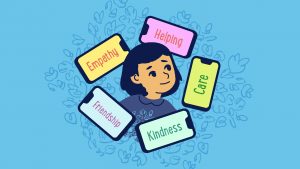
Learned Behavior: How Youth Digital Life Shapes Moral Development
What do parents need to know about how experiences with digital media shape youth moral and social development, as well as how they apply their morals online and offline?
Marina Krcmar, PhD
Professor
Department of Communication, Wake Forest University
Lindsay Hahn, PhD
Associate Professor
University at Buffalo
Eva Telzer, PhD
Professor
Department of Psychology and Neuroscience, UNC Chapel Hill
Rosemarie T. Truglio, PhD
SVP, Global Education
Sesame Workshop
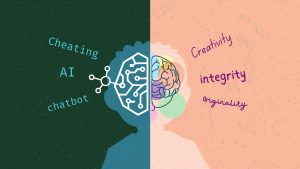
Raising Independent Thinkers in the Age of AI
Is AI use impacting the development of resilience, critical thinking, creativity, academic integrity, and intellectual curiosity in today’s youth? What happens to forming one’s own identity as a thinker when easy answers are just a few keyboard taps away?

Harmful Social Media Algorithms and Children | Imran Ahmed

Growing Up Online: Understanding Youth Internet Trends, Subcultures, and Relationships
Where and how are children and teens spending their time online, and what is the nature of the cultures and relationships they are forming there? How are these affecting their offline development and sense of self?

Social Media and Youth Mental Health
A two-page research snapshot on how social media use affects children’s and adolescents' mental health