Learning to self-manage emotions, attention, and behaviors is a critical developmental milestone of childhood. But as children are increasingly exposed to screens at young ages, parents and healthcare providers are left with a pressing question: How is early digital media use shaping children’s ability to self-regulate?
Children and Screens held the first of its two-part #AskTheExperts webinar series on digital media and youth self-regulation, “Meltdowns to Mindfulness – Self-Regulation in a Digital World,” on Wednesday, April 22, 2026. The series kicked off with Part 1, focused on early childhood (ages 0-9). A panel of child development experts, researchers, and clinicians explored:
-
- How self-regulation skills develop across early childhood, and what parents can do to promote them.
- The risks of using screens to pacify a young child, and how to foster healthy emotion regulation skills.
- How screen use impacts children’s school readiness and their ability to manage tasks and focus.
- How to avoid and reduce screen-related behavioral dysregulation.




Resources Mentioned During the Webinar
- Relations between Preschool Attention Span-Persistence and Age 25 Educational Outcomes (Scholarly Article)
- Vroom! (Tool/App)
- Mind in the Making (Website)
- Stop, Think, Act! Promoting Self-Regulation in the Early Childhood Classroom (Book)
- Harvard Center for the Developing Child Executive Function Activities Guide (Toolkit/Parent Guide)
- Waiting Is Not Easy (Book)
- Practice Guide: Preparing Young Children for School (Toolkit/Parent Guide)
- Screen Time and Executive Function in Toddlerhood: A Longitudinal Study (Scholarly Article)
- Screen media exposure and young children's vocabulary learning and development: A meta-analysis (Scholarly Article)
- Associations Between Screen Use and Child Language Skills: A Systematic Review and Meta-analysis (Scholarly Article)
- Effects of Media Use on School Readiness (Scholarly Article)
- The Sisyphean Cycle of Technology Panics (Scholarly Article)
- Assessment of Screen Exposure in Young Children, 1997 to 2014 (Scholarly Article)
- The 5Cs of Media Use: User Guides for Clinicians and Parents (Toolkit/Parent Guide)
- Child and Family Blog (Website)
- The Baby Blog (Website)
00:00:00 – Introductions by Executive Director of Children and Screens Kris Perry.
00:01:29 – Moderator Megan McClelland on the development of self regulation during early childhood.
00:13:55 – Peter Reschke on fostering emotion regulation skills in young children and the role of digital media.
00:26:34 – Moderator follow-up: What are some strategies parents can use to regulate their own device use?
00:29:34 – Andy Ribner on the impact of screens on executive functioning, cognition, and school readiness.
00:41:29 – Moderator follow-up: How do different types of screen media and content affect self-regulation?
00:45:07 – Gabrielle Izralson on screen-related dysregulation and strategies for parents.
01:03:24 – The panel addresses questions from the audience.
01:03:44 – Q&A: Is it a bad thing to give phones to toddlers at a restaurant or at a doctor’s office?
01:04:51 – Q&A: Does the risk of giving a baby or a toddler a device to calm them down outweigh the benefit of parents’ peace of mind?
01:06:08 – Q&A: For parents who have been using digital media as a regulating strategy already, how should they stop this?
01:08:51 – Q&A: What does counterfactual mean?
01:12:17 – Q&A: How do we navigate screen time with children who are diagnosed with ADHD or autism?
01:16:20 – Q&A: Is it best to allow controlled screen time so that a child can become used to ending screen time, thereby developing a form of self-regulation?
01:17:42 – Q&A: Does having a reward system that gives tablet time for tasks negatively impacts self regulation?
01:18:44 – Q&A: What should parents do if there is too much screen time at school? How is this impacting their child’s self-regulation?
01:22:10 – Q&A: The panel shares final thoughts.
01:23:44 – Wrap-up with Children and Screens’ Executive Director Kris Perry.
[Kris Perry]: Hello everyone, and welcome to Children and Screens’ #AskTheExperts webinar series. Today’s session is part one of our series, “From Meltdown to Mindfulness – Self-Regulation in a Digital World,” and focuses on early childhood self-regulation. Self-regulation, learning to manage emotions, attention, and behavior, is a critical part of development. At the same time, screens are becoming part of children’s lives, and increasingly younger ages, raising an important question: How is digital media shaping children’s ability to self-regulate? Our panel of experts will share what the research shows and offer practical strategies for parents and professionals – from understanding early development, to managing screen use and transitions. I’m delighted to introduce you to our moderator, Megan McClelland. Dr. Megan McClelland is the Katherine E. Smith Professor of Healthy Children and Families at Oregon State University, and Endowed Director of the Hallie E. Ford Center for Healthy Children and Families. Her research explores the relationship between young children’s self-regulation, executive function, and educational success. Her recent work includes a focus on long-term outcomes, advances in measuring self-regulation, and efforts to improve these skills. Welcome, Megan.
[Dr. Megan McClelland]: Hi. Thanks for joining us today. It’s really exciting to be here. I’m going to talk, just to level set us in the beginning, and I’m really excited to moderate this fantastic group of experts on this really interesting topic that we’re all pretty passionate about. So thanks a lot for joining us. So when we first talk about self-regulation, one of the things we’re talking about is a collection of skills. They include things like your cognitive processes involved in executive function, that means how well you can have some self-control or inhibitory control, how well you can focus, pay attention in terms of and switch back and forth, stop something and do something else instead when you need to refocus. And then how well you can remember instructions and that’s your working memory. And I’ll give a few more examples in just a second. So these are these cognitive processes that develop in the front part of your brain in the prefrontal cortex, especially in young kids. And actually throughout our life, but especially there are critical sensitive periods in early childhood and through adolescence. The other part of self-regulation has a lot to do with emotions and how well we can recognize and manage emotions. For young kids, this is really a development, developmental process. And honestly, as adults, some of us are still working on these things. So it’s a lifelong process of managing, and recognizing our emotions. And then when you think about what self-regulation is, it’s sort of putting this all together. It’s integrating your, these cognitive abilities to focus and pay attention and then also manage your thoughts, feelings, emotions and actions into behavior. So, in a nutshell, what we talk about sometimes is your ability to stop and think first, and then act. For young kids, this can be really challenging and rightly so, it takes a while. So we don’t expect three year olds to be able to do this okay. But by the time we’re getting into more structured school settings, or as you get a little bit older, we do have these expectations for how we help kids manage these thoughts, emotions, and actions. So here are a few examples of what I’m talking about when we say, “what is self-regulation in a young child?” – which is the focus of our webinar today. This is the ability to listen – can a child listen and follow directions when they need to? Are they able to ignore distractions? Can they focus and stay on task? Raising your hand instead of blurting out an answer if you’re in a classroom setting? – it’s very challenging for little kids. How well we learn to negotiate and work with social situations, within social situations. Working well with other kids and other people. Can you remember and follow through with instructions? – that’s that working memory. And then we have those emotional parts that one of our panelists is going to get a lot more into which is just managing emotions when needed. Have you, can you show empathy and kindness towards others? So again, this is a real developmental process, it does not just, children are not born with these skills. Some children have and are a little bit less reactive than other children, so they might have an easier time developing them than others. But I want to focus a little bit more on why these skills are important and why we care so much. I don’t think if you’re on this webinar, I have to do too much of a sales job because it turns out these kinds of self-control and self-regulation skills are pretty important for young kids. And it turns out that they are, they predict a number of things in our lives. So that’s why I think there’s been a lot of attention paid to them in the last 20 to 25 years. So it’s, these skills have emerged as a predictor for short- and long-term outcomes. So obviously if you have some self-control and self-regulation, you have better, you know, social competence and social skills with other children. We have also focused a lot on how well these skills and these are foundational for taking in academic and in school content. So we looked, and lots of people look, at short- and long-term academic success. And as one quick example, we found a while ago now that in one study, children whose parents said that they could focus, they could pay attention and persist on difficult, challenging tasks when they were just four years old, had nearly 50% greater odds of finishing university or college by the time they were 25, which is pretty stunning to us at the time. And still, because we had taken to into account their reading and math skills throughout childhood and adolescence, and the single most predictor of, strongest predictor of finishing university by the time they were 25 was their age four attention and persistence skills, which I think speaks to the importance of why we’re all here today. And we also know these skills are, can be important for long term physical and mental health, occupation, educational outcomes, wages, and employment. I want to say it’s not everything. There’s lots of other pieces. It’s one thing, but it might be one factor, one thing that we might be able to do something about. So when I think quickly about how to present this, how understanding how self-regulation develops in young children and what we can expect of young children at what ages, I think it can be very helpful to parents, to caregivers, to adults who work with young kids. And in general in a very simplistic nutshell, the way that self-regulation develops in children, is it moves from being externally regulated in a child, to what we hope is to be, to have this internal model of regulation that we can draw from and calm ourselves down. And so, one quick example I often give when I teach child development to many undergraduate students is, that when my son was young, he would go up to the stove and I would as parents, we always say, “no, no, don’t touch that, that’s hot,” and, you know, eventually, you know, over time, he one time went up to it and kind of put his hand up and then he said himself, “no hot.” And I thought, “oh my gosh, this is, this worked like, something’s, something’s working here.” And in it, it was crazy because it actually showed that he was taking in, thankfully, you know, the things that we repeat over and over and over as parents and it was getting internalized, it’s a simplistic example, but, when I often remember. So it, in it moves really from having been externally regulated by important people in our lives that are telling us what to do or what not to do. And then the idea is that you have this internal ability to regulate, as adults and children. How does this happen? Well, you have to have positive role models in your life that are also acting in ways that are regulated. So, you know, if you, if you lose it, when your flight is canceled and you’re in the airport with two young kids and, then and that’s the way you manage emotions, then it’s, you know, this is what we’re but, you know, it’s hard in those situations, but it’s also, you know, how we are helping teach our kids to what to do is something I’m always thinking about. Learning and practicing skills in school and at home. And this is actually going to come up a lot in this webinar because we have less opportunities for that. And then being able to receive supportive feedback from these important people in our lives and adults, all those things help children integrate and internalize this feedback. And the more we can do it in positive ways with having a secure, positive relationship, it helps quite a bit. And just to quickly say this, the way that when we see young kids, the factors that really help children develop this in the home, in the family, is developing a really warm and secure relationship with kids because then they feel safe and secure, they feel like they can develop their own independence and autonomy, they’re more likely to comply with instructions if they have a safe and secure place, relationship. And then also having stimulating environments. Obviously, this looks like things like reading to your kids, talking, having lots of opportunities for learning in different ways. In classroom settings there, or other learning contexts, we talk about the ability to develop autonomy and independence. Scaffolding kids, you know, to you helping them a little bit and then they continue to problem solve can be challenging for us these days. As parents, I think we want to show kids how to do something, and being able to let them problem solve is important. And then we’ll get more to this in our webinar today, but playful learning that supports these foundational skills is incredibly important. And then being able to do things that support those social skills and self-regulation. This is really important because if we can do these things, or provide opportunities for children, what that means is that, this can be, these skills can be an incredibly protective factor or a buffer for children who are growing up with lots of chaos or risk in their life. That, so this can be quite protective for them. I’m just going to mention a few challenges, and then I want to make sure we have lots of time for our incredible panelists. Some things that I think might resonate with you, why you might be here today, challenges that parents, and adults, and caregivers are facing. We know that screen use is becoming, you know, more and more common, it’s increasing a lot in children, in school and at home. We also know that along with that, and not always, but we’ve also seen increases in children’s behavior issues in the past few years. We also have seen some interesting results showing that attention, children’s ability to focus and pay attention, has decreased especially with the onset of social media. We’ve seen some interesting research come out about that. And then you pair that all with less opportunities for play and free time, and you can see sort of some of this perfect storm that contributes to, I think why lots of us are concerned, or just if we are going to use digital media, how do we do that in ways that are beneficial for kids? And then finally, children have, may have less opportunities to practice these skills, which is kind of what I’ve already said. And games especially that help them stop and think and then do something are quite useful to practice these skills. So I’m happy to talk about that later if needed. But in general, what I just want to end with is that, you know, this is an important piece of a larger puzzle, that these skills can be quite, you know, important for kids to develop – we know that they predict positive outcomes like behavior in school success. We know that they can be quite protective for kids who are experiencing lots of other chaos in their life. And we also know there’s a lot we could do about them. And so I’m really excited to have, to turn this over and talk more about some of the other aspects, and learn about how these skills can be supported and improved through practice, and how that intersects with digital media in these children’s worlds. So with that, so my, all my amazing collaborators. Okay. Now, I think I’m going to move on. I’m going to introduce Dr. Peter Reschke. He’s an Associate Professor of Human Development at Brigham Young University and Director of the Center for Emotion and Cognition. His research examines how emotional understanding, empathy, and prosocial behavior develop from infancy through early childhood. He studies how parent-child interactions and digital media environments shape children’s emotion knowledge, regulation, and social development. His work has explored the effects of technoference, media-based emotion regulation, and social context on children’s emotional and behavioral outcomes. His research aims to inform evidence-based guidance for supporting children’s healthy development in an increasingly digital world. Peter, welcome.
[Dr. Peter Reschke]: Thank you for having me today. So today I want to talk a little bit more about how we see this component of self-regulation, namely emotion regulation, in a digital world that we live in. So let’s talk a little bit more about emotion regulation. As a quick reminder, self-regulation and emotion regulation is how we deal with strong emotions, and it’s a really important skill for children to develop. We just talked about all the long-term outcomes of having healthy self-regulation and emotion regulation. The key thing to understand here is that we don’t come into this world knowing exactly how to regulate our emotions. Emotion regulation is something we have to learn early in development, and we learn that through experience with emotions. And a lot of this in early childhood and infancy happens through interactions with parents and caregivers. So because emotion regulation develops gradually across early childhood, it’s something to keep in mind that it’s, we don’t learn this just from being instructed what to do like in a lecture or a classroom setting, we actually learn by going through emotional experiences and figuring out either on our own or with parental guidance, what helps calms us down and respond to emotions in healthy ways. So emotions are not just challenging things to have, they’re actually opportunities to learn. So how do children learn effective ways to calm down from strong emotional experiences? Like I mentioned, this isn’t something that children learn primarily from one-time lessons, they learn it through their own experience. Children have to learn how to deal with the emotions they feel on a day-to-day basis, whether that’s being told no at the store. or dealing with conflict from a sibling or friend, or peer. These experiences bring up emotions like frustration, disappointment, or feeling overwhelmed. And these are the moments where the learning actually happens. But that learning doesn’t happen on its own. Some of the earliest lessons come through interaction with caregivers, who help guide in those moments and can help children calm down and understand what they’re feeling and why. And over time, across development, through these repeated experiences, children can learn to build emotional regulation skills for themselves and be able to regulate on their own. So these emotional experience, moments really are the classroom where children learn how to regulate their emotions. So what does emotion regulation look like in real life, and how can parents help? So here we see a child who is clearly upset. At first, we can recognize the emotion and we can see that she’s sad. But when we zoom out on this picture, we can understand why she’s sad. This little girl dropped her ice cream in the dirt, it’s gone, she really wanted it. And we’re not just seeing the emotion, we’re seeing the cause of the emotion. And that helps us understand a little bit more of the context. But when we zoom out, even further, we see something even more important. Here, the parent. Because at this young age, children don’t yet know, they’re not very good at handling situations like this on their own. They’re feeling really big emotions and feeling overwhelmed, and they don’t know yet just what to do. And this is where the parent comes in. The parent in this moment can help the child calm down, understand what they’re feeling, begin to work through it. And this might involve labeling the emotion, providing comfort, or just staying present with them as the child goes through this emotion. This process where the parent and child are working together to regulate the child’s emotion is what we call in the scientific community, co-regulation. So if this is how children learn to handle emotions early in development, what happens when we throw a digital media device into the picture? And this is what I want to talk about for the rest of my time is a concept called media emotion regulation. And this is an increasingly common strategy that parents use to help a child calm down in moments of distress like when they’re upset, overwhelmed, or having a tantrum. It might look like giving a child who’s upset a phone at the store when they’re crying, or handing them a tablet in the car or bus to settle them down, or using a screen at a restaurant to even prevent a meltdown before it starts. So these are very common situations, and it’s important to acknowledge that this strategy really is effective in the short-term, it works quickly to calm a child down and reduce the stress of the situation. But this is where it’s really important to pause and ask a really important question, “is this something we really want to rely on as our default response in these moments with children, or are there important developmental considerations to think about?” So why do screens calm children so quickly? What’s happening is that the screens are very powerful at capturing attention. We just talked about how self-regulation involves the ability to maintain attention. When a child is upset, their attention is focused on whether, whatever caused their emotion. And when we introduce a screen, it immediately pulls their attention away from that emotion and onto something else. So instead of the child processing that feeling, they’re now focused on something totally attention grabbing, something else, the video or game or whatever is on the screen. And because that shift happens so quickly, the intensity of the distress can drop almost immediately. And that’s why it feels so effective in the moment, it brings quick relief not just for the child, but often for the parent as well, who might be stressing in a public setting. So giving a child a phone seems to work in the short-term, but it’s by redirecting attention away from the emotion, and it’s also replacing potentially a really important part of how children learn to develop emotion regulation. And that’s that parent-child interaction in that moment. Sometimes parents give child a screen when they’re upset, and that kind of replaces all the good stuff that happens when the parent is there interacting with a child. So what happens if this becomes the default strategy for parents over time? So what’s the trade off when we use a device to calm a child down? In the short-term, as we talked about, this works really well, the child can calm down quickly, it can bring almost immediate relief to the parent because the situation is faster. But long-term, our research is showing that when we zoom out and think about the developmental ramifications of this, that’s where we need to pause and consider what might be happening developmentally. When a parent consistently, as a default uses a device to calm their child down, they’re reducing the amount of practice the child gets in, actually handling their emotions and regulating their emotions. So instead of working through the feeling the child is being redirected away from it. And over time, that can mean fewer opportunities to develop coping skills and less experience regulating emotions on their own or with help from a parent. So if you think about it, there won’t always be someone there with the child who can give them a device to take the emotion away. So the ability to regulate emotions really depends on having repeated interactions with their parent in those early years to practice getting good at regulating those emotions. So when we remove those opportunities by giving them a device, even if we have a good intention, and if this is a pattern in our parenting behavior, we may be limiting children’s development of emotion regulation over time. So the key question for caregivers is this, in these moments where a child is having a meltdown, and they’re upset, what is the strategy going to do for them? If we give them a phone, or whatever we decide to do, is what we hope to do helping them engage with their emotions and learn how to work through them, or is it helping them avoid figuring out that process? And it’s over time where the difference in this matters. Do we want our children to get more practice working through emotions, which takes work and takes repetition and consistency, or do we want to have the default be stepping away from this opportunity? And that’s really the core of it. It’s, and it’s important to say it’s not the screen itself that’s bad, It’s what it’s displacing in that moment in those parent-child interactions. So at this point, a lot of parents are probably wondering, “what should we do instead?” What we see is that one of the most helpful things in these situations is to stay with the child. Whatever you decide to do, don’t let the strategy displace the parent-child interaction. Because when, oftentimes when we hand over a device, we’re not just distracting the child and calming them down. The parent is stepping out of the interaction and they don’t get that help in learning how to cope with emotions. This might involve getting down on the child’s level, using a calm tone of voice, and just being physically and emotionally present and helping the child ride through that emotion, maybe labeling “I can see you’re really upset,” or “that was really frustrating.” And this might not fix the situation right away, but that is not necessarily the goal. We don’t want the emotion to disappear as quickly as possible, it’s to help the child move through it. So sometimes that means just sitting with them, staying present and patient, and letting the emotion run its course. So your presence in that moment is what helps the child feel safe, and begin to calm down. But that’s only the first step. Once the child has calmed down, the next step is what we might call the teaching phase. This is where we can help the child, depending on their age, make sense of what they just experienced. For older toddlers, this might look like putting words to the emotion. You could say “you felt frustrated because you dropped your ice cream,” or “that was really disappointing.” And you can help them connect what they’re feeling to what caused it. And with even younger children who might not fully understand the words yet, they’re still learning from your tone, your response, and how you handle the situation. And as children get older, you can involve them more by asking simple questions like “what can we do next time this happens?” And you’re not expecting a perfect answer, you’re helping them practice thinking through it. And like Megan mentioned earlier, you can also model responses when you feel emotions like taking a breath or choosing something else to do, and you can help your child see here’s a healthy way to deal with emotions. And over time, these repeated experiences are what helps children build their own emotion regulation skills. And that’s how we go from a child needing a parent and co-regulating their emotions, to being able to self-regulate more on their own over time. So this is not about perfection, this, what I’ve been describing sounds like a perfect scenario where we can say the right thing, everything works out perfectly. But that’s not how it works out oftentimes in real life. Parenting is a challenge, and sometimes it’s unpredictable. And most of us are trying to do the best we can. So it’s important to recognize that screens are not inherently bad, it’s really what they might displace or replace when we use them consistently to regulate a child’s emotions. So what’s one small change we can actually start with? I think one small change you can try today, everyday, is to pick a moment where a child is feeling upset and trying to deal with emotions. And in that moment, if you feel like your default is to give a child a phone, put the phone away, stay present and write out the emotion with them and be there to comfort them and provide a safe place for them to work through those emotions. And it’s not going to be perfect, and that’s okay. But it’s that consistency of being present and helping them learn and recognize and label their experiences and learn from you. And it’s these small moments where we build the emotional skills that children will use for the rest of their lives. So just to close and make sure to remember that these emotional skills of children are built in small moments everyday, not necessarily through big lectures or through perfect parenting, but these everyday interactions where children just experience their emotions and they learn with guidance and support from their parent in that dyadic interaction, how to go through that and that’s where their learning really happens. All right, thank you. I can take questions if we have time.
[Dr. Megan McClelland]: Yes, thank you. That was fantastic. Thank you. Thanks, Peter. I have one question for you. I thought you could answer it quickly before we move on to Dr. Ribner, which is: so how does the phone use of parents who have young children impact their child’s self-regulation? So what are some strategies that parents can use to adopt non-screen regulation strategies as a better model? Because we all do this, we’re on our screens a lot.
[Dr. Peter Reschke]: Yeah, so what are some strategies we can use instead of a device? So I think, I think the first thing is to really self-evaluate is this something that is very common? Because if a phone, if a parent gives a phone to a child once in a while, that’s probably okay. But if it’s more like the default. But what can happen instead? And like I said earlier, I think one of the important things is just to, that parent-child interaction. Even if it’s pausing with a screen and watching a show with your child but talking about those emotions, that’s the important part. It’s not necessarily what the screen does poorly, it’s what’s not happening oftentimes when we give a screen to a child, it’s that they’re not getting any parent guidance on how to deal with emotions at all. And so, it’s really about that parent-child interaction and that could even include a screen. But if it’s without a screen, it could just be getting down on the floor, reading a book with them. It could be, asking how, questions, depending on the development, how old they are, “why do you think that happened?” “Let’s talk about it.” And just really getting the child to think through what’s happened and what caused it and what they could do differently. And I think the main point is, what is the parent-child interaction happening, going on there. And that’s the main thing to focus on.
[Dr. Megan McClelland]: Super, thank you. That’s wonderful. Super helpful. We have more questions that we’re going to get to. So I’m going to ask one question after each presentation and then we have lots of amazing questions that have been submitted that what we’re going to try and get to. But without further ado, I want to now talk – introduce Dr. Andy Ribner for our next presentation. Dr. Ribner is an Assistant Professor of Psychology at Chatham University and a Research Associate with the Kids Thinking Lab in the Learning, Research, and Development Center at the University of Pittsburgh. Lots of friends there, I have lots of friends there. He earned his PhD in Developmental Psych from New York University in 2019. His work aims to set up children for success as they enter school and improve educational outcomes for all children. He studies the development of self-regulatory skills in children and their role in mass learning in and out of classroom settings, as well as the antecedents and consequences of screen-based media use. So, without further ado, Dr. Ribner. Welcome.
[Dr. Andy Ribner]: Thank you so much for the kind introduction. Megan. It’s wonderful to be here. I feel like my talk really nicely compliments a lot of what Peter was saying in the last talk. So I’ll be talking about the idea of the counterfactual. And so what I would like everyone to do first is imagine, say being a child of the 90s, say you were born in 1991, as I was. What would your day have looked like when you were, say 6 in 1997? What was your relationship with technology? And now imagine today, does it look the same? How does it look different? And it turns out that we have some data to be able to explore this to some degree. We have the average amount of screen use that children were using in 1997 and then again in 2011 and throughout time. And maybe it’s a little surprising, or maybe it’s not, that actually the average screen use hasn’t really changed over the last almost three decades. We’re seeing that children are using, on average, about the same amount of time on screens. And yet we’re seeing increasing numbers of opinion pieces, articles, and webinars like this one talking about the problems with screens as though something has changed, and maybe it has. And so I think it’s important to ask, how does media use affect young children, and how has this changed over time? Because we know that while, there’s been relative stability in the average amount of screen use over time, there’s substantial within-person or between-person variability and screen use, where some kids are viewing between no screens and about an hour of screens, whereas others are viewing, say between 5 and 10 hours or more of screens per day. And so the question really becomes not how has the change in average screen use affected children over time? But what does this variability mean? And we’ve been able to study this to some degree, particularly with its relation to self-regulation. And what we see is that as children on average use more screen time, their performance on executive function or self-regulation tasks tends to go down. But interestingly, this seems to be a little bit driven by age. So we’ve seen over time that it actually is more about the effect of earlier screen time, say screen time at age two relating to later self-regulation at say, age three, then actually it is the concurrent screen use as children are age three. And we can see these effects even a little bit earlier. And you might ask, “well, how do we even test executive function or self-regulation in this age?” And so we might use something like this kind of example. So this was an inhibition task, a prohibition task, where we asked the child to not do something, grab a really attractive and exciting toy. And we see that, on average, children who have regular screen use when they’re four months old, their parents report the use of screens in any regularity, they, on average, wait about 4.5 seconds less before waiting to grab that thing, suggesting that there might be some relation to their ability to, say, delay gratification. But again, this is really early. So it’s important to consider the child age where we see that screens seem to be especially powerful early. And that was really looking at overall screens – do children use screens or not? – but doesn’t answer the question of what kinds of media drive these associations? Because we’ve also seen, along with the kind of media focus on negative effects of screen use, a lot of positive effects of screen use, particularly, screen or prerecorded programming that is recorded for the purposes of education, either for say, literacy, language and literacy skills, like Sesame Street, or social and emotional development, like Daniel Tiger’s Neighborhood, shout out to Fred Rogers Productions here in Pittsburgh. And so we do see some positive associations. And when we look across a lot of different studies, we can see that there is substantial variability in the amount of, of the association between language and literacy skills and screen use for children in the early childhood space. But when we focus on educational media specifically, we actually see something close to zero, but trending toward a slight positive effect of the increased screen use on children’s school readiness, and particularly language and literacy skills, which tells us that it’s important to consider the content, right? What is the child watching? And then the question becomes, how is the child watching? Or under what conditions do we see associations? And so to unpack some of this, I worked with some colleagues to look at the associations between different components of media, some prerecorded media and some more traditional media, things like educational, entertainment, and background media, and then reading as a non-screen based media, and how these relate to self-regulation, and how self-regulation in turn relates to language and literacy skills in the early childhood period. We also looked at the residual effects over and above the effects on self-regulation. And we see a lot of patterns. And if this is a little overwhelming, or if you’re colorblind like I am, and can’t actually tell the difference between the red and the green here, I’m going to break it down a little bit. So we saw these associations with entertainment and background media negatively relating to self-regulation. And when I talk about entertainment media, I’m talking about things that are made not for the purposes of education. This includes things that are not necessarily age appropriate. Say you’re watching law and order with your child, watching the evening news, it also includes things like children’s cartoon shows like, say SpongeBob SquarePants, or Power Rangers, and then background TV where we see the primary goal of the TV being on is to set the, to just be on in the background. It’s not the primary activity that the child is doing – say the child is reading a book, building blocks, building Legos, drawing, coloring. And this is where we see some pretty consistent associations where having background television on negatively relates to self-regulation. And then, thankfully and somewhat unsurprisingly, positive associations between reading and self-regulation. We see that there is indirect effects, where we see that through self-regulation, especially background TV, but also entertainment TV, is affecting these school readiness skills. And then we see some residual associations that background TV again seems to be negatively affecting these language and literacy skills which reminds us that it’s important to be intentional, to make screens a main activity when we’re using screens. And with all of this, as with all good science, there’s some caveats to think about. Technology moves fast, right? If we look over the last, say 50 years, 100 years, we’ve seen a march toward more technology that has increased substantially over time, which means that technology use and its effects may look different even within generations, right? Across a four year period from 2013 to 2017, we saw an increase in the extent to which families had smartphones at home, and that also corresponded to a nearly triple, or a more than tripling in the amount of time that children spent using mobile media, or media on something like a tablet or smartphone device. And then, it’s also clearly possible that media might look different now with the change in available technologies. And we can see, for example, that young children, even infants, can learn from video chat. This is my son Beckett, and my dad, Louis, who is actually here right now, hi, dad. Where even though they live about 800 miles away from one another, they’re able to engage in interactive interactions, interactive play across several states. They can talk regardless of where they are, they talk several times a week, and they really get to know each other. And it’s important also to think about, kind of, what are the average effects, right? We look at single studies and we say there’s positive effects, there’s negative effects, but we can look at the average across lots of effects using meta-analyses. There have been a lot of studies on this and we can look at, say are their average effects? And it looks like on average, the association between screen characteristics, different screen characteristics, and young children’s executive function, children birth to nine are largely null. We see no effect, positive or negative, of child-directed content, no effect of age inappropriate content, no effect of the use of gaming or apps. We see a positive effect of screen co-use, using a screen with a child, but no effect of unsupervised use. We again see this consistent negative association of background TVs, and we see, kind of the idea of maybe passive viewing not being as good. But if we can trust this to other things that we know have effects on executive function and self-regulation, say things like parenting, positive parenting, cognitively stimulating parenting, things like offering support, involvement, communication sensitivity, warmth, scaffolding assistance, attention maintenance, and redirection. A lot of the things that Peter was talking about in the last talk. Those things are very consistently and even more strongly positively related to executive function than are these kind of middling effects from the use of screens with young children. And we see a negative effect of negative parenting, things like negative regard, intrusiveness, controlling behavior, negative affect. And if you think back to times and maybe it’s been important for you to use a screen, or for your child to use a screen, so that you can maybe say, “take a break, make dinner, have a breath, be able to regulate yourself.” It looks like there’s more positive effects of you being able to better regulate and better provide positive parenting than there seems to be effects of having a child view screens. So it’s important to consider the counterfactual, or what’s not happening because we’re avoiding screens. And I just want to close on the idea that we’ve seen this all before. In, Amy Orben wrote about, in ancient Greece, philosophers opined about the damage writing might do to society and noted youth’s lack of respect. Novels became increasingly popular in the 18th century, and soon there were concerns about reading addiction and reading mania being associated with excessive risk-taking and immoral behavior. And so with that, I’d like to close on the reminder to be mindful of the content and context, be intentional and consider the counterfactual. Thank you so much, and I look forward to discussion.
[Megan McClelland]: That was fantastic. Thanks, Andy. I have one quick question. And this relates to – we’re getting lots of great, amazing questions too, in the chat – but this relates to different kinds of screen media. So how do these different types of screen media, TV, iPads–or even I would add in content–affect self-regulation? Do they affect them in the same way? Is there a best kind of screen time? And then also someone asked about the content. So we know in the research world that slow paced content is a lot better than really rapid paced, “SpongeBob SquarePants,” for example. So, “Daniel Tiger’s Neighborhood”. “Daniel Tiger’s Neighborhood” is higher quality in terms of, you know, the pacing and the…so I’m curious to hear more from you about that, if you could.
[Andy Ribner]: Yeah, a great question, and one that I look forward to continuing the study into the future. But yeah, as far as thinking about what is the most appropriate or most supportive shows for children, I think you really hit it. It’s things that are, to some degree, relatively slow paced. That doesn’t necessarily mean that it is, you know, a picture, or a slow moving video of a sprawling landscape. It can be something that actually captures kids’ attention. And things that are less fantastical. There’s been some really interesting work on the EF effects, or immediate EF effects on things happening that are unexpected and that break our understanding of the world around us. Right. A lot of infant research is really focused on understanding what are children’s concepts, what do they already know? And when we tax those things by showing them things that aren’t real–by showing them things that seem to kind of break the laws of physics, things floating up, appearing out of nowhere, changing colors–that’s drawing our attention and kind of splitting our attention in really, unexpected ways. It does look like there’s been recent research showing that children recover from seeing these things after a little bit of a break, but there might be a time when parents need to offer additional supports, additional scaffolds, or additional self-regulation, or other regulation, external regulation, immediately after viewing particularly highly stimulating shows.
[Megan McClelland]: That’s really… and I think there was a question I remember about like when you’re if a child is watching a really exciting show, but it’s like, avatars or something, that can be really intense, for very young kids. And it’s going to get them activated. And so… and different temperamental styles of different kids may respond differently, but I think that’s a really, really important point. All right. Let’s move on. I am really honored to introduce now our next speaker, who is actor Gabrielle Izralson. She’s a licensed clinical psychologist and board certified behavior analyst based in Los Angeles, California. She earned her bachelor’s degree in Psychology from University of Southern California and her doctorate in Clinical Psychology from the California School of Professional Psychology at Alliant…Alliant… Sorry, Alliant International University. She completed her BCBA training through the Florida Institute of Technology and for the past 15 years, or past 15 years…she served as the Clinical Director at Beautiful Mind Center for Autism. Today in her private practice, she integrates her clinical experience with personalized and empathetic approaches to support children and families in achieving growth, resilience, and well-being.
[Gabrielle Izralson]: Welcome. Hi. Thank you. Quite an introduction. Thank you so much for joining us. And thank you for all of the experts and panelists. I think you’ve really touched upon what self-regulation is and how important co-regulation is. I’m going to be talking about screens and behavior and some practical strategies that parents can use in the home setting and how to structure their home in order to make screen use not the enemy, and how to make it rewarding, but also manageable. And how to also set up your home environment where it’s not the sole focus of receiving joy and fun activities. There’s other ways to also create these reinforcing experiences that are going to help with regulation, they’re going to help with forming more secure attachments with your child, and just create a more peaceful environment in the home. So what is self-regulation? It’s managing emotions, managing your attention and behavior. It’s typically during childhood developed through co-regulation, and eventually, we would like for our kids to be able to demonstrate some self-regulation when it comes to situations where they are going to be frustrated, where they’re not going to get what they want, where they need to delay gratification. So like, the only way that they’re going to be able to do that is by learning through parents, through role models, through teachers and getting it in that format. So, self-regulation also includes impulse control and flexi-sorry, flexibility. Why is this important? So self-regulation is foundational, and early childhood digital media directly impacts emotional behavioral control, and parents often see real time behavioral challenges that are being linked to screens. And so what do screens do to the developing brain? Well, I think it’s really important that in order for us to understand that, we need to talk about what these screens are doing to our dopamine levels when we’re being exposed to them or when our children are being exposed to them. So dopamine is a neurotransmitter, which is a chemical messenger in the brain, and it has to do with reward pathways. It has to do with motivation and has to do with, you know, what else? Mood regulation, and learning and memory. So high stimulation, which is what the screens are doing when we’re watching them, it leads to dopamine spikes. So any content that’s super fast paced, algorithmic, the shorts and the reels that they watch and they can keep scrolling, it tends to overstimulate these pathways and then it makes everyday activities feel really boring. So if you’ve ever been with your child and they’re like, “I’m bored, I’m bored, this is boring. I don’t like this.” After watching a screen for, you know, maybe 30, 40 minutes to an hour, it’s linked to those dopamine levels going high up and then spiking down. And then what is this lead to? So it leads to lower frustration tolerance. It’s much harder to transition away from screens because they have that addictive quality. It also impacts mood, sleep, and behavior. For example, sleep disruption. So blue light emitted from screens suppresses melatonin. Even 30 minutes of screens before bed can delay sleep onset. So as a takeaway, maybe don’t give screens right before bedtime because you’re not going to want that to interfere with their ability to sleep. It also impacts attention and self-regulation. So excessive screens in the early years correlate with increased impulsivity and shorter attention spans. Recognizing screen related dysregulation. So during screen use, we want to really look out for signs. Signs that if our child has a glazed look, are they irritable when they’re interrupted? Are they ignoring hunger cues or toileting cues because they’re just so locked in? Also, at the transition, when the screens turn off, is your child having explosive tantrums or are they negotiating for more time? Is there prolonged crying agitation, physical aggression? Is there this inability to shift attention? And then after screen use, it might be really hard for them to engage in play. They might present with hyperactivity or a lot of emotional lability. There might also be increased demands for more screen time. So any of these types of behaviors or signs – they’re related to the dysregulation piece that’s associated with being on a screen. And it’s not just being on a screen. It’s more like, what is the content and what are they being exposed to? So what are some risk factors? So long screen duration. I really don’t recommend letting your child be on the screen for like two hours. Three hours. I think 30 minutes is appropriate. You know, 30, 40–20, 30, 40 minutes. I think it also depends on your child. If you know that your child runs a certain way or how they’re going to respond, that should really also dictate how long your child should be exposed. We talked about this, the fast paced, high content, high reward content. It’s usually those reels. It’s the algorithms. It’s something that doesn’t have like a storyline with the beginning, a middle, and an end. And something that you can also like sit and watch with your child and then talk about what’s going on. Those are better options. Screens used as a primary calming tool. I know that we’ve touched upon this in previous presentations. So we don’t want to replace screens with the ability to actually deal with your negative emotions. And I think that’s what’s really been the challenge with most of the clients that I work with is instead of sitting in the moment and being uncomfortable and learning how to help regulate, that’s being replaced with the screen. So you’re not really giving your child the opportunity to develop these skills that they’re going to really need to have later on in life. And then also inconsistent boundaries. So consistency is key with anything that you’re parenting…parenting with your children. So for example, if you say like “no screens during the week, only on the weekend,” then you really have to follow through with that, because if you don’t, then the child is going to learn, “oh, Mom and Dad, they’re not taking me serious. They’re not serious about this. If I cry, if I’m lying, if I pester them long enough, I can get the screen during the week.” So it’s really important in order to avoid power struggles and to create consistency, boundaries, and also a sense of safety and security where the child is going to know what to expect. That will also help decrease a lot of transitional difficulties, and it will also help decrease a lot of these power struggles that I feel parents, myself included, are presented with. So what can parents do in the moment? So let’s say your child is having a tantrum. You want to take the screen away. They’re having a meltdown. The most important thing is to regulate yourself first, because your nervous system is what’s going to help regulate their nervous system. If you’re dysregulated, that’s what you’re modeling for them, and they’re not going to be able to access some calming strategies. So take a breath. You know it’s okay. Lower your voice, slow your pace. Relax. You want to model this behavior for them. I think another really important factor is validating and connecting with your child before you redirect them. A lot of kids, they just want to feel seen. They want to feel heard. They want to feel respected, just like grownups. So validating that feeling in the moment, like, “I know, I know you love this show. And I know it’s hard to stop watching this. I would have a hard time too, but it’s time to put it away. The timer went off and now we’re going to go do your homework or go play this game. Or set up for dinner.” Whatever. Whatever you have planned next to do. And you also want to give them some space and time to process, because maybe that’s their way of developing some self-regulation. Just because they’re not doing it right away doesn’t mean that they’re not listening. Sometimes they just need some time to actually process and understand and then come to. So another strategy is a body-based reset. A lot of times movement regulates the nervous system faster than words, especially for kids who may be sensory seeking, who may, you know, just have more hyperactivity. So it’s really great to transition into dance or into maybe giving them a deep squeeze or suggesting to go outside and play basketball, or going on a nature walk or going on a scavenger hunt. Getting them outside is also a naturally dopamine booster. It will boost their dopamine naturally. So being outside, doing things with interaction, that will boost dopamine. So like finding other outlets that are also going to be equally rewarding is going to be very important. Using “when then” language. So you can explain to them, “when your body is calm, then we can talk about more screen time tomorrow.” So this will preserve your autonomy without engaging in a power struggle. I always recommend to limit your language when a child is upset, you don’t want to bombard them with a lot of words. You don’t want to bombard them with a lot of directives. You really want to help them just calm down. And then once your child is calm, that’s when you can go into more of like, you know, “I know that you’re upset. And then when your body is calm, we can talk about this or we can talk about what’s going to be tomorrow.” I did mention earlier a little bit about predictable routines and how children who know what comes next or what to expect show less transition anxiety. That’s true with a lot of things. With kids, it’s always great to front load them and let them know what to expect, what the sequence is. Sometimes having a visual schedule that, you know, in a visible place, maybe it’s on the refrigerator, maybe it’s on the countertop. Maybe you just make one with your child really quickly on a piece of paper and talk about, you know, the next five things that are going to happen in the afternoon. It will really help them prepare and understand, like, okay, “so I get this much of screen time, and then after that, the timer will go off and I have to put it away.” This is much less jarring then, “Okay. All done. That’s it. No more.” And they’re like, “wait, what? I was in the middle of the show.” So it’s just really finding a way to connect with them and set up the situation in advance, where it’s going to have a favorable outcome, both for the parent and for the child. And then, repair. Don’t shame. So if you lose your temper, model the repair. You can say, “I got loud. I’m sorry. Let’s try that again.” Because repair is also a regulation skill in and of itself. What are some things you don’t want to do? You do not want to abruptly stop and take the screen away without giving a time warning. This will just make the meltdown worse. You do not want to give in and extend screen time to stop the tantrum. This will teach your child that “I can scream as much as I want, and then mom or dad will give in and I can get, you know, more screen time.” You don’t want to yell, shame, or threaten. This only escalates dysregulation. You do not want to take screens away as a punishment in the heat of the moment. So that’s only going to also create more of a power struggle. And it’s not sending the right message. You do not want to negotiate or explain during the meltdown. That’s what I talked about keeping, you know, keeping language to a minimum and really giving them short directives to just be calm in the moment. And then you can talk more about what happened. And don’t allow them to watch binge style content. So remember, consistency beats perfection. And it’s not really about being perfect. It’s about being mindful yourself, and acknowledging in this moment, like, “what can I do in order to make it a little bit better than it was yesterday?” And I know today as parents, there’s so much pressure out there. We’re just being pulled in so many directions. And I think the most important direction is always connection with your child. At the end of the day, nothing is going to be that one-on-one time that you spend with your kid, whether it’s reading the book, whether it’s watching a show together, whether it’s giving them some snuggles or throwing a ball back and forth, in my opinion, and in my personal life, that’s the biggest dopamine hit you can actually ever get. So don’t forget the importance of how important you are in your child’s life. And now I want to touch a little bit about neurodiversity, because I do work with a lot of kids who have ADHD and autism and, you know, they have a higher level of vulnerability to dysregulation just naturally. So they are also more drawn to screens and more affected by them for different reasons. So when it comes to ADHD, or children with ADHD, the screens provide the dopamine hit that the ADHD brain seeks. Kids with ADHD. They are wired with lower levels of dopamine to begin with, so that’s why they’re always seeking that reward. You know, it’s more like, “how do I get more dopamine? How do I get more?” And they also have more difficulty with planning, organization, impulsivity. And this leads to trouble with motivation for tasks that are not interesting, like homework or chores. So that’s when you’re going to see a lot of I’m bored or a lot of I’m not following through with instructions. And you think that it’s your child being non-compliant or defiant, but what’s really happening is it’s an issue with dysregulation. So you really want to help them develop stronger self-regulation skills through those co-regulation strategies. When it comes to children with autism, screens may be preferred for predictability and control. Sensory overload from certain content types may also affect them negatively once they stop and special interest content can be regulating. So that’s not always a bad thing, but it’s still difficult for them to transition away from that. So just five rules that really work. The “before rule” – so screens come after after homework, after outdoor time, after eating, never as the first activity of the day. You also want to give them the five minute warning. Always give them a heads up prior to the transition. For example, “five more minutes and then it’s time to turn off the tablet.” No screens in bedrooms. You really want to create screen free zones. Co-view you when you can. This will, you know, it doubles the learning benefit and it creates more opportunities for conversation and sharing. And also have some tech free family time. So whether that’s at the dinner table or any type of, you know, time that works, that’s feasible for your family’s life, it’s one daily ritual without screens. And parents, you’ve got this. And the goal is not to be perfect. The goal is to have a healthier relationship with technology through structure and consistency, connection over correction, and progress, not perfection.
[Megan McClelland]: Perfect. That’s great. Thank you. I really appreciated you answered actually my follow-up question which was on strategies to do. So you answered those things. So I think it’s perfect timing now for us to move into a general Q&A. And I’ve been collecting some questions. There’s been many, many questions that have been submitted prior to the start of our webinar and during the webinar. One of the first ones, I want to give a suggestion myself, and then I’m going to ask Peter about this. But someone asked, if someone who gives their toddler a phone when I have to bring her to the doctor’s office or at a restaurant, is this giving her phone a different? Is it a bad thing? Is it going to, you know, it’s the default. And I’m going to say one thing that I used personally and it wasn’t actually intentional–I don’t even know how I thought of it. But when my kids were little, when we would go to a restaurant–this is just a very quick example of what we are all talking about–when we go to a restaurant. We started having this family rule where in order to have any screen time, you had to wait till after dinner. So every single time we go to a restaurant, from when they were little, the rule was you had… you could do other things. You could color. We could talk, we could play with things. But no screen time until our dinner was finished. And so I think that’s what we’re all kind of getting at, which is don’t make it the default. And how do we make it, you know, a delay. How you’re teaching your child delay of gratification is actually quite useful. But, Peter, I wanted to ask this of you kind of related. What is the risk of giving a baby or a toddler a device to calm them down all the time? Does it outweigh the benefit of a peace of mind, that peace of mind, that short term benefit that a parent gets in the moment? Having experienced this myself.
[Peter Reschke]: Yeah, that’s such a good question. And I yeah, I think the, the main, the key distinction here is, is it the default? In every situation where a child might feel at risk of feeling bored or feeling upset or feeling any kind of emotion, if our default is to give them a device to kind of prevent that from happening, or to resolve in the short term what’s going on, that’s replacing the the kind of normally expected parent-child interaction where children learn, like “if I do feel bored, here’s what I can do about it.” Because if, if…or “if I feel an emotion, I just am distracted from it. I don’t know how to deal with it on my own.” And it’s that pattern that is the concern. If it’s a one time thing here and there and it’s not the default, I think that’s probably going to be just fine. As long as your default is helping your child figure out how to deal with their emotions.
[Megan McClelland]: What about for parents who have already done this? So I think someone, you know, asked for parents who have already used this strategy, right? I mean, I see this all the time. It’s the you go, you get on an airplane and you hand the child. I mean, we always had like 12 things to do first, and then the like first, before we gave them the screen. But what do you do if this is kind of your go to as a way to calm your child, how do you stop it? And this is kind of open for everybody actually. But Peter and Andy, if you guys want to take a first stab at that.
[Peter Reschke]: Yeah, that’s a great question. I think because the, the main, the healthiest way to help a child co-regulate their emotions is that parent-child interaction with, like what with Andy was talking about, with those positive parenting practices. If your default has been give them a device and walk away. Maybe start by giving a device and and be with them and watch something positive content together and and then talk about the emotions. Right. And then maybe eventually try to, to wean them off of, of using the device as a default. And maybe they’ll feel that you being there is the default and you helping them, go through the emotions and, and label them, understand them and learn strategies is the default rather than the device. So kind of pairing the effective positive strategy with it. And then weaning off when needed.
[Megan McClelland]: I know I feel like my entire parenting is called systematic desensitization. I’m like gradually helping my kids to do something. Andy, do you have any quick thoughts on that?
[Andy Ribner]: Yeah, I, I absolutely agree with what Peter was saying. And I think that, as in developmental psychology and in education, we talk a lot about scaffolding. And scaffolding takes the form of both kind of verbal scaffolding, preparing children for things, as Kathy was saying in her presentation, make sure you’re getting ample warning. Plan ahead. And then I really like the idea that Peter brought up of kind of finding ways to slowly scaffold something else, and whether it’s co-viewing, and then maybe playing a game together, and then making that an interactive card game, and then we have some really cool card games that we could teach with actual cards, or drawing together or something like that, where it is providing that positive parenting. To the extent that that one can. Obviously, a lot of times we’re not, you know, flying on an airplane every day. And so sometimes, if that’s what’s going to work for you, that’s going to work for you. Whereas something like going out to eat, maybe you want to have something that’s a little bit more interactive, and, and move away from the screens.
[Megan McClelland]: Right. Andy, this question is squarely for you because I realized someone asked this question and, I know you kind of tried to define this, but I think that everyone understands what we mean by the “counterfactual.” And I’m just wondering, like someone said, I let my son watch educational shows a couple of days a week, but not video games–is one worse because it’s passive? So like maybe explaining a little bit more about what you mean.
[Andy Ribner]: Yeah. So, for those of us who are in kind of the science literature we describe the counterfactual as the thing that we are trying to estimate, if everything else had gone exactly the same except for this one thing. And we use that in terms of causal inference, whether or not you are in a class versus not in the class, whether you were old for your grade or young for your grade. I sometimes will describe it using–for those who remember–the movie “Sliding Doors,” where it’s just whether you caught a train one day or you didn’t catch a train that day. And it completely changes the trajectory of your life depending on whether you ended up getting through that tube door or not. And in the way that I’m referring to it here, the counterfactual is you’re allowing your child to engage your screens or you’re not allowing the child to engage with screens. And what is there to be gained from either side of that? Where it’s kind of this, either yes or no. It’s a binary. And I think there’s a lot of discussion about what can happen within each of those categories. Either, is your child engaging with screens and if so, what are they engaging with? Or, is your child not engaging with screens? And then in that case, what are they doing? And there are, I think, varying degrees of kind of quality and the goals of what each of those should hold. Yes, to the extent that you can, having your child, if they’re going to be engaging with a screen, doing something educational or interactive. And for me, my first choice is always going to be, let’s call somebody, and let’s have a face to face conversation. It has that responsiveness, that immediate contingency that a face-to-face conversation does. Obviously there are lags, there are delays. There are things that make it a little bit less ideal than a face-to-face interaction. But it’s something that he can do. He can call friends. He can call my parents, he can call family members, and be able to, you know, show them something, do something about them. I’m less concerned about that being kind of background attention grabber if he’s also kind of engaging and showing, something that he drew, something that he’s making, then, you know, fully locking into a, say, highly fantastical, interaction. And then within any one of those screen medias, too, there are video games that are better, because we know the interactivity and the ability to engage with things is useful for the kind of efficacy of screen use. And then there’s shows that are better and worse. And so I think, you know, look at Common Sense Media, look at some of the online resources. Evaluate it for yourself. Does it feel good? Because typically you have a pretty good, kind of gut reaction.
[Megan McClelland]: Great. Thank you. Gabrielle, this one is for you. Can you talk a little bit about we’ve received a number of questions around neurodiversity and maybe talking…you talk some of that quickly at the end of your talk, but how do we navigate screen time with children, who have ADHD or autism.
[Gabrielle Izralson]: Yes. So I did talk a little bit about that in my presentation. And like I said earlier, you know, unfortunately this population of children is more vulnerable to the screens and being…wanting to be in front of the screen for longer for different reasons. So when it comes to children affected with ADHD, it’s primarily because of the dopamine. And they’re just seeking that as a reward pathway. So in that regard, I think having really set, clear boundaries and rules, and routines, and really saving it as the reward, and as the last thing on the list of, you know, first we’re going to do this and then we’re going to do that. And then, you know, you’ll get 30 minutes of screen time. And really making sure that those 30 minutes are not 60 minutes from, you know, having this back and forth negotiation. And also providing the child with other opportunities to feel that same type of motivation–whether it’s through being outdoors, whether it’s through interaction. Also avoiding those algorithmic, kind of shorts and reels, that are really just feeding your brain, and there’s not a lot of learning being taken place there. So in that regard, but children affected with autism, I think the screens are also rewarding because it’s harder for them to connect to people, and it’s a more preferred way to be. With the screen, it’s less stressful. It could be soothing, so you can actually use a screen to your advantage. You know, after maybe a behavioral therapy session or after an outing, your child can help self-regulate with a little bit of screen time, as long as that content is also not the negative type of content, that’s just going to create more addiction. And you really have to individualize your plan for each child. Each child is different, and I’m a big believer that nobody knows your child better than their own parent. And don’t put so much pressure on yourself to do everything all at once, like one small change makes a very big difference. And if you tackle those small changes, you know–this week or this month, we’re going to try this. And if it works, great, we’re going to stick with it. If it doesn’t work, we’re going to tweak it. And just build upon those blocks and give yourself a little bit of grace. It’s a really tough world, navigating not just you know, regular kids and screens, but also having a child affected with autism or ADHD or any other type of developmental disorder. But the reality is that screens are here to stay. They’re not there. They’re here. They’re a part of our lives. We need them. Our kids learn on them. And it’s about making sure that our kids know how to manage themselves in relation to the screens, and also find the other joys that kind of the kids of the 80s and 90s grew up with as well. So yes, is the load doubly hard for parents because we need to work harder to do that? It is. But there’s also so many people out there who are on this webinar right now that themselves… who are all…we’re all in the same boat.
[Megan McClelland]: We’re all working on it.
[Gabrielle Izralson]: Yeah, we’re all working on it.
[Megan McClelland]: I have one quick question. So someone asks…that I’m going to quickly respond to and then I’m going to ask Peter, another related one, which is, and it goes back to what you were just talking about, which is interesting. Is it best to allow control screen time so a child can become used to ending screen time? So developing a form of self-regulation. And I’m going to say this is really interesting. Here’s the thing. Like you have to scaffold–I think Andy was talking about this–you have to create, you have to have clear boundaries–like Gabrielle talked about–so that you can scaffold those kinds of screen times. So it’s like moving from that external regulation to the internal. And so if you have a five year old who you say, I’m going to let them figure out, like it’s going to be their practice, it’s really hard for them. Right. And so again, as Gabrielle just said, it depends on the child. But honestly we had to do some pretty clear, explicit guidelines and boundaries around screen time. I am going to tell you that my now 14 year old did ask me, a year or two ago, for me to put screen limits on her phone. And so she said, “I need to make sure that I am not getting sucked in.” And so we made a rule, and it was great because we came about this together and we made this agreement. And, you know, after a certain time at night, her entire phone gets locked. And so that’s really good because she was the one who said, I need this. And, that was also because we had been pretty intentional about screen time earlier on. Peter, does having a reward system that gives tablet time for tasks negatively impact self-regulation? Oh, that’s the reward part. And Gabrielle talked a little bit about that. Go ahead.
[Peter Reschke]: Yeah, that’s a good question. I think it depends on the age of the child. So, I would be a little cautious with very young children, especially infants, rewarding things with screen time. And it also depends on the type of screen time. We’ve seen that if it’s just, here’s something and you do it on your own, versus if it’s co-viewing with you, if it’s co-viewing with a parent, I would see that as a very positive reward because it’s the parenting part that’s also rewarding. So I would caution against kind of solo screen time as a reward for very young kids and maybe, urge more co-viewing with the parent.
[Megan McClelland]: That’s great. Andy, I have one question. Around, you know, as it comes up a lot, about what parents should do if they feel that there’s too much screen time at school and how is that impacting their child’s self-regulation? Because there’s a lot of – I couldn’t believe it when my kids got – they’ve actually gone backwards and now they have to write everything out instead. And in my own kids’ high school. But, so, I’m curious to see your thoughts.
[Andy Ribner]: Yeah, it’s such an interesting question and so interesting to talk to emerging adults and teenagers today about their own experiences using screens in and out of the classroom. I taught a class last semester on screen use in child development. And the big takeaway both from my attempting to integrate more technology into the classroom and from having a lot of discussions with students, is that they find technology often counterproductive, and particularly when it comes to edtech, which is more anecdotal. And obviously edtech has a time and place, and everyone is using it. But sometimes people feel they learn best the old fashioned way, as we might say, with handwritten notes, and, you know, having discussion and not just typing everything up, and actually reading physical materials, not necessarily on the screen. I think it’s – I always encourage conversations with teachers and with decision-makers in educational settings. I think to the extent that we can get people to verbalize their rationale as to why they’re doing something and hopefully that both also helps us as parents to understand what’s happening in the classroom, and why, and under what conditions. And it will also hopefully help the decision-makers–whether that be the teachers, the principals, the superintendents–to reflect on, on what the purpose of technology is. Is it actually value added to be using something technology based versus not technology based? And I think Gabby’s point to the fact that screens are here to stay is important. I mean, unless we lose all ability to charge our devices and the electricity grid fails across the world, which, you know, it might any day. We’re pretty – we’re looking at a future where technology is here to stay. And that has been true with every technological advancement over time. There are people who kind of push against it. And then it ends up being, that we’re going to move forward with what tends to be the newest technology. And it is important to be able to figure out how to be responsible users of technology rather than say, “we’re not going to use technology.” And so to kind of, build off of this scaffolding that that Peter was talking about and that you were talking about Megan, with setting limits and helping children to learn how to self-regulate through external regulation. We want to give children the opportunity to be using devices, and to be using them effectively and responsibly so that they can learn when not to, because we don’t want children entering the workforce not knowing how to use devices responsibly, and then being kind of thrown to the wolves in terms of safety, and privacy, and how to set our own limits.
[Megan McClelland]: Great. We’re almost really at time. We have two minutes left. Peter or Gabrielle, do you have any quick final thoughts? You want to just offer up to parents or caregivers or teachers?
[Gabrielle Izralson]: I don’t know. I think I said pretty much…my, you know, my whole thing is that you have more, more knowledge and more strength than, you know, as parents. And, yeah, just trust yourself and trust your child. Believe in your child that they have the skills and they will develop the skills to be able to go from co-regulation to self regulation. But we have to give them those opportunities. And we have to scaffold. We have to model. But we are really all in this together. So. Yeah.
[Peter Reschke]: And I think my last thought is just whenever making a decision about how to use media with your child, it’s important to focus on what’s the function. What is it, what are you… what is its function? Is it to help you calm down so that you’re a better parent? That’s probably good. If it’s…is it going to function to prevent the child from learning how to go through emotions? That helps you make a decision too. So focus on what is it? What is the function? What is its intent and purpose? And I think that can help differentiate.
[Megan McClelland]: Wonderful. Thanks. Thanks to all of you. This has been really exciting, interesting. Love it. And I want to turn it over to Kris.
[Kris Perry]: Thank you to all our panelists and to all of you for joining us today. We hope this conversation provided helpful insights into how self-regulation develops in early childhood, and how digital media can influence that process. If you found today’s conversation helpful, we invite you to consider supporting Children and Screens. Your support helps us provide trusted resources like this free and accessible to all. Thank you again for being here and for your commitment to children’s well-being in a digital world. Have a great afternoon.

Helping Young Children Learn Self-Regulation in a Digital World: Tips for Parents of Children Ages 0-5
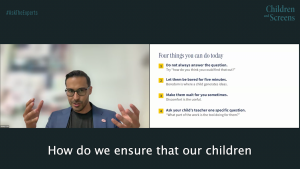
Four Simple Ways to Support Kids' Thinking Skills in the Age of AI
From the #AskTheExperts webinar “Raising Independent Thinkers in the Age of AI”

“I’ve let screens take over”: Maternal Guilt About Media and Relations to Children's Problematic Media Use

The Costs of Using Devices to Calm Children | Peter Reschke, PhD

Before You Post: Tips for Sharing Your Child’s Life Online