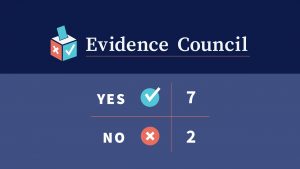
The Children and Screens Evidence Council voted 7-2 in favor of making Pre-K classrooms screen free.
By a majority vote of 7-2, the Children and Screens Evidence Council members determined that Pre-K classrooms should be screen free. Council members determined that early childhood classrooms are uniquely important environments for fostering the social, emotional, cognitive, and physical experiences that young children need to thrive – and screens can interrupt or displace these experiences.
Why the Majority Support Screen-Free Pre-K Classrooms
-
- Social and Emotional Development: Early childhood is a critical time for nurturing human relationships. Removing screens encourages face-to-face social interactions, emotional growth, and the building of fundamental communication skills.
- The Importance of Play: Real and imaginary play, movement, and hands-on experiences are vital to a young child’s development. Preschools are a prime environment for these activities, which do not require digital interaction.
- Displacement of Healthy Habits: Screen time frequently replaces physical activity, creative play, and valuable peer engagement. Furthermore, even high-quality content becomes detrimental when it contributes to an excessive total daily screen volume.
- Risk of Developmental Harm: Available evidence indicates that excessive screen exposure in early childhood is linked to a higher risk of attention problems, language and social delays, behavioral issues, and sleep disruption.
Dissenting Perspectives and Key Considerations
While the majority supported a completely screen-free environment, dissenting members emphasized the need for a nuanced, balanced approach rather than a total ban, including:
-
- Screen Light Approaches: Rather than being wholly eliminated, technology can be integrated in limited, judicious, and highly intentional ways under direct teacher guidance to support learning.
- Practical and Urgent Utility: Screens can serve necessary, non-educational functions in the classroom, such as facilitating urgent communication with a child’s parent or guardian.
What the Evidence Shows
The majority of experts emphasized that the research overwhelmingly supports limiting screen time for preschool-age children. Current evidence suggests that the potential for harm caused by screens in a Pre-K setting far outweighs the modest, conditional benefits—which typically require 1:1 co-use with an adult, and is rarely feasible in a standard classroom.
The Takeaway
Making Pre-K classrooms screen free may foster essential real-world experiences for young children that facilitate key areas of early child development, including social and emotional development, play, physical health, and may help protect against the risks associated with early screen exposure.
Naomi Baron, PhD
American University
“Early childhood is a precious time for learning about the physical world and for nurturing human relationships. Encouraging children to rely on screens hinders both kinds of development.”
Kelly Brownell, PhD
Duke University
“High quality screen time may have benefits, but ensuring quality would be a challenge, and in any case screen time displaces time for social interaction, creative play, physical activity, etc.”
Dimitri Christakis, MD, MPH
University of Washington; Children and Screens
“Studies have shown that preschool children spend as much as a third of their waking hours in front of a screen and that as much as half of that time occurs in daycares and preschools. Even if the totality of that time is devoted to high quality programming, it is simply too much. Play – both real and imaginary – is so essential to children’s development and preschools are the best place for it.”
Lauren Hale, PhD
Stony Brook University
“Pre-K classrooms should be focusing on social, emotional, and fundamental skills. You don’t need a screen to learn how to play Duck Duck Goose or sing the alphabet.”
Colleen Kraft, MD, MBA, FAAP
University of Southern California School of Medicine; Children’s Hospital Los Angeles
“The educational and health literature overwhelmingly supports limiting screen time for preschool-age children. Weight and physical health, language development, cognitive development and social-emotional relationships are all affected by too much screen time. In-person physical and communication skills should be a goal of preschool, and screens are not needed for these activities.”
Ellen Wartella, PhD
Northwestern University
No rationale provided.
Paul Weigle, MD
UConn School of Medicine; Hartford Healthcare
“Available evidence indicates the potential for harm done by screens in Pre-K classrooms is far greater than potential benefits. Adding to the excessive screen habits of most children puts them at higher risk of attention problems, language and social delays, behavioral problems, and sleep disruption, and can delay ability to tolerate frustration. Screens can have modest benefits when engaged together 1:1 with an adult, which is very unlikely in the classroom setting.”
Desmond Patton, PhD, MSW
University of Pennsylvania
“Pre-K classrooms do not need to be completely screen-free, but they should be screen-light, not screen-dependent. Young children learn best through play, movement, language, relationships, and hands-on experiences. Screens become harmful when they replace those things. Used briefly, with a clear purpose and teacher guidance, technology can support learning. But it should never organize the classroom. Children, play, and connection should.”
Marc Potenza, MD, PhD
Yale University
“Screens should not be wholly eliminated from early learning environments such as Pre-K but rather used in limited and judicious fashions. For example, they could be used for communicating with a parent or guardian in urgent situations or for specified learning activities. Screens should not be used in lieu of person-to-person social interactions on a regular basis.”

Meet the Evidence Council
The Children and Screens Evidence Council is composed of leading researchers and clinicians convened to provide clear, evidence-based guidance on some of the most urgent and debated questions surrounding children, adolescents, and digital media.

Experts Vote 7–2 in Favor of Screen-Free Pre-K Classrooms
Children and Screens Evidence Council finds strong support for making Pre-K classrooms screen-free
The Children and Screens Guide for Early Child Development and Media Use: Infants and Children Ages 0-5

What Matters for Young Children's Healthy Digital Media Use and Learning? | Rachel Barr, PhD
Measuring How Screens Change Young Brains | Tzipi Horowitz-Kraus, PhD
What To Do About Screens in Schools? Phones, Tablets, and Focus in the Classroom
What do we know about the effectiveness of phone bans, and what do experts recommend for device use in the classroom?
Education Technology: Summary and Recommendations
Summary and Recommendations found in the "Handbook of Children and Screens: Digital Media, Development, and Well-Being from Birth Through Adolescence," Part Three: Digital Domains, Education Technology Section (pages 517-567)