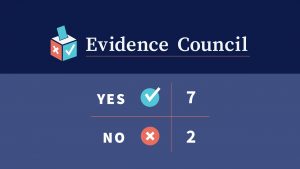
The Children and Screens Evidence Council voted 7-2 in favor of banning smartphones from all K-12 schools for the entire school day.
Implications for Families, Educators, and Policymakers
A strong majority of Children and Screens Evidence Council members agree that restricting smartphone access throughout the school day may support student learning, social development and overall well-being. This vote reflects growing momentum among educators and policymakers seeking to create more focused, supportive learning environments while also highlighting the importance of flexibility and careful implementation.
Why Most Experts Support School-Day Smartphone Bans
-
- Cognitive Capacity: The mere presence of a personal phone – even if silent or stowed in a pocket or backpack – can reduce a student’s concentration.
- Social Development: Removing phones encourages face-to-face peer interactions, play, and social skill acquisition.
- Academic Environment: Early evidence suggests these bans promote gains in academic achievement, improves student focus and behavior, and benefits the overall classroom environment.
- Mental Health: Restricting access to personal devices limits exposure to potentially toxic social media influences and provides “relief” from the irresistible distractions of smartphones, pivoting students’ time to more beneficial activities.
Dissenting Perspectives and Key Considerations:
While the majority supported bans, dissenting members, and even some supporters, emphasized the need for a nuanced approach, including:
-
- Relevant exceptions, such as for students with disabilities, where phones may provide essential assistance or accessibility support.
- Flexible approaches, based on student age, rural vs. urban contexts, timing of use, or other variables that may indicate when and for whom phone use may be harmful or helpful.
- Policies designed in partnership with with parents, students, and school personnel
What the Evidence Shows
The Council noted that while empirical research is still evolving, current evidence suggests that bell-to-bell bans could support improvements in student learning and overall well-being. Experts emphasized the importance of continuing research to better understand how different policy approaches affect diverse student populations over time.
The Takeaway
School-day smartphone bans may offer meaningful benefits for student learning, attention, and social development. However, experts agree that these policies should be:
Naomi Baron, PhD
American University
“Research shows that mere presence of a cell phone can reduce students’ concentration and cognitive capacity, even if the phone is on silent or tucked into a backpack. I suspect that allowing student access to cell phones during lunch break can divert mental energy: before lunch (anticipating usage) and after lunch (feeling of deprivation). Given how many states have enacted different cell phone ban scenarios, I look forward to empirical tests of the consequences of allowing usage during lunch.”
Kelly Brownell, PhD
Duke University
“Anything that limits the exposure of youth to social media is likely to be helpful, both because it removes potentially toxic influences and permits more time for better alternatives, such as interactions with peers, reading, etc. The results of studies thus far suggest that cell phone restrictions in schools have beneficial effects. I suspect further research will confirm this initial finding, and will show an even broader range of benefits than what has been documented thus far.”
Dimitri Christakis, MD, MPH
University of Washington; Children and Screens
“School time is precious. Studies show that adolescents spend 25 percent of it on their phones. That time— whether it’s during class, recess or lunch —comes at the expense of learning or face to face interaction. Those experiences are essential to developing children’s learning and social skill acquisition.”
Lauren Hale, PhD
Stony Brook University
“Removing phones during the school day provides students an opportunity to learn, play, socialize, focus, and listen to their teachers and each other without the temptation or distractions from the outside world.”
Marc Potenza, MD, PhD
Yale University
“Developing youth are often spending considerable time on smartphones including in situations when focusing on face-to-face social interactions or directed attention to learning what is being taught is important. A “bell-to-bell” ban with specific exceptions could help youth develop in more optimal manners. Additional testing of such interventions is warranted as is training to promote effective and healthy use of digital technologies.”
Ellen Wartella, PhD
Northwestern University
No rationale provided.
Paul Weigle, MD
UConn School of Medicine; Hartford Healthcare
“Smartphones are an irresistible distraction from schoolwork and the face to face connections. We don’t allow kids to smoke or drink alcohol and cannot expect them to manage smartphone use. Smartphone bans give youth the relief from distraction to allow for academic success, healthy relationships, and better mental health. Studies of bans have shown improvements on classroom environment, academic performance, behavior, and need for mental health support.”
Colleen Kraft, MD, MBA, FAAP
University of Southern California School of Medicine; Children’s Hospital Los Angeles
“Cell phone bans have been piloted as a policy solution to reduce classroom distractions and improve student well-being, focus, and learning. Many states adopted policies restricting cell phone use at school. Early evidence suggests this promotes gains in academic achievement. An effective “cell phone ban” solution should consider rural vs. urban contexts, students’ ages, and be thoughtfully designed in collaboration with parents, school personnel, and students.”
Desmond Patton, PhD, MSW
University of Pennsylvania
“We do not yet have clear enough evidence to support a universal bell-to-bell smartphone ban in all K-12 schools. Schools should partner with local universities, parent groups, and students to collect and evaluate data on when phones are harmful, for whom, and when they are useful, including for students with invisible disabilities or during emergencies. As Sonia Livingstone and Christopher Ferguson suggest, policy should be guided by evidence, context, and student need.”
Important Definitions / Glossary
A bell-to-bell ban is a policy that prohibits students from using personal devices (in this case, smartphones) for the entire duration of the school day – from the first morning bell to the afternoon dismissal bell.

Learn More About the Evidence Council
The Children and Screens Evidence Council is composed of leading researchers and clinicians convened to provide clear, evidence-based guidance on some of the most urgent and debated questions surrounding children, adolescents, and digital media.
Experts Vote 7–2 in Favor of Bell-to-Bell Smartphone Bans in Schools
Children and Screens Evidence Council finds strong support for full-day restrictions, with calls for flexibility and further research

Digital Devices in Schools
A two-page research snapshot on the impacts of school phone bans and classroom devices on students and educators

What To Do About Screens in Schools? Phones, Tablets, and Focus in the Classroom
What do we know about the effectiveness of phone bans, and what do experts recommend for device use in the classroom?

Phones in Schools? What the Research Says | Abe Flanigan, PhD