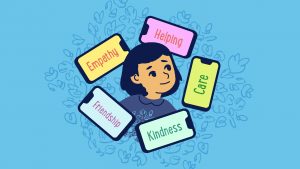
Children’s observations and interactions with the people and world around them shape their emerging sense of morality and engagement in kind, helping, and socially positive behaviors. What do parents need to know about how experiences with digital media shape youth moral and social development, as well as how they apply their morals online and offline?
Children and Screens held the #AskTheExperts webinar “Learned Behavior: How Youth Digital Life Shapes Moral Development” on Wednesday, September 16, 2026, the next installment in its “Character Matters: Values and Resilience in the Digital Age” series. A panel of leading researchers examined how moral behavior develops across childhood and adolescence and its relationship with digital media, what positive social behaviors look like in online spaces, and tips for parents and caregivers on how to encourage digital media use that encourages more empathetic and moral behaviors.
The “Character Matters” series is made possible through the support of Grant 63314 from the John Templeton Foundation. The opinions expressed do not necessarily reflect the views of the John Templeton Foundation.




Resources Mentioned During the Webinar
- A meta-analysis of prosocial media on prosocial behavior, aggression, and empathic concern: A multidimensional approach (Scholarly Article)
- Ready For School!: A Parent’s Guide to Playful Learning for Children Ages 2 to 5. (Toolkit/Parent Guide)
- Sesame Street (Website)
- Sesame Workshop: Emotional Well-Being (Toolkit/Parent Guide)
- Sesame Workshop: How to Talk to Kids About Tough Topics (Toolkit/Parent Guide)
- Winston Center on Technology and Brain Development at UNC (Website)
- Developmental Social Neuroscience Lab at UNC (Website)
- The Power of the Like in Adolescence: Effects of Peer Influence on Neural and Behavioral Responses to Social Media (Scholarly Article)
- For Black Americans, Using Social Media Means Risking PTSD (News Article)
- Media Psychology and Morality Lab at UB (Website)
- Narrative Media’s Emphasis on Distinct Moral Intuitions Alters Early Adolescents’ Judgments (Scholarly Article)
00:00:00 – Introductions by Children and Screens Executive Director Kris Perry.
00:02:22 – Moderator Marina Krcmar on reframing digital platforms as developmental spaces for youth moral growth.
00:15:11 – Rosemarie Truglio on how young children build prosocial behavior through media.
00:24:30 – Moderator follow-up: Does screen time shift children’s values even when content is wholesome?
00:26:29 – Eva Telzer on how algorithms and peer feedback shape youth prosocial behavior and activism online.
00:39:42 – Moderator follow-up: What is the best way to teach kids how online material can influence them?
00:41:43 – Lindsay Hahn on how media narratives and online spaces shape youth moral reasoning and values.
00:54:24 – Moderator follow-up: How can we support children who fall down an algorithmic rabbit hole?
00:55:54 – The panel addresses questions from the audience.
00:57:02 – Q&A: At what age can children learn positive lessons from media, including toddlers and preschoolers?
00:59:58 – Q&A: Are there moral or prosocial milestones parents should watch for, and does media help or hinder them?
01:07:21 – Q&A: What variables support healthy technology use?
01:10:34 – Q&A: How can parents identify prosocial media when mediating what their children watch?
01:12:35 – Q&A: What is one actionable takeaway from each panelist’s research?
01:17:27 – Wrap-up with Children and Screens’ Executive Director Kris Perry.
[Kris Perry]: Hello everyone, and welcome to Children and Screens #AskTheExperts webinar series. I’m Kris Perry, executive director of Children and Screens: Institute of Digital Media and Child Development. Today’s session, “Learned Behavior: How Youth Digital Life Shapes Moral Development,” is the second installment in our fall 2026 series, “Character Matters: Values and Resilience in the Digital Age.” This series of webinars addresses a spectrum of topics related to youth character development and digital media use, and was made possible through the support of the John Templeton Foundation. Children learned about kindness, empathy, fairness, and right and wrong from the people and the world around them. Today, the digital world is part of that environment. So what happens when children come across different models of behavior online? How do social media and other online experiences influence the way young people think about right and wrong and the ways they treat others? Can digital media provide opportunities to model and reinforce kindness, empathy, helping, and other prosocial behaviors? Today, we’ll explore how moral development and prosocial behavior evolve across childhood and adolescence, and what the research tells us about the role media can play in that process. And importantly, we’ll discuss what parents and caregivers can do to help children carry their values with them wherever they go, online and offline. We have an outstanding panel of researchers and experts here with us to help examine these questions. Now, I’m pleased to turn things over to our moderator, Dr. Marina Krcmar. Dr. Krcmar is a professor in the Department of Communication at Wake Forest University. Her research focuses on the effects of media on children and families, including social media and adolescent well-being, and young children’s moral reasoning and prosocial learning from media. She has authored two books, more than 25 book chapters, and more than 100 peer reviewed articles, and in 2023 received the Senior Scholar Award from the National Communication Association’s Children, Adolescents, and Media Division. Welcome, Marina.
[Dr. Marina Krcmar]: Hi. Thank you very much. Good afternoon, everyone, and welcome to today’s webinar. I am Dr. Marina Krcmar from Wake Forest, and I’ve been researching children and media for more than three decades or since the previous century, as my students and children now refer to it. And it’s a true privilege to be here with these scholars today to introduce today’s session on how youth digital life actively shapes moral development. When I first started in this field, I studied this quaint little medium that we called television, and the focus then was mostly on media violence. Both research and media itself, of course, have come so incredibly far since that time. And I think those of us who can remember, even the millennials, have had a very different childhood from the one that our youth are experiencing right now. And we can testify to the dramatic changes – we see them all around us. For many years, the public conversation surrounding youth and digital media has been dominated by this risk-deficit model, focusing almost exclusively on screen limits, cyberbullying, social isolation. And while those concerns are certainly valid, and I’m sure we will hear about some of them today, they fail to capture the full picture. Today, we want to reframe the dialogue. We’re examining digital platforms not merely as passive distribution channels or potential hazards, but as dynamic developmental spaces where young people actively can explore their empathy; they can construct moral priorities and practice prosocial behavior. To understand moral development today, we first have to recognize that digital media act as an active socializer, and I think we can all agree with that. It’s no longer just a television set sitting in the corner; it’s an interactive ecosystem embedded in young people’s pockets that they can pull out at a moment’s notice, and that online spaces afford youth entirely novel opportunities for prosocial engagement from organizing grassroots campaigns to providing peer support and emotional support in real time. According to research from the Pew Research Center, nearly 95% of teens report having access to a smartphone, 81% report social media makes them feel more connected to their friends, 67% report that these platforms make them feel supported during tough times. In my own kids’ public high school, a 15 year old named Maya, noticed that some of the younger kids didn’t have warm jackets in a particular cold snap, so she quickly put together a TikTok video about the issue. This video went viral, and she was able to collect $3,000 in a matter of 48 hours and provide gift cards for families in need. This really gave us an idea about how digital tools reduce the friction between adolescents’ real feelings of empathy about a situation, and they can translate that into real world impacts, and it provided some redemption for TikTok. However, these digital contexts are really complex. There’s algorithmic feedback loops, there’s public visibility, there’s asynchronous communication, there’s perceived anonymity, and all of these can amplify negative things as well as positive prosocial actions. That’s why we want to bridge the gap between developmental theory and practical caregiver guidance. So to navigate these complex dynamics our presentation today brings together three distinct scholars. They offer a scholar and practitioner perspective across developmental stages and offer us an inside look into some of their expertise. We’ll start with Dr. Hahn on moral values and media, and she’s going to apply moral foundations theory. She’s going to unpack how exposure to different media narratives really shifts which core values a particular child or adolescent is focusing on in the moment, such as care, fairness, loyalty. And she’s also going to evaluate the experimental evidence on media’s effects on these moral factors, and how online feedback loops influence moral reasoning. We will then move on to Dr. Telzer on peer norms, and she’s going to draw on developmental neuroscience and social psychology. Dr. Telzer will discuss how digital platforms scale youth activism and how peer modeling on public feeds really accelerates prosocial norms. Peer feedback, like comments and shares, that are incredibly important to teens, really can be an intense reinforcement loop. And there’s brain imaging that shows that receiving positive peer feedback activates the key reward centers, and it makes public prosocial modeling a really powerful driver for group behavior. My own students refer to this as the dopamine loop. And she’s also going to address potential social costs like digital burnout, something that we can all identify with. Dr. Truglio’s extensive work on Sesame Street and early childhood development – she’ll be discussing how research is brought into practice in Sesame Street all the time – it was one of the earliest models for how to do kids programming right. And she’s going to be drawing on decades of experience translating research into educational programming. Dr. Truglio will discuss how early media exposure impacts foundational social behaviors in very young children, and she’s going to share practical, evidence-based tools for caregivers and educators that mitigate the potential risks of media, while also actively scaffolding all of the positive media habits from a very early age. So as a panel, we’re going to expand traditional definitions of prosocial behavior. Historically, developmental psychology defined prosociality primarily as doing basic, clear behaviors, such as sharing or helping an adult pick up toys. But we need to broaden that definition in the digital age to encompass things like civic activism, online peer support, digital citizenship, and cross-cultural solidarity. So empirical research strongly supports this expansion. There’s been meta analyzes examining over 70 studies, and it demonstrates that exposure to prosocial media content consistently predicts higher levels of things like empathic concern, voluntary helping behaviors, and even reduces aggressive cognitions. The average effect size there is 0.22, which simply means that prosocial media can boost a kid’s prosocial behavior by about 20%. So digital environments alter how youth construct their moral priorities, again, for good or for bad. Online feedback can act as a powerful tool to help them prioritize that good and bad behavior, and it can reinforce that peer reinforcement loop. So when a young person witnesses a peer standing up for someone in the comment section, that action can really model that prosocial support over and over again across hundreds of youth. So consider another brief example from an online gaming community: there’s a 14 year old player, and he noticed that one of their teammates was expressing real emotional distress during the game over voice chat, and instead of ignoring it or giving some sort of banter to go along with it, he reached out to both the teen online and to the in-game moderator to flag peer support resources. And that also gave the peer moderator an opportunity to establish a dedicated peer support channel for young people during that game. So it was a way for a young person themselves to get involved in shaping the online game to have a more prosocial effect. So this brings us to our central takeaway for caregivers, for educators and clinicians, and that’s the concept of scaffolding moral navigation, or bridging in-room adult guidance with out-of-room youth autonomy. We’ve all had that experience of looking at kids online and wondering what we can do, since we can’t be there all the time. But research shows that simply restricting kids really doesn’t do what it’s intended to do. Simply banning apps or turning off the Wi-Fi offers a short term solution, but it’s largely ineffective in teaching moral agency, something that we want all kids to develop over time. So instead, we want parents and caregivers to use active mediation, where they can use and engage in a kind of open dialog. And we know from the research that that predicts levels of digital literacy and ethical behavior online. So imagine a parent co-viewing social media with their ten year old child, and they see a kind of viral prank video that borders on humiliation. One thing that they could do is, they could simply close the app and say, “We’re not going to watch that. That’s not very kind,” but it’s really an opportunity for the parent to say, “How do you think that person being pranked might feel? Why do you think people like those kinds of videos?” And that brief 30 second conversation could help build the child’s internal moral compass, giving them critical perspective taking skills and, frankly, more tools necessary to evaluate these digital interactions going forward that they’re going to encounter again and again. So to summarize our roadmap for today’s session, we really have two primary objectives split between research and practice. We’re going to unpack precise psychological and developmental mechanisms that drive online prosocial behavior across childhood and adolescence, examining how digital environments influence moral value adoption and how peer dynamics reinforce those positive behaviors. On the practitioner application front, we’re going to translate these empirical findings into real, concrete, actionable steps and strategies for parents, educators, and clinicians. We want to provide practical tools to help young people cultivate digital resilience, empathy, and healthy moral agency. So I’m now going to turn things over to Dr. Truglio to kick off our first deep dive into moral values. Dr. Rosemarie Truglio is SVP of Global Education at Sesame Street Workshop, where she leads curriculum and content development, new show productions and content development across platforms. Dr. Truglio manages a global education team responsible for identifying the critical needs of children and their families, and for the development of educational frameworks which guide content development. Dr. Truglio has published widely, presented nationally and internationally, and authored Ready for School: A Parent’s Guide to Playful Learning for Children Ages 2 to 5. She received her Ph.D. in Developmental and Child Psychology from the University of Kansas.
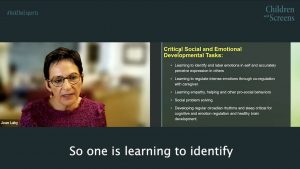
[Dr. Rosemarie Turglio]: Thank you. So happy to be a part of this panel and to focus on the really young children. So Sesame Workshop is the nonprofit educational media and our mission is to help children grow smarter, stronger and kinder through the content that we create. And so we have a long history of, in fact, we are currently on both PBS and PBS Kids and Netflix, airing our Season 56 episodes, and later this fall we will be airing Season 57. So we have this long history of meeting the needs of kids and families and a range of learning outcomes because we are focusing on a whole-child curriculum. But what we also do is we’re constantly reflecting the needs of kids today. So our focus has been on what we’re calling “emotional well-being,” which gives us an opportunity to model and to be more explicit about the motivation regarding the skills that are the underlying skills for character development. So when we think about emotional well-being – it’s really important – as I said, we’re focusing on really young children: what are those early skills? It’s emotional awareness, right? We can’t think about other people unless we have a better understanding of what we are dealing with or focusing on. So what we’ve learned is that children need to build, we’re calling “a range of emotional vocabulary.”
They need to get beyond the “happy,” “sad,” “mad” words and really have the words that really are reflecting what they’re feeling. What’s the difference between “angry” and “frustrated?” Talk about disappointment. Talk about jealousy. So these words are really important because it gives them an opportunity to understand what that feeling is, so then we can have the strategies to help them be with those feelings, right? That’s a part of resilience: so that we understand how to cope with the feeling so it’s not impeding what we want to do in terms of moving forward, but also noticing and recognizing the emotions of others. And that brings us to the social connection. What are those positive relationships? How do we develop those caring connections and how do you use these emotional wellbeing strategies to practice these prosocial problem solving skills? Because children are facing problems on a regular basis and they just don’t know how to model, and parents need the guidance; how to guide children to develop these prosocial behaviors. And we’re extending into this compassionate mindset, not only being compassionate to others, but being compassionate to oneself, right? Having that sense of hope and kindness and understanding without judgment, which informs us how we interpret the events in our lives and help us overcome obstacles because compassion is related to challenges. So this is just a nice summary of – we talk a lot about kindness – and kindness is great but we need to get beyond, you know, just the “please” and the “thank you” and the holding the door for someone and to really think about kindness when you are focusing on either: you’re having a hard time, kindness to yourself, but when someone else is having a hard time to have that understanding of the feelings and the needs of another person. We talk about empathy. Yes, young children do have empathy, but they need to understand the motivation for this compassionate mindset so that they know how to engage in a caring behavior. “How do I help?” “What can I do?”So I’m bringing up this parasocial relationship because this is key for children’s learning, especially when you’re developing young children’s programming. They need to be able to connect with the characters. They need to see these characters as their friends. These characters are real to them- that social-realism. And we know that when we have this parasocial relationship, it actually helps with story comprehension, and engagement, and also driving learning impact. And we have these wonderful adorable characters that we know that young children do relate with. And they see them as their friends. So they really, truly listen to them. And we have lots of evidence to know about the increase of story recall and most importantly, the impact gains. Sesame Street is all about addressing the needs, but most importantly, assessing “did we actually achieve learning outcomes?” So we’re constantly doing research. We do research in the development of the episodes, but we’re doing the impact research. And so I’m going to give you an overview of some of the results from Season 55, which is currently on air, so that we could see: did we move the needle? And what we found is looking specifically at these parasocial relationships is, yeah, when a child felt a strong connection to Elmo before the intervention, showed greater improvements in recognizing emotions, understanding the cause of why the character was feeling these big feelings, and most importantly, what are the strategies to be with that big feeling? Same is true for Abby – we focused on Elmo and Abby as the two core characters for this age group. But what was wonderful to find out is that yes, we were assessing the emotional awareness outcome goals, but we found that these stories actually showed significant improvements in independent play, which is great, but what we really want to see about those social connections is that were increases in cooperative play and sharing. And we know that really young children have a very difficult time with sharing. And a decrease in unprovoked aggression. So now they have the vocabulary, they have the strategies. So they’re less likely to act out physically – in a physically aggressive – way because they have the tools. And that’s the power of telling these stories through media with characters that they associate and love. So I just wanted to leave with some of these take home messages for the parents and caregivers out there, and through the lessons that we’ve learned over, over the years, is that, yes, the world is tough, but Sesame is all about providing those lifelong lessons to give them the tools so that they can build the resiliency. And that’s what this Emotional Wellbeing Curriculum is all about. Another important message is: help children be with their feelings. Look and notice what physical expressions that they are expressing, so that you could help them label these emotions. All feelings are okay. We need to have a better understanding of these feelings. And to give them the agency- we all need these tools and the adults just the same, we all need these tools. What are the strategies to help us be with these feelings? And it’s okay to ask for help. We’re so resistant to ask for help, but we all need help. We don’t- no one is a superhero out there, and a very important message is we need to stop rescuing our children from these big feelings. As parents and caregivers, we want to take these feelings away, but we’re not going to be able to build this resiliency unless they feel these feelings, understand why they’re having these feelings, how do they regulate these feelings, and also to recognize this in other people- their peers and the adults in their lives. And another key message is: we all learn from failure. We don’t want to avoid the failures. We have to shift away from perfectionism. Learning is messy. Let’s focus on curiosity, not talk about shame, and let’s praise the effort and not the outcome. So I hope these are good takeaway messages and sums up my ten minutes of my time.
[Dr. Marina Krcmar]: Okay. Thanks, Rosemarie. That was wonderful. And we all know how important those early years are, so really getting sort of actionable advice was very helpful. So we have some great questions, and I thought I would throw this one out there because I think it’s an important one that we think about a lot. And the question we have is, “does the amount of time on screens impact changes in values, even if they’re consuming more wholesome material?”
[Dr. Rosemarie Truglio]: Well, that’s a good — that’s a really good question — because you’ve got to think about how much time we are spending on media, as opposed to more hands-on, interactive, outdoor play as well, and building those social relationships. So I think we need to be mindful of time, but it’s not time alone. And the question says, you know, “even though you’re watching wholesome TV,” which is – or media across the board, across platforms — content does matter, right? Let’s not forget that: content does matter. But we also, we know with, especially with really young children, it’s about those building those social relationships and spending time in the physical world off the screen. So it’s a balance, and that’s the best way I could sum it up.
[Dr. Marina Krcmar]: Okay. Thank you so much. That was very helpful. All right, next I’m going to shift over to Dr. Telzer. So Dr. Eva Telzer is a professor of psychology and neuroscience at UNC Chapel Hill and the co-director of the Winston Center on Technology and Brain Development. Her research examines how social and cultural processes shape adolescent brain development, with a focus on prosocial and risk-taking behaviors, family and peer relationships, and the role of social media and youth’s lives. She has authored over 250 publications, and her research has been continuously funded for over two decades by numerous agencies and foundations, including the National Institute of Health, the National Science Foundation, the Templeton Foundation, and the Jacobs Foundation. Thank you very much.
[Dr. Eva Telzer]: Great, wonderful. Thanks for having me today. So today, I’m going to talk about prosocial development in the digital age, largely focusing on the adolescent period. So here are just funding and disclosure statements before I dive in. So adolescence is a time when youth are learning how to contribute to society, whether it’s to their family, to their peers, or to their broader community. They engage in prosocial behaviors such as sharing and cooperating, helping others in need, volunteering, voting in some domains, youth activism and really just staying informed and raising awareness about different issues. So this is a really key aspect of the adolescent period. Now, digital media has, in many ways, transformed usability to engage in prosocial behaviors in many new ways that were often unavailable offline. And this includes the ability to share information beyond adolescents’ immediate daily lives, so adolescents can access information outside of their school or their home, or the sort of small in-person bubble that they might live in, in order to have access to greater diversity of perspectives and engage in prosocial behaviors in ways that might not be available in person. Adolescents are able to immediately follow up on information that they receive by forwarding it, commenting on it, following a link to a donation page, signing a petition – so there’s a greater speed with which information is accessed and followed up on. There’s many social barriers, such as physical access, that are reduced. They don’t need transportation, for example, to take action online, they can reach larger audiences and really mobilize really large networks, things can go global at a faster pace. And this is especially important for some adolescents, who may be in communities who are more remote or that have higher risks related to violence or discrimination. They can use these digital tools to really band together. And finally, adolescents can really express their civic identities and prosocial tendencies in really creative ways, using videos or creating memes or artwork and being really creative in this expression. Now, online visibility and more prosocial behaviors in these online contexts mean that prosocial behavior can reach wider audiences and youth can contribute in really powerful youth movements in really unprecedented ways. Something that did not exist before social media was around – it facilitates information beyond one’s immediate daily life, and they can become increasingly aware of world events at much younger ages. They have access to information at a younger age, and in fact, youth and children and adolescents are leading some of the biggest and most powerful social movements in really extraordinary ways. So as an example, in 2018, when she was only 15 years old, Greta started a school strike for climate change. It started really small, she was just outside of her school with very few peers coming on board, but protests soon went viral over social media, reaching millions and millions of people, and promoting and prompting protests around the world she developed millions of followers and was elected by Time Magazine as the “Person of the Year,” and this would not have been possible without social media. One of the most successful campaigns that was led by teens is the “March for Our Lives” campaign, and they also were able to do this through social media. So after the school shootings in Parkland, Florida, the students made use of social media to organize and post photos and video clips of the events that were happening, and it provided access around the world to this inside-view of what was happening from the students’ perspectives. And then Emma Gonzalez created social media accounts to lead these movements, to mobilize young people to vote, and she also got millions of followers, which culminated in the “March for Our Lives” in 2018, where there were upwards of 800,000 protesters in D.C. and another 900,000 protesters around the world. So again, social media facilitated the flow of information – this mobilization – led by adolescents. This can also occur in other ways, so, for example, this is a young child who noticed that women in Seventeen Magazine and other platforms were being airbrushed and thought that this was not good for girls’ mental health or their body image. She writes in a campaign, for example, that girls want to be accepted, appreciated and liked, and when they don’t fit that criteria, some girls try to fix themselves, and this can lead to eating disorders, dieting, depression and low self-esteem. And so she was asking Seventeen Magazine to commit to printing one unaltered real photo spread per month. She wanted to see regular girls that looked just like her in magazines that’s supposed to be for people like her. And this was signed by over 85,000 supporters, and thousands of people responded to this on many social media platforms and blogs, asking for women and girls’ magazines to stop photoshopping women’s bodies. And this campaign, again, was successful: Seventeen Magazine agreed to stop altering girls’ faces and bodies with Photoshop. Now, peers are a really important component of how information is experienced and spread in adolescence, and what adolescents are exposed to online can influence their own attitudes and behaviors. So it’s not just about individuals posting and creating social movements, but this can also influence day-to-day values and behaviors, when their peers are posting different smaller scale things on social media. So this can be, for example, exposure to alcohol-related posts that they may see; this changes adolescents’ perceptions of their peers’ attitudes about drinking, and is associated with subsequent increases in heavy episodic drinking. But this can also apply to prosocial and positive behaviors. So we have some preliminary data from a project funded by the Templeton Foundation, where we showed adolescents a curated feed of ten minutes of prosocial short-form videos. So they saw these short-form videos depicting positive prosocial behaviors that adolescents were engaged in, and what we found is that after watching these prosocial feeds, adolescents showed a significantly large increase in their own prosocial behaviors. So it is possible that seeing prosocial posts on social media will increase adolescents’ own prosocial behaviors in ways that can help adolescents engage in these really positive behaviors. Now, unfortunately, the algorithms of social media platforms are designed in ways that promote more engaging content that is oftentimes more negative behaviors; it’s rare for an adolescent to be exposed to ten minutes of continuously looping, positive, prosocial behaviors. And then design features like likes, or comments, or other peer influence effects can heighten adolescents’ sensitivity to that type of feed that they’re exposed to. And this is associated with the way that the brain is actually programmed to engage and like what peers are liking. So in an experimental study led by Lauren Sherman and colleagues, they presented adolescents with photos that were manipulated to have many likes, and this included images of risky behavior. And they found that adolescents were significantly more likely to like the post themselves, that they saw that their peers also liked them more. And at the brain level, this was coupled with greater activation in brain regions involved in reward-processing and social salience, suggesting that viewing these more popular posts elicits this reward-response, which is likely reinforcing digital behaviors and potentially offline behaviors as well, and that this is influencing, or enhancing, these peer-influence effects that could come with some costs if what they’re seeing online is more negative. So in terms of potential costs to youth’s online prosocial behavior, it’s important to consider that the very thing that makes online civic engagement and prosocial behavior successful, the visibility of it, the speed at which it can quickly go from person-to-person, is also potentially going to create some costs. Prosocial engagement online is public, visible, and it’s oftentimes permanent. And so there can be some backlash, including harassment, surveillance, increased public pressure that could be potentially negative for adolescents who are engaging in very visible behaviors online. As one example, individuals such as black teens using social media more, they can be exposed to activism in some positive ways, but also activism in the context of race-related issues is related to risk for PTSD, anxiety, and exposure to discrimination. And social media features, such as algorithms, are designed in ways that promote more engaging content, and unfortunately, that means prioritizing sometimes less positive and more negative things online, and this can include race-related content over prosocial or affirming content. So as an example, there’s been some research led by Brendesha Tynes at University of Southern California, where she showed that black youth are exposed to very high levels of online discrimination and algorithmic bias, and this outweighs all of the positive race-related content and positive things that they’re exposed to and is linked to poor mental health. Okay, so what can parents do to support, especially adolescents, as they’re navigating social media? So first, it’s important to really change the focus from time, as our previous Q&A mentioned, to the quality of those activities with which youth engage in digital spaces. Now, adolescents are so sensitive to their peers, they are looking for ways to engage in positive behaviors. And so when parents and community members can help adolescents navigate their digital spaces in ways that help them to increase the positives of that social media space, that can hopefully be one way of promoting and helping adolescents. So rather than limiting total screen time, parents can focus on what teens are doing in these digital spaces, what information are they accessing, what content are they being exposed to? If they open up a digital media feed, what are the algorithms feeding adolescents and how can we reshape what they may be exposed to? Parents should also engage in open discussions with their teens about what they see and do online. Research has shown that adolescents whose parents are actively monitoring their media use — so discussing the media with their children — are more prosocial with their friends in person, whereas adolescents whose parents are restricting their media use — so cutting off time spent on media, as an example — engage in fewer helping behaviors towards their peers. So this more active discussion with adolescents is a way to potentially promote the prosocial, positive sides of digital media use. So I will end there and look forward to more discussion with you all. Thank you.
[Dr. Marina Krcmar]: Hey, thank you Eva. Those are wonderful.
We have time for a very brief question, which is, can you talk to us a little bit about the best way to teach kids how online material can influence them so that they have a way of, kind of, engaging in it and maybe even counteracting some of those negative influences?”
[Dr. Eva Telzer]: Yeah, absolutely. So, you know, adolescents, in many ways, are shaped by their social context. And when they have more exposure to positive, prosocial interactions, this can outweigh some negative social influences. So there’s experimental research that shows that the positive peer influence can outweigh the negative peer influence. So to help promote and support this, parents can have more active discussions about what is happening in these online spaces. What are adolescents posting? What are some of the features of those posts that make it more or less engaging? Are there lots of likes or comments that may be associated with this misperception that that is a social norm, as opposed to maybe, potentially, just one popular peer liking something doesn’t necessarily mean that a whole cluster of adolescents support that kind of behavior.
[Dr. Marina Krcmar]: Okay, great. Thank you so much. All right, next we’re going to move on to our third speaker, Dr. Lindsay Hahn. She’s an associate professor of communication at the University of Buffalo, where she is the founder and co-director of the Media, Psychology and Morality Lab. She is an affiliated faculty member of the Center for Cognitive Science. Her research examines how media shapes moral thinking and behavior across the lifespan, and she specializes in understanding how media and technology influence children’s developing moral values and social behaviors. She serves as an associate editor for the Journal of Children and Media, the leading outlet for research on young people’s media environments.
[Dr. Lindsay Hahn]: Hi, everybody. Thank you so much for being here today. I am so excited to talk with you about some of the work that we’ve been doing to try to understand media’s role, if any, in moral development. And so I guess I’m going to dive right in. And I wanted to actually start with a little bit of a reframe. So we tend to ask, as parents — I’m a parent too, so I feel all of you out here — this question about the media that our children can consume and, you know, “is this good or bad for my kid”? And I’ll say honestly, we really ask this about anything in their world, right? “Is this good or bad?” But I’d like you to think today about, instead of asking that question, try to get yourself to ask instead: “What is this content teaching my kid to care about?” This question, first of all, removes the guilt from you as caregivers, you know, worrying over what might be good or bad. But second, it also is moving you toward considering the nuanced content that they might be exposed to, instead of, kind of assigning this blanket, prescriptive label of something as universally good or prosocial or universally bad or antisocial, which, of course, is often not the case. And so, with that reframe in mind, I actually want to walk you through how our team has kind of thought about studying this question and just understanding how media – role, do they even have a role in moral development? And I’ll tell you that I became interested in this line of work because like someone who had just mentioned in the Q&A, I actually was not super satisfied with these, like labels of good and bad and prosocial and antisocial that were being applied to broader TV episodes for kids. Because of course, we know that some content can teach really good lessons, but also teach bad as well. And so I’m going to show you a very dated example here, but it’s dated on purpose, because the Mighty Morphin Power Rangers is actually the reason that I got into this line of work, mostly because as a kid, I watched it and I was often kind of struck by, even as a young kid, how they are doing good, right? They’re fighting evil on behalf of all the innocent folks, like any good superhero, which seems really good, but often they’re using violence to achieve their goals. And so does that mean it’s bad? And a lot of content is like this, right? Superhero content is – kind of, puts it really highly on display. But I think a lot of content does this. It’s really complex where you sort of have a little bit of good and a little bit of bad, and what even is good and bad to begin with, right? Like what I say is “good,” you might say is “bad.” And so what we’re trying to do in a lot of our work is kind of get away from those labels of good and bad, because all of that is really in the eye of the beholder. And so we started this line of work trying to ask a broader question, “What does content teach kids to care about?” And then you, as the kind of receiver of that research, can decide, do you want your kid to care about that thing or not? That’s a decision for you. And so I really want to briefly introduce to you, kind of a grouping system that Dr. Krcmar had previewed here that that we and other moral psychologists and scientists have kind of used to think about how morality and values exist. So some of the work that we’ve done in the past has shown that when we think about what we mean when we say “prosocial,” that we’re all not talking about the same thing. It really breaks down into five different moral values that as human beings, we’re all kind of attuned to from infancy: a capacity for caring and compassion, for fairness, for loyalty, for authority and for purity. And then it turns out that even in the scholarly literature, across 346 studies, which were all the studies we could find that actually referred to the term prosocial, they all mean different things when they say this, too. And, you know, some studies actually show that children even a few months old are kind of attuned to these things from infancy, right? Like even those of you who have really young children, or if you remember, when your child was only a few months old, kids notice whenever you have an unfair distribution, you give one kid more Cheerios than the other. The one who got not enough Cheerios is going to tell you about it. And so the idea here is that we’ve kind of evolved as a species to favor these things for communal living, because everybody is kind of thought to be kind of wanting to live in a communal capacity. And then with culture, kind of like a tuning for, tunes these things up or down to make us place greater emphasis on one versus another. And so if I’m in an environment, including a media environment that’s spending a lot of time focusing on the capacity for care and why it’s important, I’m probably going to value care a lot more than some of these other values. And so if you take nothing else away from my talk today, I would say that prosocial often can kind of feel like a single kind of “Good for Kids” stamp and seal of approval, but a show about a hero kind of rescuing a stranger might also teach care for innocent others is important, even if it means you need to harm evil others to achieve it. And you can also think about one team refusing to snitch might teach loyalty, and all of those things might be housed under the term prosocial. But there’s very different values that are being taught here, and a story can uphold or violate any of these things. And so the question is always really which one? So with that question in mind, some of our previous work has shown that stories can really shift which values kids care about. And in fact, in one study we showed with 10 to 14 year olds, we had them all read the exact same comic book. And the only thing that differed among those things was which value it emphasized. So, do you know the importance of care, the importance of fairness, the importance of loyalty, and so on. And right afterward, we showed that those kids actually weighted the same specific value that they just read about much more. And so the takeaway here is not only can story shift values, but values are really supposed to be sort of the building block for behavior. And so not only can we shift values, but that specific value having emphasis placed on it, should elicit all kinds of behaviors that are sparked from that value as well, which is really nice. So we’re not trying to model behavior here, but we’re trying to kind of inculcate values. And, you know, a lot of our other work has shown that the ability to understand specific moral lessons that stories and media in general can, can communicate to us, increases in specificity with age. For instance, there’s some really fantastic work from previous researchers who have shown that younger children around ages five and six cannot easily generalize moral lessons from stories to their own lives. But we’ve shown that as they age into early adolescence, so, like, that 10 to 14 year old range, children can understand a value’s boundaries, and exactly when and how and where that lesson should be applied to their own lives. So, for instance, you might, you know, kind of take away something like, “yeah, you should stick out with your friends, but not if it means you have to harm other people to do it.” Whereas any of you who have had experiences with with five year olds and even younger, right, if they, you know, witness a behavior potentially using violence or hitting to get something that they want, if a character does that, often they model that behavior exactly without considering that they’re harming people along the way. And so we also have shown in the past that the moral signal in media content, particularly in television, becomes blurrier in content that’s popular for older children. Shows that are really popular for – in content for younger, younger children have these really clear moral cues. And you’ve probably seen this to this is probably not a surprise where good is rewarded, bad is punished, heroes are good. The moral of the story is really easy to take away. But in shows for older kids, we’ve shown that the cues become quite fuzzy sometimes here we have bad guys win, heroes do questionable things to get what they want to win, right, to do the good thing. And generally characters just become kind of morally gray. And one way you can think about that is some of these like villain origin stories like Maleficent or Cruella, right, that came out kind of to to expand upon the character. These movies kind of ask kids to root for a character who used to be the bad guy. And although I think as adults, we think it’s great storytelling, this is, of course, a much harder moral to read, right? And so often I would say for caregivers in the audience here, that we think maybe we should back off a little bit and kind of let a kid figure it out as they age. And that still might be true. But one thing I would say is that this finding in particular, might suggest that we still should be having conversations around those boundaries. For instance, talking about when it’s okay to stand up for your friends, but is there a threshold at which point that becomes a problem, you know, is it you’re harming others? And what does harm even look like? And I really want to impart upon you that movies and games are a really great way to spark these conversations so that it doesn’t feel so preachy, right? So if you’re watching Maleficent together, you could say something like, “Maleficent was bullied and then she went really on a revenge tour, that kind of seems like over-punishment, doesn’t it?” And “I probably would have liked her a little more as a character if she had not went so far.” And so that’s a really great way to kind of bridge talking about a value without being like, hey, you’re not going to go on a revenge tour, right? And so in this way, you’re kind of talking about the boundaries without saying what you think your kid ought to do. I just wanted to mention really briefly, because of course, the previous speakers spoke really greatly about what this looks like online. But from our perspective, when we’re thinking about how the online environment works from morality, typically the ways that we’re looking at this is that most viral content is moral in some way, might be immoral, but it’s somebody being wronged, it’s somebody crossing a line, and therefore it almost feels like paying attention to it is a righteous thing for me to do. And then, of course, we know that, as the previous speaker talked about, reactions reinforce this, and they are teaching kids kind of which of these moral framings win, right? And who is right and who is wrong. And then, of course, the algorithms are sort of helping to amplify those same things that we have already reacted to. And so I would just say here to just add to what they had mentioned before that, you know, moral outrage and kind of that “my side” vs. “their side” framing are really engaging, so of course they do get boosted. But the work in moral psychology generally suggests that over time, if we had repeatedly have these study diets of “us” vs. “them” that can nudge kids and not just kids, actually adults to, perhaps unsurprisingly, toward this kind of rigid tribal thinking where my group is right and your group therefore must be wrong. And so the point here is really just that the moral wiring which makes stories really powerful, is the same wiring that kind of makes this online outrage really sticky in our minds, so it’s something to be aware of. I wanted to end on a little bit of a happier note, right, rather than talking about that. And so thinking about some practical tips that I can give you from our, from my line of work and just kind of what I’ve learned over the years from moral psychology is, first of all, try to ask a better question instead of worrying yourself over whether something is good or bad for your kid, ask them “what is it teaching them to care about?” And then ask yourself, “do I want them to have that value or not?” Co-view and co-scroll when you can, especially as kids get older and the content gets a little bit blurrier and fuzzier. But of course when you can’t – you can still ask questions when you can’t co-view and co-scroll – you can still ask good questions to help them frame those things whenever you’re not in the room. A really easy question you could ask your kid is, “who’s the good guy in your Roblox server right now?” And “Why? What makes them the good guy?” It’s a really kind of innocuous question that’s just getting them to open up a little bit about what they value and why. I also really am a big proponent of using stories as a way to avoid preaching your values. And so watching a movie together on a movie night and then saying, “well, I can’t believe Cruella did that. I don’t think it was fair. Do you think it was fair?” You’re talking about values. You’re talking about the boundaries around those values, and you’re using great characters to kind of figure out where the boundaries of those values might be. For instance, saying even “Cruella had a really hard life, but does that really ever justify hurting somebody innocent? Lots of people have hard lives and they don’t hurt people.” And then finally, I think when it comes to online in particular, you can ask, “Why do things go viral?” “Why do you think that everyone is so angry about this?” And “Why is this getting so many views? What do you think?” And “Hey, you know, plenty of people don’t feel this way and we’ve never heard about their views. Why is that?” These are just some really kind of, you know, non-reactive questions that I think hopefully get you talking with your child. Because, again, you might not always be in the room, but the questions that you leave them with can be. And so in closing here, I think if you can talk about what you can when you can, trying to ask again, “What is it that this is trying to get us to care about,” then when they’re not with you. Hopefully the questions that you’re asking will still be in their mind so that you can kind of use every conversation now as a question that they can think about without you later, in a way that doesn’t feel so preachy. Thank you so much.
[Dr. Marina Krcmar]: Thank you Lindsay. That was great. And looking over all the wonderful questions we got from our audience, I’m going to ask you, with the way the algorithm works and with how peers influence kids, what do we do- what do parents do- how can we support families when kids do go down a rabbit hole? How can you counteract some of that and use some of what we know to to help kids and families in that situation?
[Dr. Lindsay Hahn]: Yeah. I’m going to answer your question in kind of two different ways, because I will tell you that one of the reasons that this is actually a really tricky thing to address is because we know that when we have moral kind of meaning attached to opinions, those opinions are really hard to change. This is probably not surprising to anybody, right, given like the world right now and people’s strong opinions. And so what that means is that if somebody already kind of does believe in what they’re doing, changing that opinion is really difficult. And so one of the things that moral psychology actually talks about doing instead is, instead of trying to change that view, talk about what else is important. So imagine it kind of like a lever, right? This thing over here is already really important and so – and I think it’s great. That also probably means that maybe you’re harming someone as a result or you’re being exclusive to someone. And so think about the value that’s kind of being sublimated and bring it up here as well. And talk about why that is important. You’re still talking about the same issue, but you’re not coming at it, trying to change a belief that’s already deeply rooted in someone’s mind. Yeah, go ahead. Great.
[Dr. Marina Krcmar]: Thanks so much. Okay. We’re going to wind down this portion and shift to a Q&A. We had a lot of great questions come in, and so I’m just going to go ahead and first of all ask if the panelists have any concluding thoughts before we get started with the questions.
[Dr. Lindsay Hahn]: I was just going to say to everybody who’s who’s listening in, that, you know, this is hard. This is really hard to do as a caregiver trying to understand how to navigate the media environment today, especially when you can’t always be in the room. And so I will – I just wanted to mention that as researchers, we’re often kind of looking to caregivers for what questions do you want us to ask as researchers? Where should we go next? So, you know, when you’re thinking about Q&A, if there are questions that you’re like, hey, has research looked at this, we’d love to hear from that.
[Dr. Marina Krcmar]: Thanks, Lindsay. Luckily, the very first question that I have for the group is one that I know we have an answer to, at least the research seems to give us some of that. And that is, at what age can children begin learning positive lessons from media? Is there an impact of media on prosocial behavior for children under two? And is it the same for preschoolers?
And we definitely have some good research on that question. So who wants to touch on that? Although Rosemarie seems like an obvious source there.
[Dr. Rosemarie Truglio]: Sure. Under two is kind of hard. Our research really starts with three and up because they’re easier to talk with and interact with. It’s hard with twos; they don’t have the language. And so I don’t know if Lindsay has any information about under two. But what we’re trying to do on Sesame through the content that we create is and I like what Lindsay said, it’s not good or bad. It’s, “What is it teaching?” Because all media is teaching a lesson. The question is, “What is it teaching?” And in our stories we are trying to, through modeling and not get too talk-y, but the motivation behind some of the behaviors. So we – you know, we experimented with, you know, Elmo is always happy and, you know, gets along with everyone. But in a recent episode, he gets angry. They’re building – he was building a tower – and they were playing beach ball bop, you know, where you got to keep the ball up and it crashes. Someone hit the ball and Rosita hit the ball and crashes into the tower and knocks it down. He got very, very angry. And he took it out on Rosita. And so what we had to do in that story is, yes, validate his feeling once again, give the strategy to to calm down. But he had to repair that relationship with Rosita, right, because he lashed out. And we need to help kids understand the motivation to repair. And that’s what we’re trying to do on Sesame is to really not just model the behavior through story, but really give the underlying motivation for that prosocial, caring, helping, repairing message. And I love what you said, Lindsay, about the co-viewing and the co-sharing. It’s really hard to always co-share, co-view, but on Sesame we are modeling how parents can learn some of the language and the strategies for how to talk to your children, right, you were saying “What are the questions?” So that’s what we’re trying to do to help with the learning. Because just media alone without that scaffolding may not be enough. We know the benefits of those extended conversations.
[Dr. Marina Krcmar]: Okay. That’s great. Thanks, Rosemarie. This next one is pretty complicated, but I think that there’s some good research out there that might be able to address this question. And are there certain milestones in morals or prosocial behavior across child development that parents should look out for at certain ages? And how can different media types, like TVs, and movies, and video games, help or hinder these milestone developments?
[Dr. Lindsay Hahn] This is a good question I can try to answer, and then maybe someone else can fill in all the stuff I miss. So I guess this does go back to even the last question too, about like, “What do children under two really get from this?” And the answer to that is really not much because under two you’re mostly getting attention stimulation. Although if you, you know – every once in a while they might pick up a behavior or two, but other than that, it’s not really teaching much. There’s something that we talk about in the literature called “the transfer deficit,” which is that like really under two and sometimes even three years old, being able to transfer what you’ve learned or seen in a 2D environment like a screen to a 3D environment like your real world just isn’t quite there yet. But after three and sometimes two, you get that. Not really so much to be thought of as a milestone to attain because everyone will get there, it’s really just more about like, is a screen going to actually give them anything? Probably not more than like maybe language, if that. And so when we think about milestones for moral development: no not really. So there aren’t things it’s not like something that you should track according to like, you know, language or how many words they should be saying, should they be doing this many moral behaviors. Nothing like that. The idea with a lot of them, where a lot of moral psychology work is thinking now, is that, again, we’re often kind of attuned to these things even from infancy. There are some really interesting studies that do look at, you know, fairness distribution, even in like six months olds. And so if you, you know, give one more Cheerios than the other, as I sort of talked about, the one who gets fewer Cheerios is not happy about it because they get fairness, right? They get care, they get, you know, compassion for other people or when someone’s hurt, do we need to look at them or do they look at them longer? And so, unfortunately, studying this stuff in kids is actually really difficult to when they’re that young because they can’t just tell you how they feel. And so we’re often interpreting a lot just from gaze patterns and like where infants are actually looking. And so really instead, what I would kind of encourage you to do is knowing that, you know, those five values that we talked about care, fairness, authority, loyalty and purity, assuming that they are sort of innate in us as human beings, you can kind of think about like, when is it appropriate to sort of tune them up? Purity is kind of a complex one, the desire to live a more noble life. I don’t know that really, kids really care a whole lot about that, just as a society in Western world, we – it’s not one that we care about. Certainly in the global East, that’s a thing that should be – that is often taught early. And so you can kind of again, think about that tuning fork of tuning it up. But other than that, really just the environment, not just the media environment, but also the rest of your environment as well, can kind of tune those things up as you go. And that can start early. It doesn’t have to wait until a screen can do it either.
[Dr. Marina Krcmar]: Thanks, Lindsay. I want to actually continue on that question and maybe shift it over to Eva. Because Eva, we know that during adolescence, the importance of social development and social behaviors, it’s just really heightened. And we don’t even need specialists to tell us that. Anyone who has ever had or talked to an adolescent knows how incredibly important peers are. So maybe you want to touch a little bit on the shift to that peer focus, and how that might interact with social media use in adolescence?
[Dr. Eva Telzer]: Yeah, sure. And some of the things that Lindsay said are not necessarily, you know, the milestones we’re looking for, but the building blocks that help us become adolescents who are going to care about the world and contribute to society. And part of that is this really big peer salience, where adolescents are thinking more about others, about their peers, about the broader society. And it is a time when one’s community, and that may be, you know, the “cool” group in school or the popular influencers on social media, or it may be a meaningful social group that is, you know, really thinking about community, and belonging, and outreach. And because adolescents – literally their brains are primed to care about their peers – we have this social brain that comes online in adolescence that makes us care so much about our peers, and that can be oriented towards so many positive things, towards really caring about the world and the community and, and engaging in positive behaviors. And these early aspects that Lindsay was touching on are the building blocks to caring about the world and being prosocial. Engaging in empathy and perspective-taking is a really big piece that helps adolescents to use that social sensitivity, to think about how their behaviors are going to impact others, how what they’re seeing on social media is being felt and experienced by their peers. What they post on social media or do on social media might be felt by others in their community. So yeah, the peer context is so important and could be leveraged for so many wonderful behaviors in adolescence.
[Dr. Marina Krcmar]: Yeah. Thank you, Eva. And I want to sort of touch on something that you talked about a little bit, which is perspective taking. Again, a lot of the parents and caretakers out here know that as far as early childhood goes, it’s a late arriving skill, right? Which is why you can play hide and seek with a three year old, and they can stand in the middle of the room covering their eyes and think that they’re hiding because they can’t even imagine your perspective. But it’s something that we need to really encourage as part of moral development at every stage, just repeatedly, “How do you think the other person feels?” As a matter of fact, I wish adults online did some more of that, but sort of, encouraging that perspective-taking as part of the developmental trajectory. Okay, so we have some other –
[Dr. Rosemarie Truglio]: Can I just say – could I just add something to that? I think, you know, so Marina, you’re absolutely right. And on Sesame, that’s exactly what we’re trying to focus throughout stories is to stop and actually listen and observe and notice and take on the perspective of others, and especially when there’s conflict in the story, because they do need help. So it’s much more, as I said, scaffold because they – you’re right, it is hard for them to take on the perspective, but you have to have these building blocks and with preschoolers. We know they’re very egocentric, “It’s about me.” But I love what Eva just said is that we’re trying to also place our characters in situations that they are part of a group, right? It’s not just about what I want, but to think about the needs and the perspective of others. So, a story can do that. And those parasocial relationships will help the children get these messages.
[Dr. Marina Krcmar]: Yeah, stories can do that. And as adults we can also help scaffold that and mediate that for them.
[Dr. Rosemarie Truglio]: Absolutely.
[Dr. Marina Krcmar]: So okay, great. Thank you. So this is a sort of broader question that any of the panelists might want to take. What does research show about which variables help or hinder parents in guiding their children’s healthy technology use? You know, is it time, education, social support, stress, burnout? What sorts of factors influence guiding your children’s healthy media use to begin with, or technology use in general?
[Dr. Eva Telzer]: I don’t know if I have the answer to this, but from the science perspective. But as a parent, I have answers. Because you know, what the science can tell us is very different than the experience of being a parent. And I think a lot of it is digital media literacy- a lot of it is just not knowing what is helpful or hurtful behaviors on social media or digital platforms or whatnot, and finding ways to become more informed. I think that it’s so much more challenging in today’s digital environment as a parent, and it is such an opaque, scary world out there that whether it’s time, you know, you can’t sit there hovering over your child every moment of the day. Sometimes we’re very busy, and the easier thing to do is to put them in front of a screen. And so, whether the science says “do this” or “do that” is different than what it means to be a parent. And I know that because I study it and I’m a parent, and in some ways, like, as a parent, I know that these are the things I should not do because the science is saying like, “this has risks.” But as a parent, I make sacrifices because daily life is challenging. And what I have found is that allowing my child to do some of the things that the science may say is not the best for them allows me to scaffold that a little bit more. So now my five-year-old has been exposed to some things that maybe I didn’t want them exposed to, but I’ve been able to, like, sit there and have a couple of discussions with them and use words like “That, that you just saw, that’s weird. Like, let’s talk through why that’s weird.” And I’m hoping that, you know, when he’s an 8 or 10 or adolescent, we’ll have some of the building blocks to be a safer user himself.
[Dr. Marina Krcmar]: Okay, great. Thank you, Eva. I’m just going to add to that also, what some of the research shows us is that, as we know, children and teens are sponges. And so our own technology modeling is also going to influence our children. And so it’s very easy to look at our teenagers and say, “Oh my gosh, they’re always on screens.” But simply being aware of the ways in which we consume media ourselves and the ways in which we would like our own technology diets to maybe be a little bit healthier is probably going to go, I would think, and the research suggests, a long way towards helping our children do that as well. Okay, I’ve got another question here, which is basically, how can parents distinguish with all of the media that is out there, how can they really distinguish what’s prosocial and what’s not? And I think some of you have already touched on this question a little bit, but maybe you can summarize it for us, that when parents are trying to mediate and mitigate some of this, how do they know what’s good and what’s not?
[Dr. Lindsay Hahn]: I think this kind of goes back to a lot of what I was talking in that, unfortunately, the answer is it really depends on what you believe is prosocial, which is one of the problems that I think I find with using that term to to do a lot of research in this area, because what I think is “good,” you might not think is “good.” And so I think the answer to that, at least from my perspective, is to think about the values in which you want to foster in your child, and if that is what you’re going to label as good or prosocial, that’s great. And so then you can kind of use that as a search strategy for those- for content around that. I will tell you that if you are a fan of, of what I just presented here with all of those values, we’re working on trying to get a resource up on our website, because we have actually kind of categorized lots of different television show content for young kids in particular, according to the values that each episode emphasizes. And so that would be a really great resource I think by the website’s link. So just check back in maybe like three months and hopefully it’ll be up by then. But so, and outside of that I think also watching the content yourself beforehand is kind of the best strategy or looking up the summaries on Wikipedia to again ask, “What is this teaching us?” And then you can decide for yourself: is that a value that you want to foster?
[Dr. Marina Krcmar]: Okay, great. Thanks, Lindsay. And I guess as we wind down, we’ve had we’ve thrown so much information out there that everyone’s probably feeling a little bit fried and overwhelmed with all of the good stuff that has been shared. But if you had to give one takeaway from your years of research to parents that’s actionable, that something sort of pithy that they can almost keep in their back pocket when they need it? What would that be? What would that be? And then maybe we can just go in the order in which you all went, starting with Rosemarie, talking about very young children.
[Dr. Rosemarie Truglio]: I think the one takeaway message is — I’m really glad, Lindsay, and I think you’ve touched upon this too – is: parenting is really hard and media is ubiquitous. And yes, we’re using media sometimes because we need to keep our child, children occupied. But that whole idea of what your place and your child in front of — every show there is intentionality, right? And so it is designed for a particular — if it’s engagement, if it’s educational, everyone is thinking about what is that message that that piece of content or game or experiences is teaching. So for parents to be much more mindful of every media is teaching something. The question is “what is it teaching” and “does it align with our values.” And I want to emphasize repair- we all make mistakes. We talk about kids learning from mistakes. We as adults will make mistakes, but we have to understand that we can repair these mistakes. And it’s through these conversations that we have with our children. So developing these very special bonding experiences where we can talk about our morals and values as a family.
[Dr. Marina Krcmar]: Thanks, Rosemarie. Yeah, I think we all, myself included, are very, very grateful for opportunities of repair. Eva, do you want to take it away next?
[Dr. Eva Telzer]: Yeah, I wish I had thought more about something pithy and exciting to leave with, but – and this is unrelated to moral or prosocial development – but I think the most easy and actionable thing a parent can do is take away screens and access to social media and tech at night. Sleep is more important than almost anything else for children and adolescents’ development, and it will have downstream effects on their ability to engage in positive behaviors the next day if they’re up at night with access to either the blue lights that are going to impact their circadian rhythm, or access to arousing and stressful content that is going to keep them up at night. And so not having access to any tech at night hours before, you know, you turn out that light for bed. Adults too, would benefit from this. But sleep is so important to every aspect of children and adolescents’ well-being and health.
[Dr. Marina Krcmar]: Thanks, Eva. Yeah, that probably means for teens getting us the old-fashioned alarm clock. Lindsay?
[Dr. Lindsay Hahn]: Yeah. So, you know, I have a toddler, and in those really early, hard days – they’re all hard – but those really early days when you’re up in the middle of the night and, you know, you feel like you’re all by yourself because no one else is there, the thing that kept me going whenever I had doubts of myself as a parent, is that the vast majority of studies of experimental studies in this area find really on both a good – the positive side – and the bad side, right, of triggering like aggressive content or aggressive content targeting or aggressive behavior or something like that – the vast majority of studies find either mixed evidence, so some positive effects, some find negative effects, or they show no effects at all. In fact, the vast majority show null effects are very, very weak effects. There are no large effects here. And so I tell myself that because on days where I know the research says to do one thing like, Eva, but I’m like, “I’m so tired.” And “I had a slip up” and like, you know, “Oh no. My eight-month-old watched ten minutes of screen time. Is she doomed now?” No she’s not. The vast majority of studies show that there are weak effects, and that’s even under perfect, experimentally controlled conditions. And so, you know, we’re all doing the best that we can as caregivers. And so do what you can. The fact that you’re paying attention, the fact that you’re even here, speaks volumes about you as a parent. And so when you’re asking these really nuanced questions that we all talked about today, I think that’s going above and beyond. And the kids will all be okay. And so will you. You’re all doing a great job. The fact that you’re here means you’re doing a great job.
[Dr. Marina Krcmar]: Okay. Thanks, Lindsay. I think we needed to end on that uplifting note. Okay, well, I’m going to- with that, I’d like to turn things back over to Kris to hear her concluding thoughts and yeah, take us on to the next step.
[Dr. Kris Perry]: Thank you to our panelists and thank you all for joining us today. As we’ve heard, digital media can challenge empathy and kindness, but it can also provide opportunities to see positive behavior modeled and to connect with others. What children see and do online and how these experiences are designed all matter. On behalf of children and screens, thank you for joining us and for your commitment to children’s well-being in a digital world. We hope you’ll join us for the next webinar in our “Character Matters” series: “Who is the real me? How online life influences youth identity development” on Thursday, October 8th. Have a great afternoon.

Who is the “Real Me”? How Online Life Influences Youth Identity Development
How do digital experiences shape the way youth navigate their developing identities?
Learned Behavior: How Youth Digital Life Shapes Moral Development
What do parents need to know about how experiences with digital media shape youth moral and social development, as well as how they apply their morals online and offline?
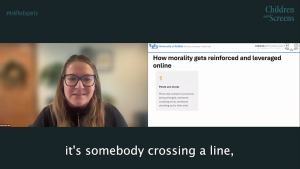
How Viral Content Shapes Moral Thinking
From the #AskTheExperts webinar "Learned Behavior: How Youth Digital Life Shapes Moral Development"
Raising Independent Thinkers in the Age of AI
Is AI use impacting the development of resilience, critical thinking, creativity, academic integrity, and intellectual curiosity in today’s youth? What happens to forming one’s own identity as a thinker when easy answers are just a few keyboard taps away?
Growing Up Online: Understanding Youth Internet Trends, Subcultures, and Relationships
Where and how are children and teens spending their time online, and what is the nature of the cultures and relationships they are forming there? How are these affecting their offline development and sense of self?
Importance of Screen-Free Interactions in Early Childhood
From the #AskTheExperts webinar “Early Childhood Mental Health and Digital Media”